





FXCM Review
FXCM is a broker with a long-standing reputation in the forex and CFD trading industry, having been in operation since 1999. Over the years, it has established itself as one of the most recognizable brands in online trading. The broker’s extensive regulatory framework, with licenses and registrations spanning multiple jurisdictions, ensures compliance with the highest industry standards. This allows FXCM to serve retail and professional traders worldwide while maintaining transparency, reliability, and trustworthiness. The broker has received numerous industry awards, a testament to its continued innovation and commitment to providing quality services.

FXCM provides an extensive multi-asset trading ecosystem, offering both well-established industry-standard platforms like MetaTrader 4 (MT4) and its proprietary Trading Station platform, which offers enhanced functionality and customization. The broker also supports various algorithmic trading solutions, making automated trading strategies more accessible, even to traders who may not have coding expertise.
When it comes to account types and pricing models, FXCM is somewhat less flexible than some of its competitors. The broker does not offer an extensive selection of account types, and while the trading conditions are generally competitive, they are best suited for high-volume traders rather than casual or low-volume retail investors. Spreads and commissions vary by region and instrument, but FXCM’s pricing structure is not necessarily the lowest in the industry. The broker’s cost structure favors traders with significant capital and high-frequency trading strategies, particularly those trading forex pairs and indices.
One aspect where FXCM could improve is the clarity and transparency of its trading conditions. While the broker does provide basic information about spreads and commission structures, detailed breakdowns of the costs associated with trading specific instruments are not always readily available. Additionally, while FXCM offers demo accounts, their functionality is somewhat limited compared to what is provided by some other brokers. Despite this, the demo accounts still allow traders to get a feel for the primary trading platforms and explore the broker’s execution model.
At the last update of this review FXCM had stopped offering copy trading, which deprives clients of the option to generate passive income. In addition to this, the broker is promoting its still-unestablished sister brand Tradu by redirecting clients from certain jurisdictions to it.
The FXCM website is available in nearly 30 languages, making it one of the most accessible brokers for traders worldwide. Customer support is proactive, available 24/7, and responsive, ensuring that clients receive assistance whenever needed. For traders looking to improve their skills, FXCM provides a wide range of educational materials, including video tutorials, articles, webinars, and interactive learning resources. More advanced traders can take advantage of specialized analytical tools, trading signals, and research reports to further optimize their trading strategies.
A significant advantage of FXCM is that it is truly a global broker, with a presence in many regulated jurisdictions where some competitors cannot operate. Unlike many brokers that avoid certain high-regulation regions, FXCM is accessible even in parts of North America, giving traders more opportunities to work with a licensed, established broker. Additionally, FXCM provides high leverage and promotional bonuses in regions where such incentives are allowed, helping traders maximize their capital efficiency. However, FXCM also upholds strict risk management measures, ensuring that clients receive protections such as negative balance protection and segregated client funds, even in jurisdictions that do not explicitly require them.
In this review, we will take an in-depth look at everything FXCM offers, from trading platforms to account types, pricing, execution models, and additional tools and services. This will allow you to evaluate whether FXCM aligns with your trading needs, investment goals, and risk tolerance.
FXCM Licenses and Client Protection
Like many other leading global brokerage firms, FXCM operates through a network of companies based in different jurisdictions, allowing it to serve clients from a broad range of countries while complying with regional regulatory requirements. FXCM holds licenses from some of the most highly regarded financial regulators in the world, including the United Kingdom’s Financial Conduct Authority (FCA), the European Union’s Cyprus Securities and Exchange Commission (CySEC), and the Australian Securities and Investments Commission (ASIC). Additionally, the broker is licensed in South Africa by the Financial Sector Conduct Authority (FSCA) and provides services in Canada through a collaboration with Friedberg Direct.
Beyond these highly regulated markets, FXCM also operates through an offshore entity based in Saint Vincent and the Grenadines. Many large brokers use offshore subsidiaries to expand their global reach, enabling them to offer services to clients in jurisdictions without well-established regulatory oversight. Offshore registration also allows brokers to provide higher leverage, promotional bonuses, and trading incentives, which are restricted or prohibited in highly regulated markets such as the UK, EU, and Australia. While offshore entities may not offer the same level of investor protections as their regulated counterparts, FXCM maintains its commitment to high standards of transparency and security across all of its operations.
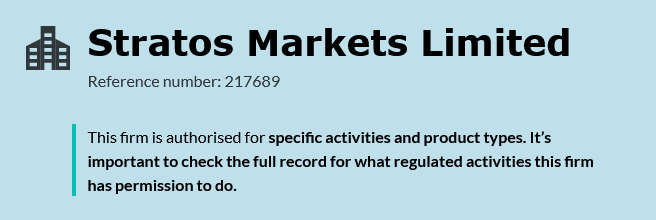
FXCM was founded in 1999 in the United Kingdom, making it one of the longest-standing names in the online forex and CFD trading industry. The broker continues to hold a license from the FCA, ensuring that it meets the stringent requirements set for financial services providers in the UK. However, in 2023, FXCM began a rebranding process under the name Stratos, and the legal entity through which it operates in the UK is now known as Stratos Markets Limited. Despite the rebrand, FXCM remains the broker’s primary trade name.
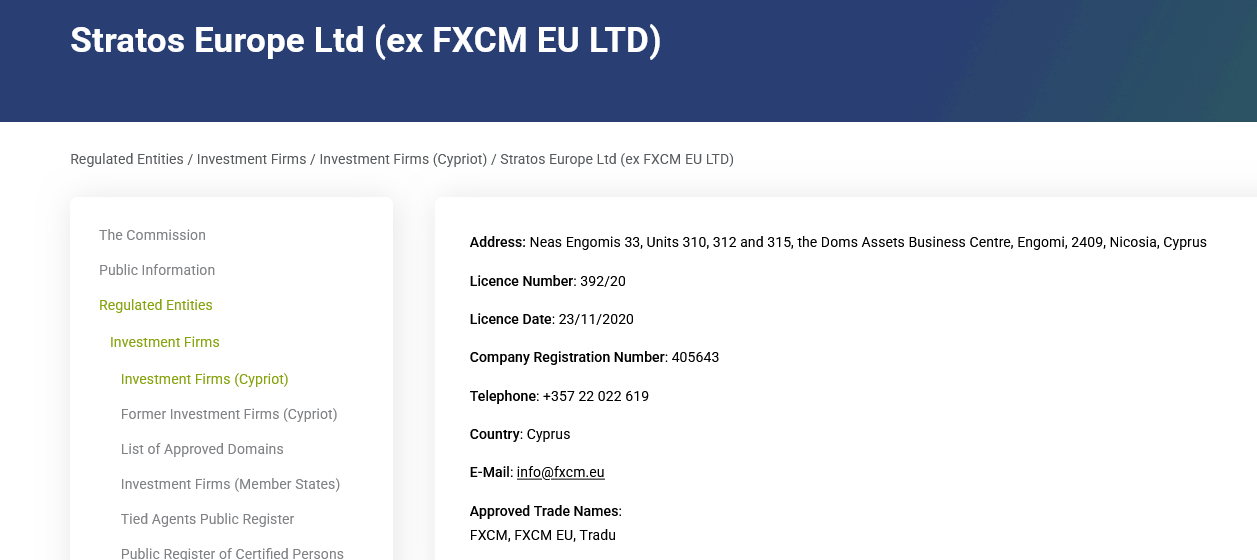
With the UK’s exit from the European Union (Brexit), UK-licensed brokers could no longer serve mainland European clients under FCA regulations. To continue offering its services within the EU, FXCM operates through Stratos Europe Ltd, a company licensed by CySEC in Cyprus. Cyprus has long been a preferred base for major brokers operating within the EU, thanks to its well-developed financial and regulatory environment under MiFID II (Markets in Financial Instruments Directive II).
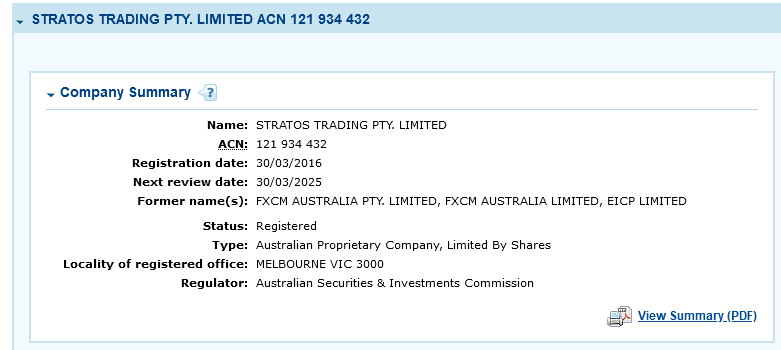
On the other side of the world, FXCM holds a regulatory license from ASIC in Australia. In this region, the broker operates through Stratos Trading Pty. Limited, ensuring compliance with Australia’s strict financial services laws and investor protections.
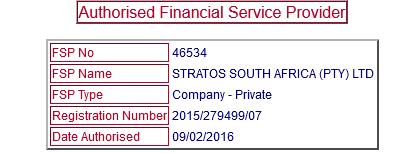
FXCM also maintains a strong presence in South Africa, where it is licensed and regulated by the FSCA. The company handling FXCM’s operations in South Africa is Stratos South Africa (Pty) Ltd. This license allows FXCM to expand its reach into African markets while adhering to local financial regulations.
For Canadian clients, FXCM provides access to its suite of trading products in partnership with Friedberg Direct, a division of Friedberg Mercantile Group Ltd. Friedberg Direct is a member of CIRO (Canadian Investment Regulatory Organization) and CIPF (Canadian Investor Protection Fund), ensuring that traders in Canada receive the same level of regulatory oversight and investor protections as those in the UK, EU, and Australia.
Adding to its global regulatory coverage, FXCM is also licensed in Israel by the Israel Securities Authority (ISA). The broker serves Israeli clients through Stratos Light Ltd, providing access to forex and CFD trading under local regulatory guidelines.
For clients in all other jurisdictions where FXCM operates, the broker provides its services through SVG Stratos Global LLC, a subsidiary based in St. Vincent and the Grenadines. While St. Vincent and the Grenadines does not impose strict regulatory requirements on forex brokers, FXCM maintains high operational standards across all its subsidiaries, ensuring that traders worldwide have access to professional-grade trading services.
Financial regulators impose strict norms that brokers must adhere to, ensuring financial stability, investor protection, and transparency. One of the most fundamental requirements is capital adequacy, which ensures that a brokerage firm maintains sufficient financial resources to meet its obligations and avoid insolvency. Even after the UK left the European Union, it continued to uphold the Markets in Financial Instruments Directive (MiFID II) standards, which set a minimum capital requirement of EUR 730,000 for brokers operating in both the EU and the UK. Similarly, the Australian Securities and Investments Commission (ASIC) requires brokers in Australia to hold at least AUD 1,000,000 in capital. The fact that FXCM meets these high financial requirements in multiple highly regulated jurisdictions simultaneously reflects the broker’s strong financial position and reliability.
Client fund protection is another critical regulatory safeguard. In the EU, UK, Australia, and Canada, brokers must segregate client funds from company operational funds in top-tier banks. This ensures that client money remains secure, even if the broker encounters financial difficulties. Additionally, FXCM, like most reputable brokers, offers negative balance protection across all its entities, meaning traders cannot lose more than their account balance. If market volatility causes a trader’s losses to exceed their funds, FXCM automatically closes positions to prevent further debt. While many offshore brokers do not guarantee negative balance protection, FXCM extends this safeguard to all its clients, even those trading under its offshore subsidiary.
However, not all investor protections apply to all FXCM clients. In the EU and the UK, brokers must also participate in Investor Compensation Schemes, which reimburse traders in case of broker insolvency. In the EU, traders are protected for up to EUR 20,000, while in the UK, the Financial Services Compensation Scheme (FSCS) covers up to GBP 85,000 per client. Canadian traders have even greater protection, as the Canadian Investor Protection Fund (CIPF) guarantees up to CAD 1,000,000 in the event of broker failure. Australia, South Africa, and many other jurisdictions do not require brokers to participate in investor compensation funds, which means that traders in these regions do not benefit from similar safety nets. Some brokers voluntarily obtain additional insurance from private firms like Lloyd’s of London, but FXCM has not taken this extra step.
Strict anti-money laundering (AML) regulations in regulated jurisdictions require brokers to maintain high levels of transparency and data security. This includes verifying client identities, assessing their financial status, and ensuring that they have sufficient knowledge and experience in trading financial instruments before opening live accounts. Offshore brokers often relax these requirements, making it easier for traders to sign up and deposit funds, but FXCM still requires identity verification even for offshore clients before allowing real-money trading.
Leverage restrictions are another key aspect of financial regulations aimed at protecting retail traders from excessive risk. High leverage can magnify both potential gains and potential losses, making it a double-edged sword. EU regulations cap leverage at 1:30 for major currency pairs, 1:20 for non-major pairs and gold, 1:10 for other commodities and indices, and 1:2 for cryptocurrencies. The UK’s FCA and Australia’s ASIC enforce the same limits, while Canada and the United States allow leverage of up to 1:50. Israel permits leverage of 1:100 for forex and gold, but caps leverage for other CFDs at 1:20. In contrast, traders with FXCM’s offshore and South African entities can access leverage as high as 1:1000, significantly increasing both profit potential and risk exposure. Negative balance protection helps mitigate some of the risks, but traders must still exercise caution when using high leverage.
Regulated brokers in the EU, UK, and Australia also offer the option for traders to obtain Professional Client status, which grants access to higher leverage in exchange for waiving certain regulatory protections. A professional trader with FXCM does not receive negative balance protection and is not covered by investor compensation schemes. To qualify, a trader must meet at least two of the following three criteria: having executed significant-sized trades regularly over the past four quarters, holding a portfolio of financial instruments exceeding EUR 500,000, or having worked in the financial sector in a position requiring knowledge of leveraged products.
FXCM’s offshore and South African entities also differ in other regulatory aspects. The UK’s FCA prohibits retail clients from trading cryptocurrency CFDs, meaning FXCM’s UK clients cannot trade crypto derivatives. Bonuses, promotions, and prize games are also banned in the EU, UK, Australia, and several other jurisdictions, but FXCM’s offshore entity is allowed to offer them. Interestingly, FXCM does not offer bonuses to South African clients, even though local regulations permit them. Social trading is also restricted in some regions.
For traders opening accounts with FXCM’s offshore entity in St. Vincent and the Grenadines, regulatory oversight is minimal. The local Financial Services Authority (FSA) explicitly states that it does not license or regulate forex brokers, meaning FXCM’s SVG entity operates without direct supervision. Due to the high number of scams and fraudulent brokers registering in St. Vincent and the Grenadines, the government introduced new requirements in 2023, demanding that brokers provide proof of regulatory licenses from the jurisdictions they serve.
While offshore registration is a standard practice among major forex brokers to offer greater flexibility and more competitive trading conditions, traders must rely on the broker’s reputation and commitment to good business practices when dealing with an unregulated subsidiary. With a highly established brand like FXCM, clients can have greater confidence that the broker will maintain professional standards across all its entities, even in jurisdictions with limited regulatory oversight.
FXCM Trading Software
FXCM offers a very flexible and diverse set of trading software that includes the industry standard MetaTrader 4 (MT5) platform, a proprietary platform and mobile app, as well as the ability to integrate your trading account with the TradingView ecosystem.
MetaTrader 4 (MT4) is one of the most widely used and respected trading platforms in the forex industry. Developed by MetaQuotes Software and released in 2005, MT4 quickly became the industry standard due to its stability, user-friendly interface, extensive charting capabilities, and support for automated trading strategies through Expert Advisors (EAs). Although initially designed for forex trading, it also supports CFD (Contract for Difference) trading across various asset classes, including indices, commodities, and cryptocurrencies.
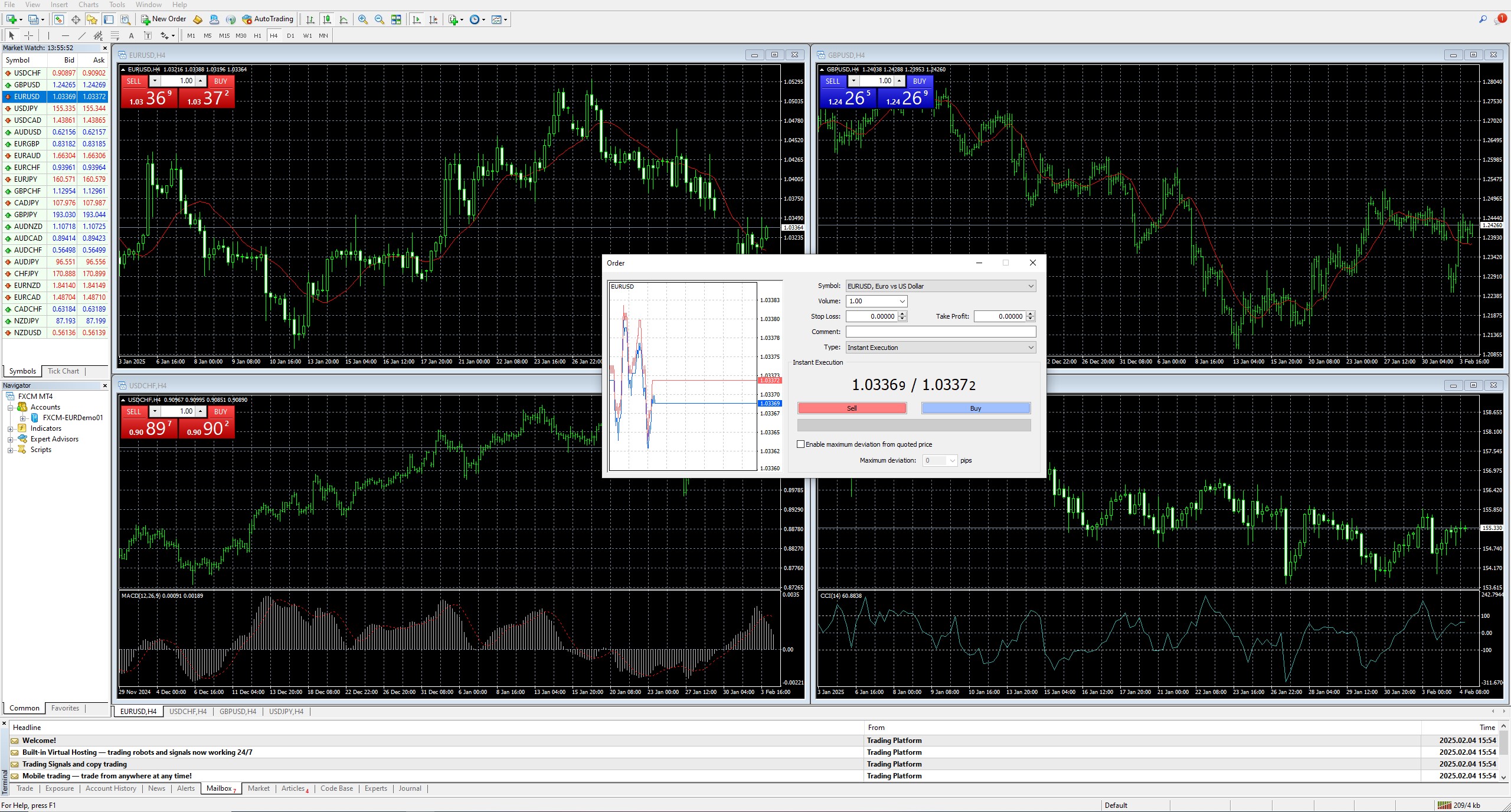
One of the key strengths of MT4 is its high level of customization, allowing traders to modify charts, create custom indicators, and develop automated trading systems using the MQL4 programming language. This flexibility makes it particularly popular among algorithmic traders and those who rely on technical analysis. The platform provides access to multiple timeframes, over 30 built-in indicators, and advanced order execution options, making it suitable for traders of all experience levels.
MT4 is available in three different versions: desktop, web, and mobile applications, each with its own strengths and limitations. The desktop version is the most powerful and fully featured, offering all charting tools, indicators, custom scripts, and automated trading options. It allows traders to run multiple accounts simultaneously, optimize Expert Advisors with a strategy tester, and execute trades with low latency. This version is preferred by professional traders and algorithmic traders, as it supports advanced features such as hedging, custom scripting, and in-depth technical analysis.
The web-based version of MT4 provides a more lightweight alternative to the desktop application. It allows traders to log in and trade directly from their web browser without needing to download or install software. While more convenient, the web version has limited functionality compared to the desktop version. It lacks support for custom indicators, automated trading (EAs), and advanced charting features, making it less suitable for traders who rely on sophisticated analysis and algorithmic trading.
The mobile version of MT4, available for iOS and Android, offers a streamlined trading experience optimized for smartphones and tablets. It allows traders to monitor the markets, open and close trades, view basic charts, and access some built-in indicators. However, mobile trading is less effective for in-depth technical analysis due to smaller screen sizes, limited indicator options, and reduced customization capabilities. Additionally, Expert Advisors and custom scripts cannot be used on the mobile app, meaning algorithmic traders must rely on the desktop version or a VPS (Virtual Private Server) for continuous automated trading.
Despite being an older platform, many forex traders still prefer MT4 over its successor, MetaTrader 5 (MT5). One of the main reasons is familiarity—MT4 has been around for nearly two decades, and traders have built a vast library of custom indicators, trading scripts, and automated strategies (EAs) based on MQL4. Because MT4 and MT5 use different programming languages (MQL4 vs. MQL5), migrating to MT5 requires rewriting or converting these custom tools, which many traders do not want to do. Additionally, MT4 is optimized for forex trading, whereas MT5 was developed as a multi-asset platform supporting stocks, futures, and other securities. Some forex traders feel that MT5’s additional features are unnecessary for their needs and that MT4 remains more efficient for forex-specific strategies.
Another factor contributing to MT4’s continued popularity is that many forex brokers still primarily support MT4 due to its lower infrastructure costs and widespread adoption. While MT5 offers improvements in speed, execution, and additional order types, these enhancements are not always essential for forex traders, especially those focused on scalping, day trading, or algorithmic trading.
However, a broker offering only MT4 without MT5 may have certain disadvantages. MT5 has several technical improvements that make it a more advanced platform overall, including faster execution speeds, a multi-threaded strategy tester, an integrated economic calendar, built-in market depth, additional timeframes, and more order types. Brokers that do not offer MT5 may appear less modern and less appealing to multi-asset traders who want to access a wider range of stocks, futures, and other financial instruments. Additionally, some traders prefer MT5’s superior order execution and enhanced charting tools, and brokers that do not offer it may be limiting their client base.
Overall, MT4 remains a dominant force in the forex trading industry due to its stability, ease of use, extensive community support, and strong focus on forex-specific trading tools. While MT5 is a more powerful and modern platform, MT4 continues to thrive because many traders and brokers have not fully transitioned to the newer software. A broker that only offers MT4 might still attract forex-focused traders, but may miss out on clients looking for a more versatile, future-proof trading platform like MT5.
FXCM’s Trading Station is the broker’s proprietary trading platform designed to offer a fully integrated trading experience for forex and CFD traders. Unlike industry-standard platforms like MetaTrader 4 (MT4), which is developed by MetaQuotes, Trading Station is built in-house by FXCM, allowing the broker to provide customized features, deeper market integration, and a trading experience tailored to its specific client base.
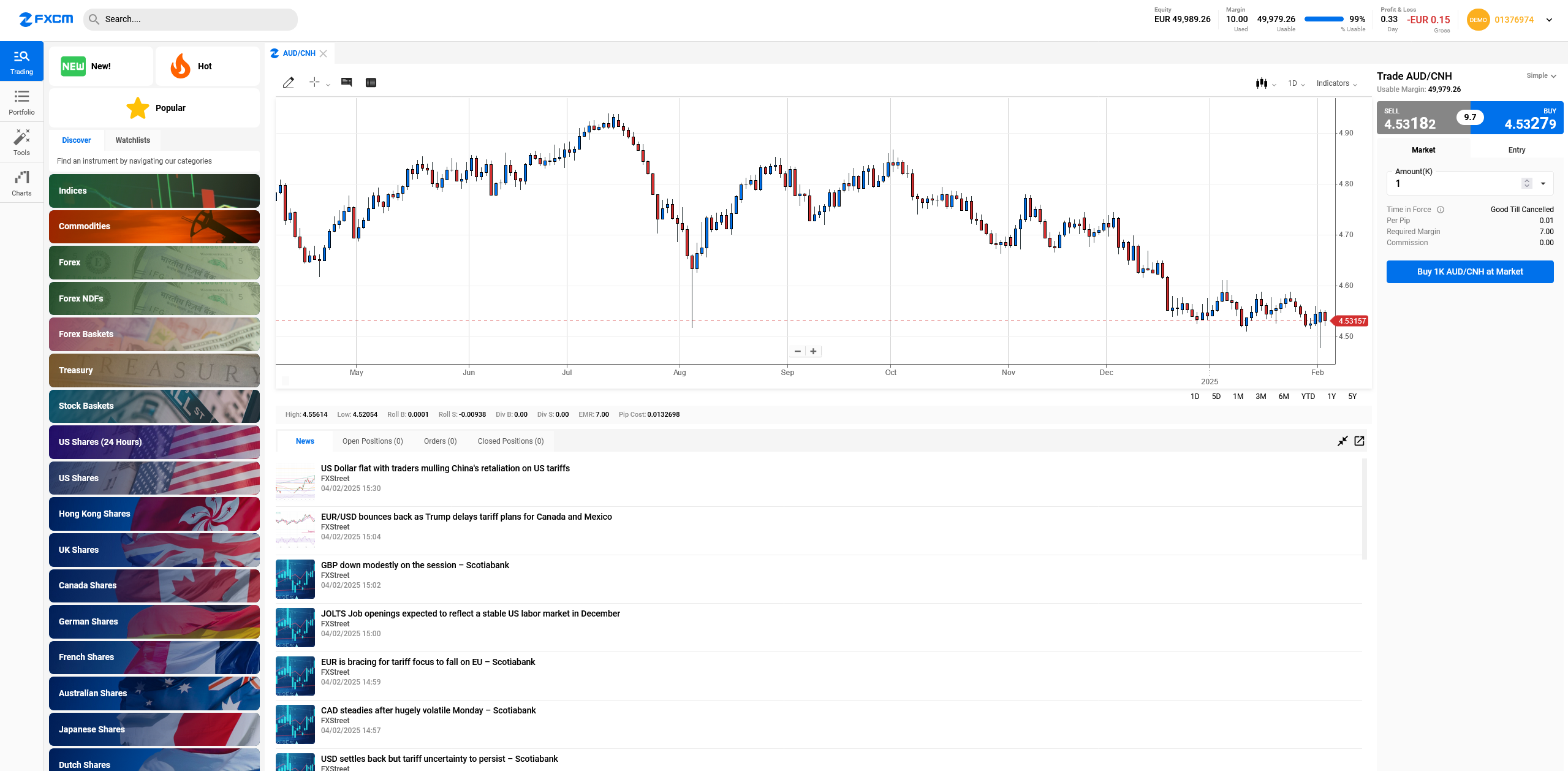
One of the major advantages of Trading Station is its modern and intuitive user interface, which aims to provide traders with a streamlined trading experience without the need for third-party plugins or customizations. It features built-in advanced charting tools, multiple order types, risk management functions, and automated trading capabilities. The charting functionality in Trading Station is considered superior to MT4’s default setup, offering more than 50 pre-installed indicators, advanced drawing tools, and a variety of customizable chart layouts. While MT4 is also highly customizable, traders often need to install additional custom indicators and scripts to achieve similar levels of analysis that Trading Station provides out-of-the-box.
A key differentiator of Trading Station compared to MT4 is its seamless integration with FXCM’s market execution model. Since it is developed by the broker itself, the platform is optimized for tight spreads, fast execution, and reduced slippage. Unlike MT4, which relies on external liquidity providers through a broker’s bridge or dealing desk, Trading Station is directly connected to FXCM’s liquidity pool, ensuring a smoother and more transparent trading experience. This can be particularly beneficial for scalpers and day traders, who rely on fast execution and minimal delays.
Another important feature of Trading Station is its order execution and risk management tools. The platform allows traders to place market orders, limit orders, stop orders, and trailing stops with greater precision than MT4. While MT4 also supports various order types, Trading Station provides additional risk management tools, such as automated trade size adjustments based on account balance and one-click trading with built-in risk calculations. These features make it particularly useful for traders who actively manage their risk and exposure.
In terms of automated trading, Trading Station supports FXCM’s proprietary scripting language called Lua, which enables traders to create custom indicators and automated trading strategies. While MT4 uses MQL4 for Expert Advisors (EAs), which has a much larger user base and extensive third-party support, Lua is considered more lightweight and efficient for certain algorithmic trading applications. However, the downside is that Lua-based scripts do not have the same extensive library of pre-built automated strategies as those available for MT4’s MQL4 ecosystem. This means that traders who heavily rely on automated trading and pre-built EAs may find MT4 more appealing due to the sheer volume of available resources.
Trading Station is available in three versions: desktop, web, and mobile. The desktop version is the most powerful, offering full customization, in-depth technical analysis, and advanced strategy automation. The web version is a lightweight alternative, allowing traders to access their accounts and execute trades directly from a browser without downloading software. The mobile version, available on iOS and Android, provides basic trading functionality, including charting, order execution, and account management. While MT4 also offers mobile and web versions, some traders find Trading Station’s web and mobile interfaces more modern and responsive compared to MT4’s somewhat dated UI design.
Despite its advantages, Trading Station has some limitations when compared to MT4. One of the biggest drawbacks is the lack of widespread adoption and third-party support. While MT4 has been the industry standard for nearly two decades, meaning thousands of traders, developers, and brokers support it with custom indicators, scripts, and trading bots, Trading Station is exclusive to FXCM. This means that traders who switch brokers will not be able to take their Trading Station tools and settings with them. Additionally, since most forex education and strategy-sharing communities focus on MT4, traders using Trading Station may have fewer resources and tutorials available to help them optimize their trading strategies.
Another downside is trading community support and automation capabilities. MT4 has an enormous global community, which means traders can easily find custom indicators, trading robots, and strategy templates shared by other traders. Trading Station lacks this community-driven support, making it harder for traders to find pre-built solutions or collaborate on algorithmic trading strategies.
Overall, FXCM’s Trading Station is a highly capable trading platform that offers an advanced, broker-integrated experience with superior charting, advanced order execution, and direct market access. It is best suited for discretionary traders, scalpers, and those who prioritize execution speed and intuitive interface over third-party customization. However, traders who rely on algorithmic trading, custom-built indicators, or want the flexibility to switch brokers without changing platforms may find MT4 to be a better long-term choice. While Trading Station is a strong alternative to MT4, it remains a proprietary platform limited to FXCM’s ecosystem, whereas MT4 offers broader compatibility and a larger community-driven support system.
Most FXCM clients, with some exceptions such as Canadian residents, have the ability to integrate their trading account with TradingView. An increasing number of brokers now offer clients the option to integrate their trading accounts with TradingView, a platform that merges the functionalities of trading software, technical market analysis, and a social network. While MetaTrader platforms primarily focus on trade execution, TradingView has gained prominence for its exceptional charting tools and collaborative features, which allow users to share and explore trading ideas within a vibrant global community.
TradingView is renowned for its advanced charting capabilities, offering an extensive range of chart types, time frames, and over 100 pre-built indicators for in-depth market analysis. Beyond the built-in tools, users can also access and implement custom indicators and strategies created by other traders. This collaborative aspect enhances the platform’s appeal, fostering a culture of shared knowledge and innovation. One of TradingView’s standout features is its web-based interface, enabling users to access their charts and analyses from any internet-connected device without requiring downloads or software installation. This flexibility ensures that traders can stay connected to the markets no matter where they are.
Another unique aspect of TradingView is its social networking functionality, which allows traders to share their ideas, strategies, and technical analyses with a global audience. This feature offers a valuable opportunity for users to gain diverse perspectives, learn from more experienced traders, and engage in constructive discussions about market trends and strategies. Unlike MetaTrader, which is largely focused on Forex and derivative markets, TradingView provides comprehensive data and charts for a wide range of financial instruments, including stocks, Forex, futures, cryptocurrencies, and bonds, making it a versatile tool for multi-asset traders.
TradingView also features customizable alerts, enabling users to set notifications based on specific price levels, indicators, or even drawing tools. These alerts can be delivered via email, SMS, or pop-up notifications on the platform, ensuring traders stay informed about important market movements. While TradingView is primarily an analysis tool, it also integrates trading functionality through partnerships with various brokers. Depending on the broker and market, users can execute trades directly from TradingView’s interface, combining the platform’s analytical strengths with convenient trading capabilities.
Overall, TradingView complements traditional trading platforms by offering powerful analytical tools, market data, and a unique social element. Its versatility and accessibility make it an excellent choice for traders seeking a dynamic and interactive trading experience.
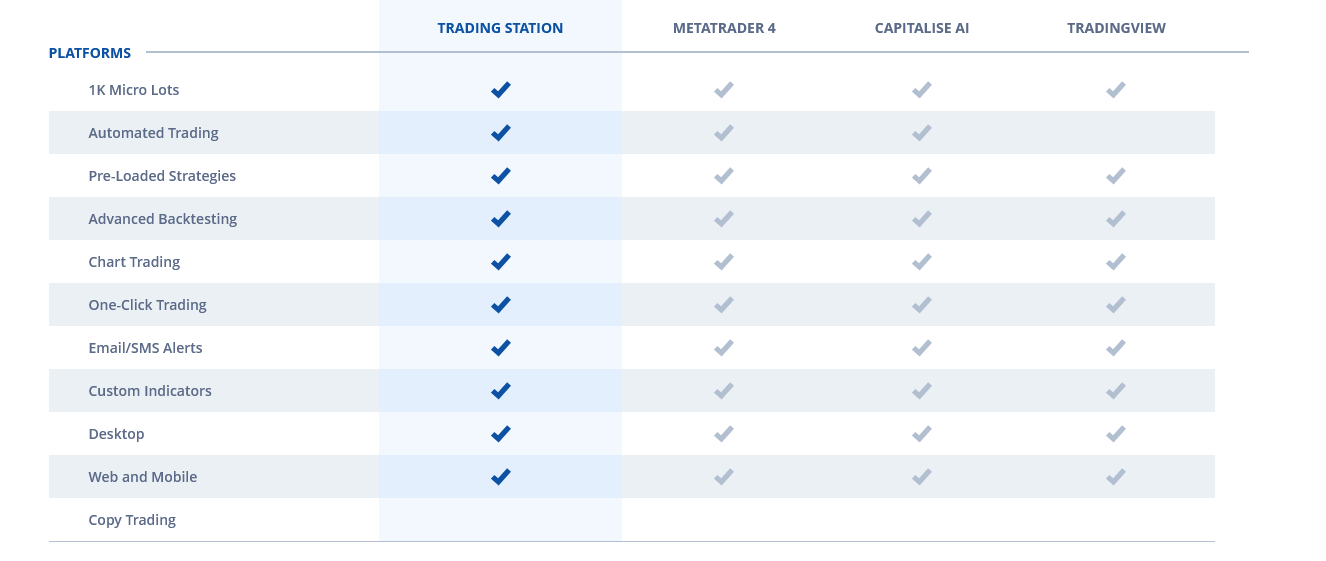
For traders who want to harness the power of automated trading but lack coding skills or prefer not to rely on third-party scripts, FXCM offers an innovative solution through its partnership with Capitalise.ai. This platform enables code-free strategy automation, allowing traders to create, test, and deploy trading strategies simply by typing them out in plain English.
Capitalise.ai is an advanced algorithmic trading platform that eliminates the complexity of programming. Instead of writing scripts in MQL4, Python, or other coding languages, traders can describe their strategies in natural language, and Capitalise.ai translates these commands into executable trading instructions. This makes algorithmic trading accessible to a wider range of traders, including those who lack technical expertise but still want to take advantage of automated trading.
One of the key advantages of Capitalise.ai is its ability to monitor real-time market data, technical indicators, and macroeconomic events to execute trades based on predefined conditions. Traders can set up strategies such as trend-following, mean reversion, breakout trading, and even complex multi-leg strategies without writing a single line of code. The platform supports if-then conditions, loop-based strategies, and custom triggers, providing a level of flexibility comparable to expert coding-based automation.
Another powerful feature of Capitalise.ai is backtesting. Traders can simulate their strategies on historical market data to evaluate potential performance before committing real funds. This helps reduce risk and optimize trading conditions by identifying weak points in the strategy and making necessary adjustments before live execution.
The integration with FXCM’s Trading Station and MetaTrader 4 (MT4) means that traders can automate their trades directly within their preferred trading platforms. The Capitalise.ai platform continuously monitors market conditions, executing trades 24/7 without requiring manual intervention. This makes it particularly beneficial for traders who cannot actively monitor the markets at all times.
Additionally, Capitalise.ai offers risk management tools, allowing users to set parameters like stop-loss levels, take-profit points, trailing stops, and risk exposure limits. These tools help mitigate losses and protect profits while ensuring that trades align with the trader’s overall risk tolerance.
Another compelling feature is Market Alerts & Notifications, where traders receive real-time updates based on their custom conditions, allowing them to stay informed without constantly watching the charts. The platform can notify traders about price movements, trend changes, volume surges, and other important factors that might affect their strategies.
For traders interested in social or copy trading, Capitalise.ai allows users to share and follow automated trading strategies. This can be particularly useful for traders who want to learn from experienced strategy builders or test out pre-made strategies that have shown strong historical performance.
Capitalise.ai is entirely web-based, meaning there’s no need for software installation, and traders can access it from any device. It seamlessly integrates with FXCM’s trading platforms, ensuring smooth execution and real-time synchronization between the automation engine and the broker’s order execution system.
FXCM Trading Conditions
FXCM operates across multiple jurisdictions through various legal entities, each adhering to distinct regulatory frameworks. However, the broker has largely standardized its services, account types, and the registration and verification process, ensuring a consistent trading experience regardless of the regulatory environment.
FXCM offers Demo accounts that can be created separately from live trading accounts, allowing traders to test the broker’s platforms and conditions risk-free. A Demo account on Trading Station grants access to real-time market prices with $20,000 in virtual funds, enabling users to practice trading strategies in a simulated market environment. If you prefer MetaTrader 4 (MT4), you will need to register a separate Demo account specifically for that platform. It’s important to note that Demo accounts do not provide access to FXCM’s user dashboard, meaning traders cannot explore account management features without a live account.
The FXCM website automatically detects your IP address to determine which legal entity you are eligible to register with, based on the jurisdiction of your location. However, the live account registration process allows you to manually select from the available jurisdictions where FXCM offers services. If you choose a jurisdiction where FXCM does not currently operate, the system prevents you from proceeding with registration.
Additionally, clients from certain regions are redirected to FXCM’s sister brand, Tradu, which offers similar trading services under a different corporate structure.
Most brokers in FXCM’s class offer clients a choice between different trading account types, primarily distinguished by their pricing models. The industry standard typically includes a standard account, where traders pay only a floating spread with no additional commission, and a zero or raw spread account, where the spread is significantly lower (or even zero), but the broker charges a fixed commission per lot traded. This flexibility allows traders to choose the most cost-effective model based on their preferred trading strategies and asset classes. Additionally, many brokers provide Micro or Cent accounts, which are specifically designed for low-volume traders and beginner investors, allowing them to trade with smaller capital and reduced risk.
However, FXCM does not offer multiple account types. Instead, all clients start with a floating spread account with no commission. The broker only offers more competitive conditions for high-volume traders who meet specific monthly trading volume thresholds. These active traders may qualify for either a commission-based model or a rebate-based pricing structure, but the availability of these options depends on the trader’s jurisdiction. Notably, clients of FXCM’s offshore entity are restricted to the commission-free model with an optional rebate system for high-volume trading. Additionally, the choice of account base currencies is limited to USD, EUR, and GBP, whereas many competitors offer a wider selection.
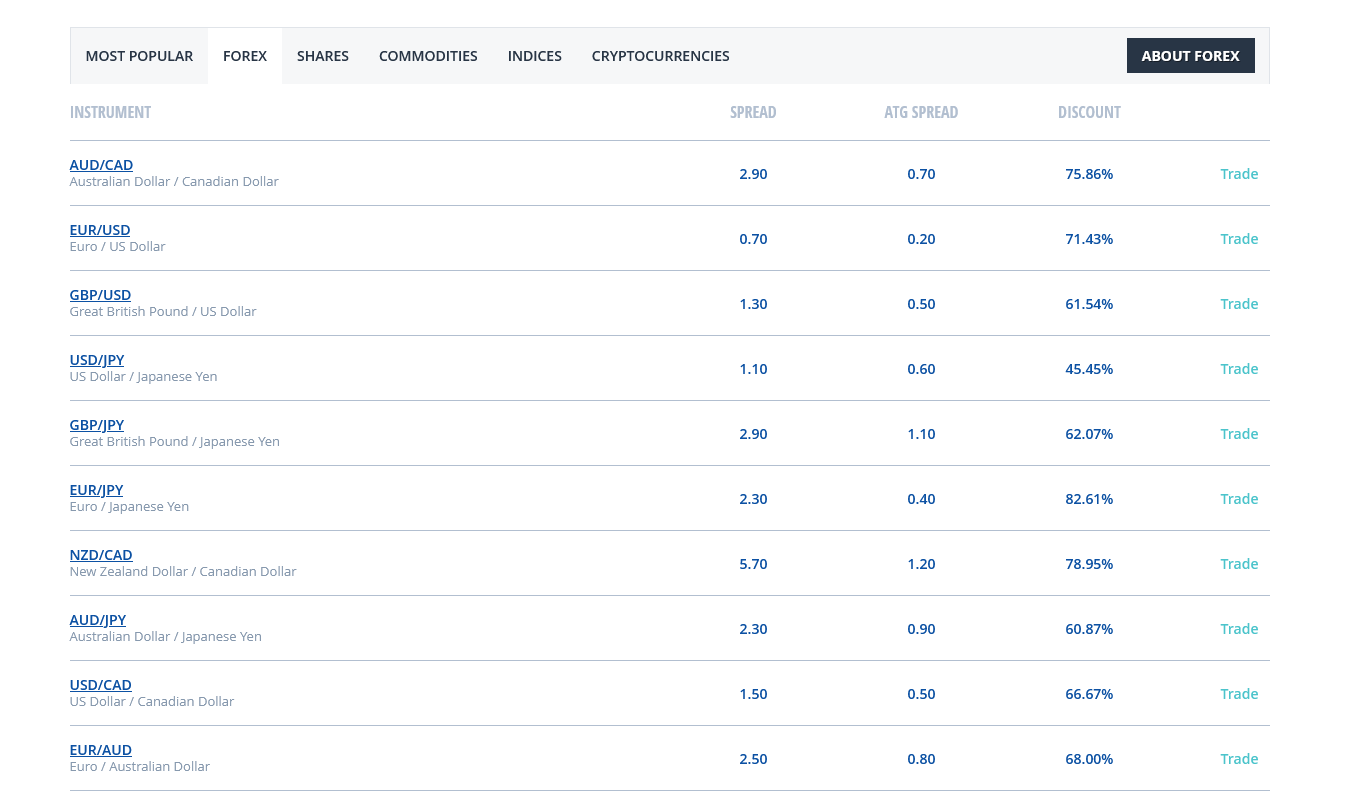
One major issue with FXCM’s offering is the lack of clear, up-to-date information on trading costs and key account parameters. The FXCM website displays average spread statistics that are outdated by over two years, and these figures differ significantly from the actual spreads observed in the trading platforms. The only accurate and current pricing information available on FXCM’s website pertains to the commission-based model, which, as noted earlier, is only available to high-volume traders in certain jurisdictions.
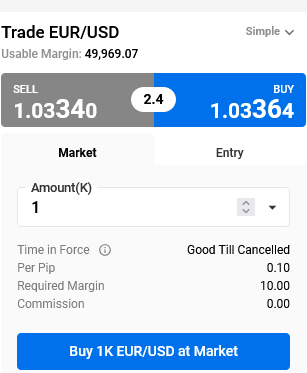
At the time of writing this review, spread levels in FXCM’s proprietary web platform Demo account appeared surprisingly high. Major currency pairs like EUR/USD and GBP/USD consistently showed spreads exceeding 2 pips, which is far from competitive compared to industry standards. This raises concerns about transparency in pricing and whether traders using FXCM’s real accounts experience significantly better trading conditions than those observed in the Demo environment.
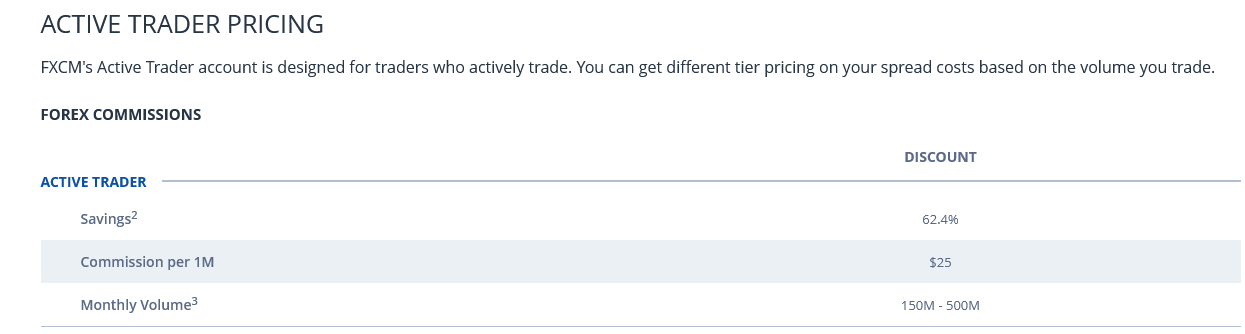
FXCM’s Active Trader pricing model provides reduced base spreads, typically ranging between 0.6-0.7 pips, which can effectively drop further to 0.2-0.4 pips through FXCM’s price improvement model. In addition to these reduced spreads, traders pay a commission, but the FXCM website lacks clear and detailed information regarding the exact structure. Based on the available details, if a trader’s monthly trading volume exceeds 50 million USD and their account equity remains above 25,000 USD for a given month, they would pay a commission of 30 USD per side per million when trading major currency pairs. For traders with monthly volumes above 150 million USD, this commission is further reduced to 25 USD per side per million.
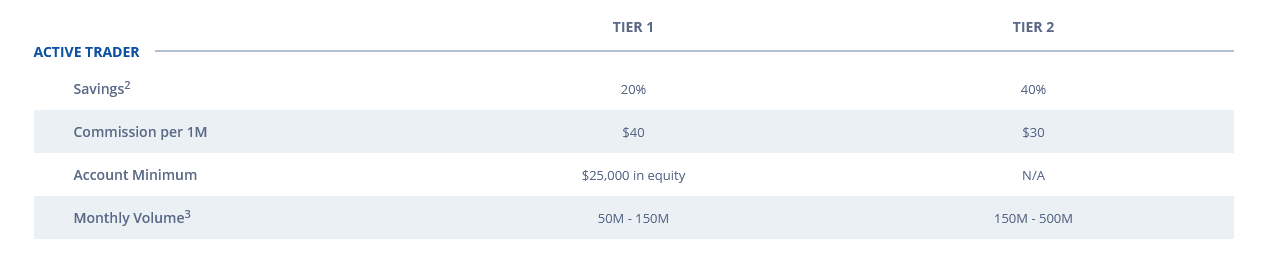
For Canadian clients who qualify as Active Traders, FXCM applies a different two-tier model. Traders with a monthly volume between 50 million and 150 million USD receive a 20% discount on the spread and pay a commission of 40 USD per side per million. If the monthly volume exceeds 150 million USD, the spread discount increases to 40%, and the commission is lowered to 30 USD per side per million.
For UK residents, FXCM offers an additional Spread Betting account, which provides tax-free profits due to the specifics of UK tax regulations. This account structure is commission-free, making it an attractive option for local traders. However, due to FCA regulatory restrictions, cryptocurrency trading is not available to UK-based clients.
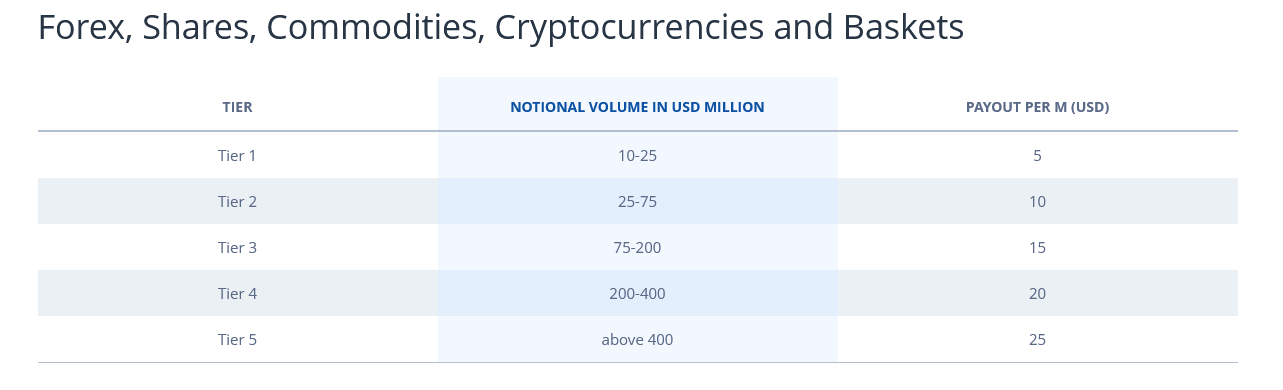
The Active Trader Program for offshore clients follows a different structure. To qualify, a trader must meet a minimum monthly notional volume of 10 million USD. Instead of a commission-based model, FXCM rewards high-volume offshore traders with spread discounts and rebates based on a five-tier system. Rebates are paid within 15 business days of the following calendar month. For traders with a monthly trading volume exceeding 400 million USD, rebates reach 25 USD per million traded.
While FXCM provides competitive conditions for high-frequency traders, the lack of transparency on commission details and live spread levels remains a concern. Moreover, the pricing models differ across jurisdictions, making it essential for traders to carefully review the specific conditions applicable to their region before choosing an account.
For retail clients of the broker in EEA, UK and Australia the maximum leverage with which they can trade forex is 1:30. In Canada the maximum is 1:50 and in Israel 1:100. The broker’s offshore clients can trade with significantly higher leverage, 1:1000 as default for new accounts. Accounts that are funded in excess of USD 5,000 will be moved to a leverage of up to 400:1 and accounts in excess of USD 50,000 will be moved to a leverage of up to 100:1 on FX and 200:1 on CFD’s.
FXCM Deposit and Withdrawal Methods
FXCM requires a minimum initial deposit of 50 units in the base currency of the account for most payment methods. However, there is no minimum deposit requirement for Wire Transfers. For subsequent deposits, a minimum of 50 currency units is required if using a credit or debit card. This makes FXCM a broker with a relatively low minimum deposit requirement, though several leading brands offer even lower entry thresholds, sometimes as low as 5–10 USD.
The broker does not charge withdrawal fees for transactions made via credit or debit cards. However, bank wire withdrawals may incur a fee, depending on the amount and the client’s jurisdiction.
The availability of payment methods varies based on the trader’s location, but credit/debit cards and bank transfers are always available for deposits and withdrawals. Additionally, FXCM supports widely used e-wallets such as PayPal, Skrill, Neteller, Apple Pay, and Google Pay.
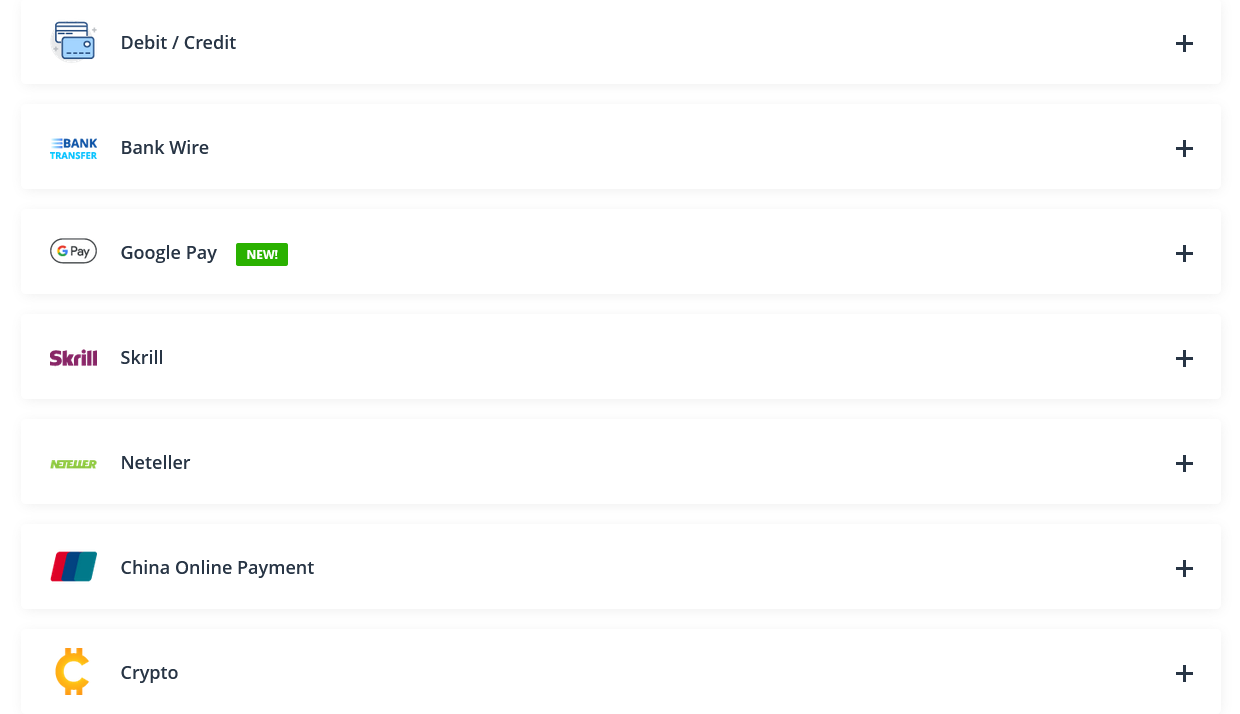
Clients in specific countries and regions have additional local payment options. Traders in the Philippines, Malaysia, Indonesia, Vietnam, and Latin America can use regional bank transfer services for greater convenience. Customers in the EEA (European Economic Area) have access to Fast Bank Wire for faster deposits and withdrawals.
Clients trading through FXCM’s offshore division have additional options, including China Online Payment (UnionPay) and cryptocurrency transactions, which are unavailable in more tightly regulated jurisdictions. However, Canadian clients have the most limited selection, with only credit/debit cards and bank transfers as available payment methods.
FXCM’s flexible and diverse payment options make it accessible to traders worldwide, but the limitations in certain regions and the potential bank wire fees for withdrawals may be factors to consider when choosing the broker.
| Deposit method | Minimum | Maximum | Processing time | Fee |
| Credit/Debit Card | $50 | Unspecified | up to 24 hours | Free |
| Bank | Unspecified | Unspecified | up to 3 days | Unspecified |
| PayPal | $50 | Unspecified | Instant | Free |
| Skrill | $50 | Unspecified | Instant | Free |
| Neteller | $50 | Unspecified | Instant | Free |
| Apple Pay | $50 | Unspecified | Instant | Free |
| Google Pay | $50 | Unspecified | Instant | Free |
| UnionPay | $50 | Unspecified | Instant | Free |
| Crypto | $50 | Unspecified | Instant | Free |
| Withdrawal method | Minimum | Maximum | Processing time | Fee |
| Credit/Debit Card | Unspecified | Unspecified | up to 24 hours | Free |
| Bank | Unspecified | Unspecified | up to 3 days | $40 |
| PayPal | Unspecified | Unspecified | up to 24 hours | Free |
| Skrill | Unspecified | Unspecified | up to 24 hours | Free |
| Neteller | Unspecified | Unspecified | up to 24 hours | Free |
| Apple Pay | Unspecified | Unspecified | up to 24 hours | Free |
| Google Pay | Unspecified | Unspecified | up to 24 hours | Free |
| UnionPay | Unspecified | Unspecified | up to 24 hours | Free |
FXCM Bonuses and Promotions
The clients of the FXCM company in St. Vincent and the Grenadines can benefit from several types of promotions and bonuses. The rebate program described above falls into this category.
FXCM’s offshore division offers several promotions to enhance the trading experience for its clients. One notable offer is the TradingView Subscription Promotion, where traders can receive complimentary access to TradingView’s Essential, Plus, or Premium plans. TradingView is a renowned social network for traders and investors across Forex, Futures, and Stock markets, providing advanced charting tools and a collaborative community. To qualify for this promotion, clients need to meet specific trading volume requirements.
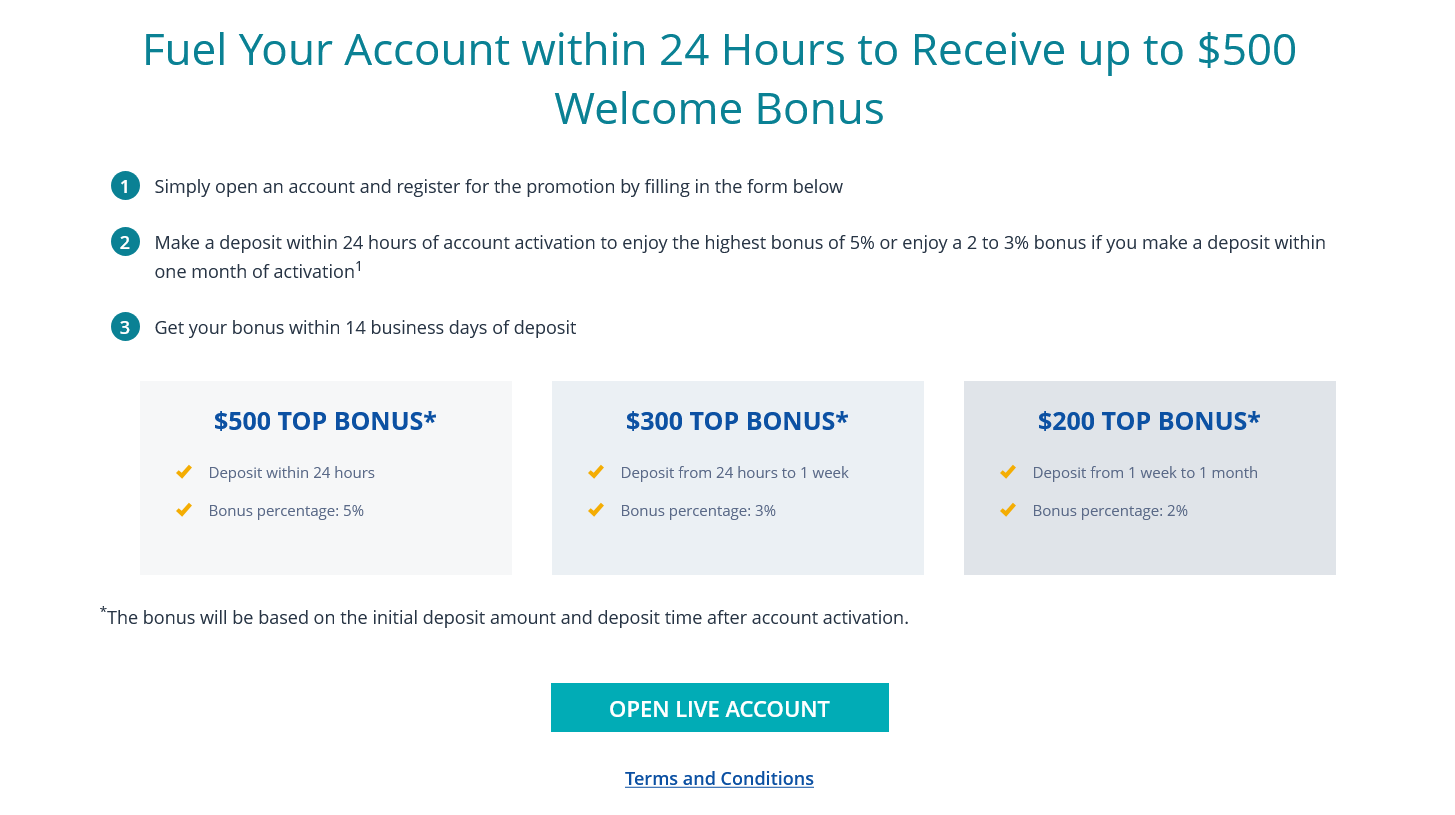
Another promotion is the Welcome Bonus, which rewards new clients for funding their accounts promptly after activation. The bonus structure is as follows:
- Deposit within 24 hours: Receive a 5% bonus on the initial deposit, up to a maximum of $500.
- Deposit between 24 hours and 1 week: Earn a 3% bonus, up to $300.
- Deposit between 1 week and 1 month: Obtain a 2% bonus, up to $200.
The bonus is credited within 14 business days after the deposit is made. It’s important to note that the bonus percentage and amount depend on the timing and size of the initial deposit following account activation.
At the time of writing this review, FXCM is offering a special promotion designed to stimulate gold trading by offering cashback. To be eligible to receive the rebate under this promotion, the trader must
execute a minimum of 300 round-turn contracts of Gold (XAU/USD) on a monthly basis
during the Promotion Period. The rebate shall be structured as rebate $0.08USD per
contract of trading. The maximum rebate each client can receive under this Promotion
is $10,000USD each month
The broker’s offshore division also maintains a refer-a-friend promotion. The promotion allows you to receive a bonus between 100 and 400 USD depending on the number of new clients you refer to the broker. In order to receive the bonus, your invitees must deposit over 300 USD and meet a minimum traded volume requirement of 200 contracts for 90 days after registration.
| Bonus | Min deposit | Max bonus | Required turnover | Cash out limit |
| Welcome bonus | $500 | 5% | $200000 | Unspecified |
| Deposit bonus | $300 | 3% | $200000 | Unspecified |
| Deposit bonus | $200 | 2% | $200000 | Unspecified |
| 100% match up | $500 | $10000 | Unspecified | Unspecified |
FXCM Tools and Education
FXCM provides a comprehensive suite of applications that enhance and personalize the functionality of the Trading Station platform. Many of these apps are available for free, but some advanced tools require an additional payment. Among the paid options are the Basic Historical Data Downloader, which allows traders to retrieve past market data for analysis, the Break-Even Strategy, designed to help traders manage risk by automatically adjusting stop-loss levels, and the Candlestick Pattern Scanner, which identifies key candlestick formations to support technical analysis.
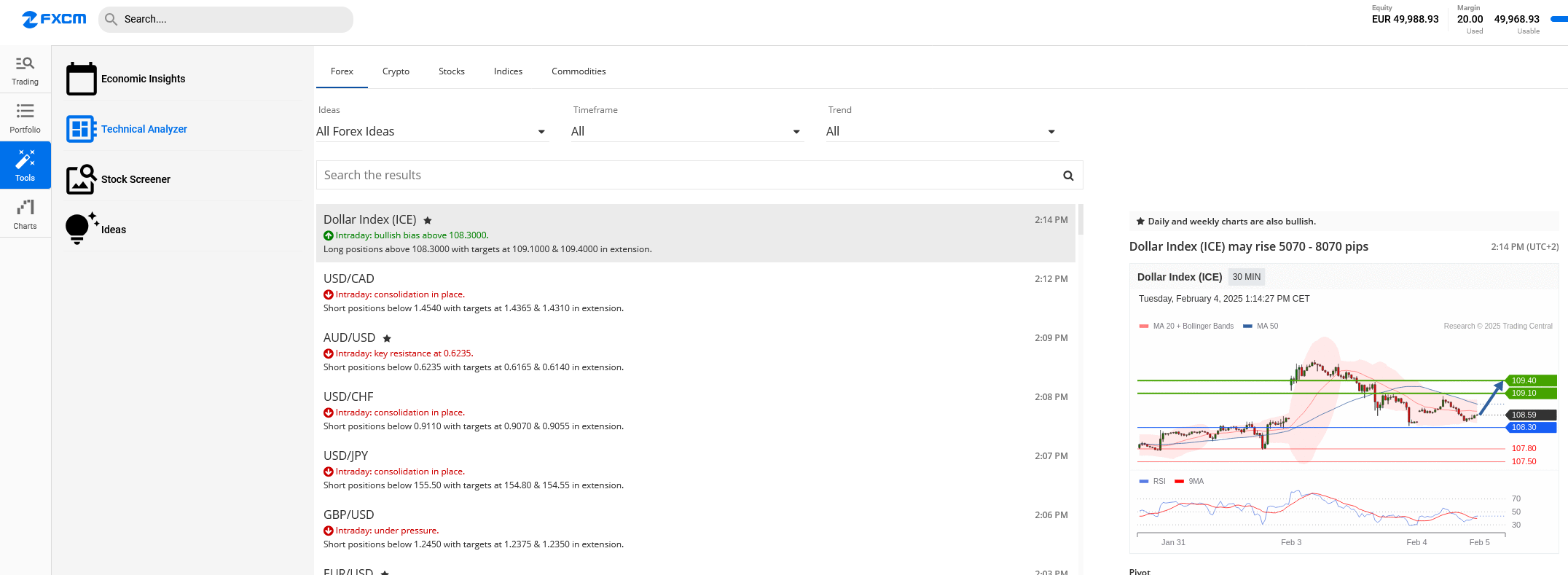
In addition to platform extensions, FXCM offers standalone applications with sophisticated analytical and automated trading capabilities. These include the Advanced Historical Data Downloader, which provides more in-depth historical data retrieval, the Tick Data Downloader, offering high-frequency market data for backtesting and strategy optimization, and the CFD Auto Roll, which automates the process of rolling over CFD contracts to maintain open positions seamlessly.
Traders also have access to several market analysis tools directly through the FXCM website, including the Economic Calendar for tracking key financial events, Live Forex Charts with real-time data visualization, Trade Volatility Data to assess market fluctuations, the Market Trade Scanner for identifying trading opportunities, and Market Data Signals, which provide insights based on technical and sentiment analysis. However, one notable absence is a trading forex calculator, which many traders rely on to quickly compute margin, pip value, and other key metrics.
For traders looking for premium market research, FXCM provides access to eFXplus, a subscription-based research website that delivers institutional-grade forex analysis. To qualify for a free monthly subscription, traders must meet a minimum trading volume of five standard lots per month. If this requirement is not met, the subscription is automatically canceled at the end of the month.
Notes from the author:
FXCM is one of those forex brokers that seems to have all the right credentials—a well-established brand, over two decades of experience in international markets, multiple top-tier regulatory licenses, and a long list of industry awards. It even has its own proprietary trading platform alongside the popular MetaTrader 4 (MT4). However, despite these strong points, FXCM doesn’t fully live up to the high expectations it sets.
One thing FXCM does well is customer support, which can be described as proactive, if not slightly aggressive. Shortly after registering an account, I received both an email and a call from a personal account manager, urging me to verify my identity before I had even explored the broker’s features. While having responsive customer service is a major plus, some traders might find it intrusive to be pressured into providing personal information so early in the process—before even deciding whether they want to deposit funds with FXCM.
A noticeable downside is the lack of clear information on account types and specific trading conditions on FXCM’s otherwise well-organized website. This is because FXCM does not offer multiple account types—new traders are automatically placed on a floating spread pricing model. Only those who meet high trading volume requirements can qualify for Active Trader status, which comes with lower spreads and the option to trade on a fixed commission. However, reaching this level comes at a cost, as the spreads FXCM offers on its standard pricing model are significantly higher than the industry average.
FXCM supports MT4, which remains a favorite among forex traders, but does not offer MetaTrader 5 (MT5). This means traders looking for the expanded features of MT5 are forced to use FXCM’s proprietary platform, Trading Station. While Trading Station is visually appealing and packed with useful features, some traders may find it too simplistic and focused on aesthetics rather than providing the most detailed and comprehensive market data.


