





ZXCM Review
ZXCM is a newcomer to the FX and CFD arena, operating from the Indian Ocean hub of Seychelles under a local FSA licence. The jurisdiction is popular among brokers for its business-friendly tax regime and speedy licensing process, but it does not impose the stringent investor-protection measures found in tier-one centres such as the UK or Australia.
On paper ZXCM delivers the essentials: a full MetaTrader 5 stack, multi-asset coverage that spans everything from major currency pairs to exchange-traded futures, and a marketing pitch that emphasizes tight spreads and fast execution. Yet the broker’s public material is thin on concrete detail—there is no compensation fund, no published audit trail, and only limited information on account tiers, margin schedules, or withdrawal policies.
Whether ZXCM merits a place in your broker line-up therefore comes down to a classic risk-return trade-off: can its trading conditions—pricing, instrument depth, leverage, and funding costs—justify the lighter regulatory safety net that accompanies a Seychelles address?
In the sections that follow we unpack each component—regulation, platform performance, trading costs, product range, funding routes, and client support—so you can judge with confidence whether ZXCM’s advantages outweigh its limitations, or whether a more tightly regulated alternative would serve you better.
ZXCM Regulation
Regulation is the core litmus test for any broker, and ZXCM’s legal footprint sits squarely in the offshore camp. The company anchors itself to a Seychelles Securities Dealer licence while maintaining a secondary registration in Saint Lucia—an arrangement that provides formal legality but far less investor protection than traders would receive under first-tier watchdogs such as the FCA, CySEC, or ASIC. Understanding exactly what these licenses do—and do not—offer is essential before funding an account.
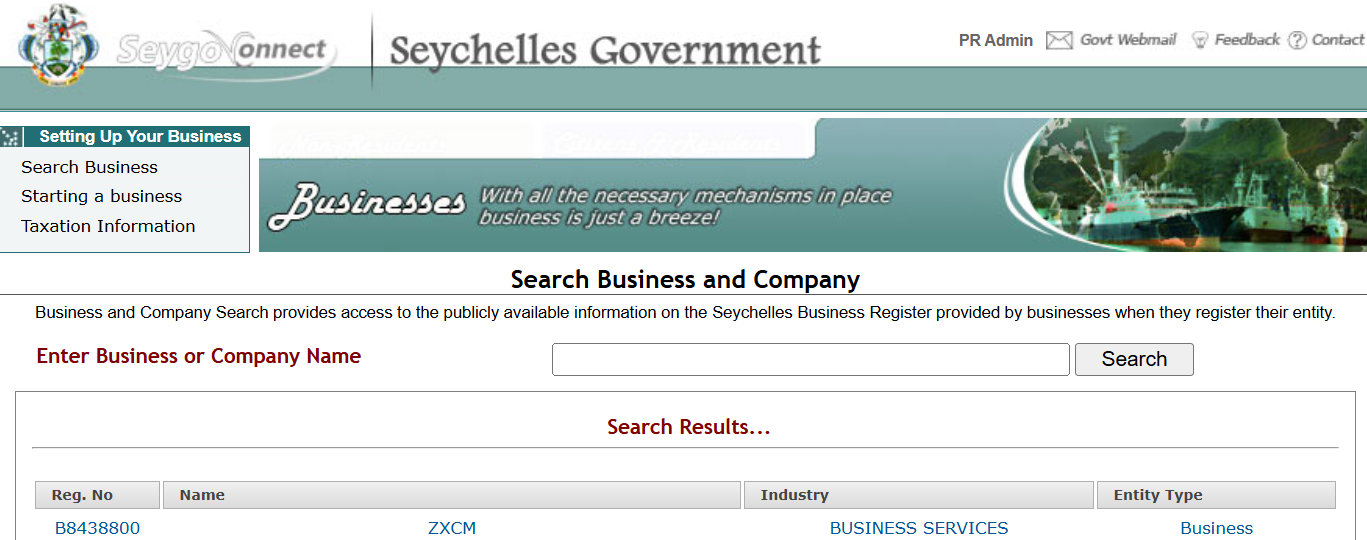
Corporate entities and licenses
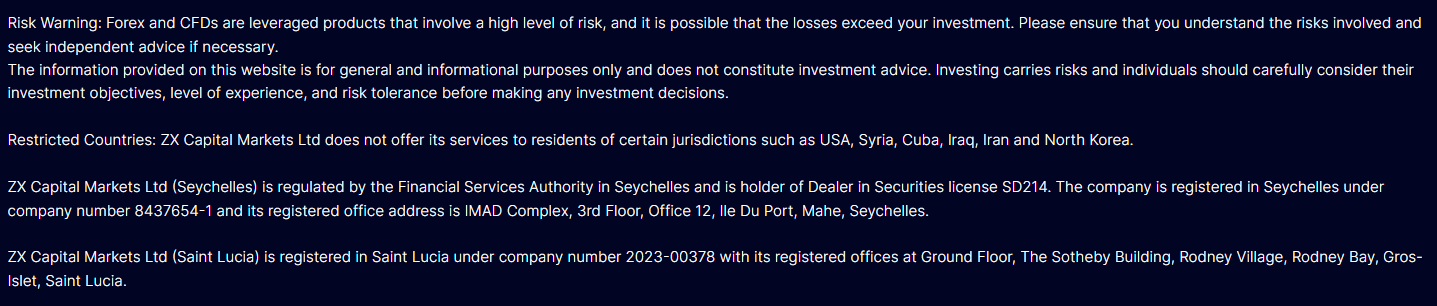
- ZX Capital Markets Ltd (Seychelles) – Securities Dealer License No. 437654-1 issued by the Seychelles Financial Services Authority (FSA); registered at IMAD Complex, 3rd Floor, Office 12, Ile Du Port, Mahé, Seychelles.
- ZX Capital Markets Ltd (Saint Lucia) – Corporate registration No. 2023-00378; address Ground Floor, The Sotheby Building, Rodney Village, Rodney Bay, Gros-Islet, Saint Lucia. The Saint Lucia entity carries no investment-services license and functions mainly as a back-office shell.
What the Seychelles FSA covers—and omits
| Safeguard | Tier-one standard (FCA/CySEC/ASIC) | Seychelles FSA | ZXCM disclosure |
| Investor-compensation fund | Yes (up to £/€ 85 k) | None | None |
| Paid-up capital | ≈ £/€ 730 k | USD 50 k–250 k* | Not stated |
| Public financial audits | Mandatory | Not required | None published |
| Negative-balance protection | Retail mandatory | Not mandated | Not confirmed |
| Segregated client accounts | Bank-verified | Required but rarely audited | Unsubstantiated |
* Capital requirement varies by license class; enforcement data is opaque.
Implications for traders
- No safety net: If ZXCM were to fail, clients have no statutory compensation fund to fall back on.
- Limited transparency: The broker is not obliged to publish audited statements, leaving its solvency and fund-segregation practices virtually untestable.
- Weak dispute resolution: The FSA offers mediation but no binding ombudsman; legal action would involve Seychelles courts and cross-border complexity.
- Unclear safeguards: ZXCM gives no hard commitment to negative-balance protection or independently verified segregation—both key for high-leverage environments.
ZXCM’s Seychelles license provides a veneer of legitimacy but lacks the capital strength, compensation cover, and disclosure discipline enforced in top-tier jurisdictions. For traders whose primary concern is fund security and clear legal recourse, the offshore regulatory setup is a material drawback that must be weighed heavily against whatever pricing or product perks the broker offers.
ZXCM Trading Platform
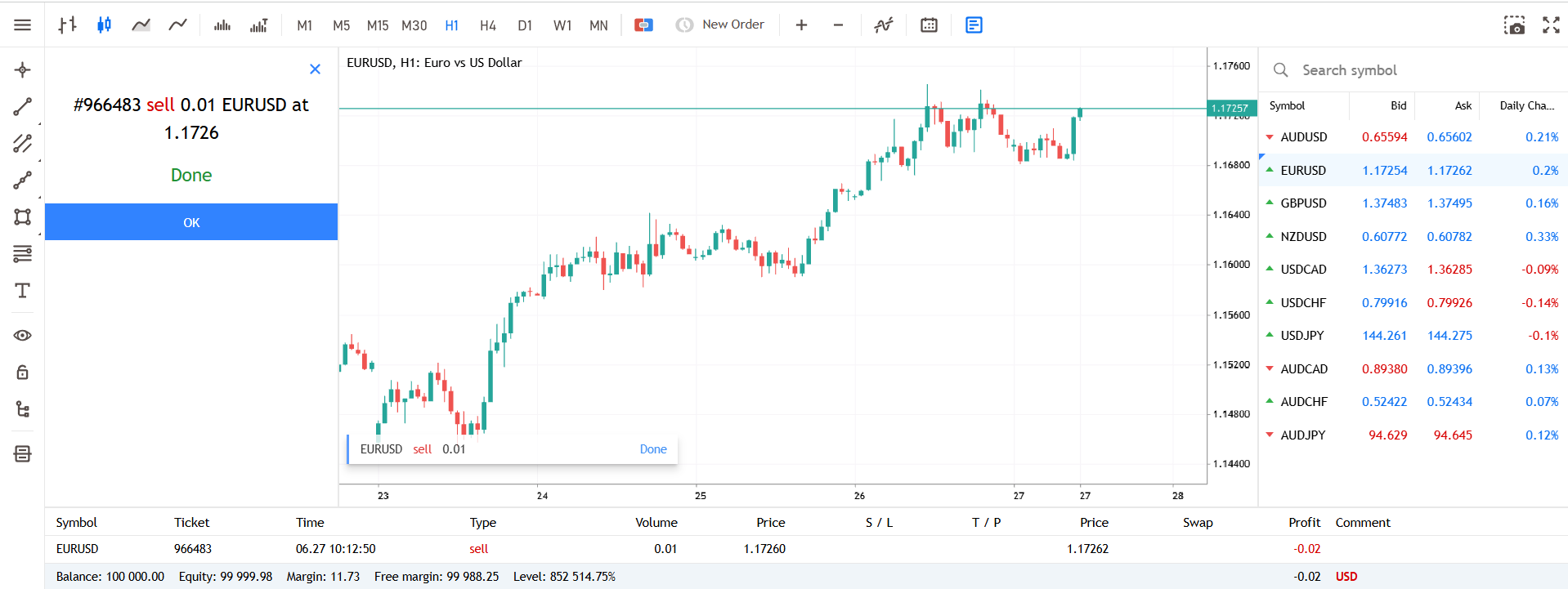
ZXCM keeps its platform line-up deliberately simple: MetaTrader 5 is the one—and only—terminal on offer. For seasoned technicians that is no hardship, as MT5 remains the market’s most complete retail workstation; for newcomers or traders who prefer cTrader, TradingView, or a slick in-house web hub, the single-platform policy may feel confining.
What you actually get
- Multi-asset dealing in one screen – Forex majors and minors, bullion, energy and soft commodities, equity indices, and the broker’s small futures roster all appear in the same Market Watch window.
- Institutional-grade charting – Twenty-one native time-frames, 100 simultaneous charts, and an 80-indicator starter pack, plus unlimited custom studies via MQL 5.
- Depth-of-Market and full order suite – Real-time book transparency, six pending-order types, and both hedging and netting modes for flexible position accounting.
- Algo and copy options – Integrated IDE for Expert Advisors, multi-threaded strategy tester, and direct access to the MT5 Signals marketplace for mirror trading.
- Cross-device continuity – Desktop, WebTrader, and mobile apps sync watch-lists and open trades in real time.
What’s missing
- Zero proprietary plug-ins – No broker-specific analytics dashboards, execution-quality widgets, or enhanced order-flow tools.
- No alternative interface – Traders who dislike MT5’s workflow or want a browser-first experience must adapt or look elsewhere.
- Platform ≠ protection – MT5’s technical muscle says nothing about spread competitiveness, fund safety, or ethical dealing; those must be proven by broker policy and regulation, not software branding.
ZXCM’s MT5 implementation delivers raw power and familiar workflows to anyone already fluent in the MetaTrader ecosystem. That alone, however, does not guarantee a superior trading experience—nor does it compensate for the lighter investor safeguards of a Seychelles licence. If MT5 is your comfort zone and you can live without extra bells and whistles, the platform will serve you well; if you value variety, proprietary analytics, or a gentler learning curve, the single-platform offer may fall short.
ZXCM Trading Accounts
ZXCM splits its live offering into four tiers that escalate sharply in funding requirements, from a starter Pro account at $100 to a VIP wallet that demands an eye-watering $50 000. Spreads and commissions—crucial to the true cost of trading—will be dissected in the next section; here, the focus is purely on entry thresholds and core positioning.
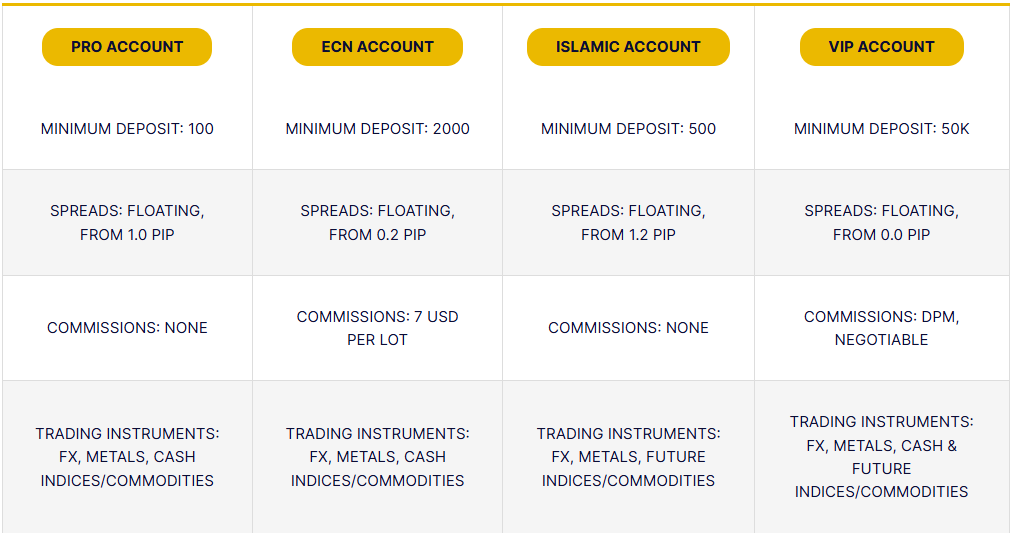
| Account | Minimum deposit | Typical user aim | Instruments in scope |
| Pro | $100 | Low-barrier gateway for testing live execution | FX, metals, cash indices & commodities |
| Islamic | $500 | Swap-free trading compliant with Sharia principles | FX, metals, futures indices & commodities |
| ECN | $2 000 | Direct-market access with raw-spread model | FX, metals, cash indices & commodities |
| VIP | $50 000 | High-balance account with negotiable terms | FX, metals, cash & futures indices & commodities |
Key takeaways
- Steep funding ladder: Moving from Pro to ECN requires a 20-fold jump, and VIP is another 25× above that—an unusually wide spacing for a retail broker.
- Islamic option priced mid-tier: The swap-free account sits halfway between Pro and ECN, a common placement in offshore jurisdictions that serve a global Muslim client base.
- No micro account: Traders wanting to test with sub-$100 stakes must use demo mode or look elsewhere.
- Deposit currency unspecified: ZXCM does not state whether thresholds are fixed in USD or convert to the base currency of the payment rail; confirm before wiring funds.
- Transparency gaps remain: Beyond the headline minimums, the broker discloses no cap on maximum deposits per tier and no explicit perks (e.g., dedicated manager, VPS) until the VIP level.
ZXCM’s account ladder caters to everyone from entry-level testers to high-net-worth speculators, yet the gulf between tiers—and the absence of micro funding or clear added benefits below VIP—may deter budget-conscious traders. Verify base-currency rules and any tier-specific conditions in writing before you commit capital. Trading conditions, including spreads and commissions, will determine whether the jump in funding actually buys better value—a question tackled in the next section.
ZXCM Trading Instruments
ZXCM positions itself as a multi-asset broker, offering foreign exchange, precious metals, broad-commodity CFDs, equity indices and selected futures contracts. While the headline mix is competitive, the public site omits a comprehensive symbol list, contract-specification file or leverage schedule, leaving prospective clients without critical detail prior to account funding.
| Asset class | Typical rationale | Information currently unavailable |
| Foreign exchange | 24-hour liquidity, tight pricing on majors and minors | Exact pair roster and leverage tiers |
| Metals | Inflation hedge, safe-haven flows (gold, silver, potentially PGM group) | Swap costs, contract size, quoting currency |
| Commodities | Macro exposure to energy and softs (oil, gas, coffee, etc.) | Margin requirements, roll/expiry rules |
| Equity indices | Broad-market positioning without single-stock risk | Complete ticker coverage, trading sessions |
| Futures | Direct access to exchange-listed markets | Exchange list, clarification on real futures vs CFD synthetics |
Practical considerations
- Contract values and lot sizes drive margin calculations; without disclosure, precise risk sizing is impossible ex-ante.
- Trading hours and holiday calendars influence gap exposure, yet ZXCM provides no timetable.
- Asset-specific leverage often differs sharply—e.g., lower gearing on gold versus major FX pairs—but remains unspecified.
- Swap and roll mechanics are undocumented, so overnight financing costs are discoverable only once trades are live.
ZXCM’s stated product range is broadly appealing, but the absence of a detailed instrument specification obliges traders to uncover key parameters only after logging in to the MT5 platform. Participants whose strategies hinge on exact contract data—or who trade less mainstream symbols—should obtain a full symbol sheet from client support before committing capital; otherwise the practical breadth, cost structure and risk parameters may not align with initial expectations.
ZXCM Trading Conditions
ZXCM offers four live accounts—Pro, ECN, Islamic and VIP—built on the same execution infrastructure (pure market-execution, 20 % stop-out, up to 1 : 500 leverage) but priced very differently. Below is a summary of headline terms; detailed swap rates, margin tiers by asset and slippage statistics are not publicly disclosed and should be verified in-platform.
| Feature | Pro | ECN | Islamic | VIP |
| Minimum deposit | $100 | $2 000 | $500 | $50 000 |
| Typical spread | From 1.0 pip | From 0.2 pip | From 1.2 pips | From 0.0 pip |
| Commission | None | $7 per lot | None | Negotiable (“DPM”) |
| Leverage (max) | 1 : 500 | 1 : 500 | 1 : 500 | 1 : 500 |
| Stop-out | 20 % | 20 % | 20 % | 20 % |
| Swap-free | No | No | Yes (7 days on major FX & gold) | Negotiable |
| Base currency | USD | USD | USD | USD |
Analysis
- Cost curve – The Pro account removes commission but starts at 1.0 pip; the ECN tier narrows the headline spread to 0.2 pip yet adds a $7/lot round-turn, putting all-in cost on EUR/USD close to ~0.9 pip—higher than many mainstream ECN brokers that charge $6/lot with 0.1–0.2 pip raw spread. VIP advertising 0.0 pip with negotiable commission could be attractive, but only traders funding $50 k or more gain access, and the final rate is set privately.
- Uniform risk parameters – Every account enjoys the same 1 : 500 leverage and a relatively low 20 % stop-out; high gearing combined with a shallow liquidation buffer demands tight risk control, especially given the broker’s unconfirmed negative-balance-protection policy.
- Islamic window – Swap-free status is limited to seven calendar days on major FX and gold, after which standard overnight charges apply—important for long-duration strategies.
- Single-currency funding – All tiers run exclusively in USD; clients funding in EUR, GBP or emerging-market currencies will face conversion spread.
Spreads
Because ZXCM does not publish an official spread matrix, we sampled real-time quotes from the MT5 terminal to establish a working benchmark. The averages recorded were 0.7 pips on EUR/USD, 0.8 pips on GBP/USD, and 1.1 pips on USD/JPY.
How to interpret the numbers
- Competitive for a “Pro”-style account: The sub-one-pip readings on EUR/USD and GBP/USD sit below the broker’s own “from 1.0 pip” marketing line, suggesting that headline figures may include a buffer for volatile periods.
- Middle of the pack for an ECN account: Once the ECN commission of $7 per lot is added (≈ 0.7 pips), the all-in cost on EUR/USD rises to roughly 1.4 pips—higher than the 0.9–1.0 pip blended rate common at leading ECN venues.
- Snapshot, not a guarantee: Spreads will widen during news events or thin liquidity; without a published historical average, traders must monitor real-time pricing to confirm consistency.
Take-away: ZXCM’s live spreads on the majors look acceptable for lower-tier accounts but lose their edge when ECN commission is factored in. Always test the platform during your typical trading hours to ensure the pricing you see aligns with your strategy’s cost threshold.
Leverage — 1 : 500 power, multiplied risk
ZXCM sets a uniform ceiling of 1 : 500 across all account types. At this ratio a trader can control a $100 000 notional position with just $200 of margin, freeing capital for diversification or short-term, high-conviction trades. The upside is obvious: small market moves compound quickly into sizeable percentage gains on the cash balance.
The downside is equally potent. A 0.20 % adverse move on a fully margined EUR/USD position at 1 : 500 wipes out the $200 margin entirely, triggering liquidation at the broker’s 20 % stop-out level. Because ZXCM does not confirm negative-balance protection, a gap through the stop-out price can leave the account in deficit—and the trader liable for the shortfall. In volatile sessions or thin off-market hours, currency pairs and metals can gap far more than 0.20 %, turning what began as a $200 risk stake into a debit balance that must be repaid.
High leverage also magnifies psychological pressure: the same five-pip fluctuation that feels negligible at 1 : 30 can provoke premature exits or over-trading at 1 : 500. Without disciplined position sizing, hard-coded stop-losses and adequate account funding, traders effectively gamble on stable market conditions—an assumption markets routinely defy.
Key takeaway: Leverage is a tool, not a free lunch. At 1 : 500 it can accelerate account growth, but in the absence of guaranteed negative-balance protection it can just as swiftly amplify losses beyond the deposit. Approaching ZXCM’s maximum gearing demands strict risk protocols: limit exposure per trade, set hard stops, and keep a cash buffer well above minimum margin to avoid forced liquidations and potential debt.
ZXCM’s tiered structure scales logically from an entry-level, no-commission Pro account to a negotiable-rate VIP bracket, yet overall pricing sits in the middle of the offshore pack rather than at its sharp end. The generous 1 : 500 leverage may appeal to experienced traders, but the low stop-out trigger and limited disclosure on swap tables, slippage and negative-balance coverage leave plenty for due-diligence follow-up—particularly if you plan to deposit beyond the Pro tier’s $100 threshold.
ZXCM Payment Methods
ZXCM supports a mix of traditional rails (bank wires, cards) and digital avenues (USDT-TRC20, Skrill). The broker advertises zero internal fees for both deposits and withdrawals, though third-party charges and FX spreads may still apply. Below is a consolidated view of the stated processing times and currencies.
| Channel | Currency | Broker fee | Deposit time | Withdrawal time |
| SWIFT wire | USD | None | ≤ 24 h | 1–5 business days |
| SEPA wire | EUR | None | ≤ 24 h | 1–2 business days |
| Visa / Mastercard | USD | None | Instant in | 1–10 business days out |
| USDT (TRC20) | USD-pegged | None* | Instant | ≤ 24 h |
| Skrill | USD | None | Instant | ≤ 24 h |
* Network fees for blockchain transfers still apply.
Observations
- Currency concentration: Most rails settle in USD; SEPA is the lone EUR path, so non-USD deposits risk conversion costs.
- Broad card payout window: A 1-to-10-day estimate for card withdrawals is wide; factor that variability into cash-flow planning.
- No published limits: Minimum and maximum transaction sizes are not disclosed and should be confirmed with support.
- KYC impact unmentioned: The broker does not specify whether identity checks can extend processing times—a common delay point in practice.
ZXCM offers a serviceable range of funding options with headline “no-fee” marketing and reasonably quick digital-wallet turnaround. Still, the reliance on USD, undefined transaction caps and a broad card-withdrawal window introduce cost and timing variables that prudent traders will want clarified in writing before wiring significant funds.
ZXCM Education and Trading Tools
A broker’s value proposition increasingly extends beyond execution to the training and decision-support resources it embeds in the client portal. In ZXCM’s case that layer is essentially absent: the site hosts no structured learning center, no market-analysis feed, and no auxiliary utilities such as economic calendars, position-size calculators, or sentiment dashboards.
What is missing and why it matters
| Area | Typical benefit to traders | ZXCM offering |
| Beginner education | Shortens learning curve, reduces costly errors | None (no articles, videos, or webinars) |
| Market research | Daily context, event-risk alerts, trade ideas | None (no analyst commentary or news feed) |
| Platform tutorials | Smooth on-boarding to MT5 functions | None (users must rely on third-party guides) |
| Risk-management tools | Position calculators, margin monitors, volatility meters | None (only MT5’s native metrics) |
| Copy-/social trading | Access to collective strategies, diversification | Not integrated; MT5 Signals marketplace unsupported by broker) |
Implications for different user groups
- New entrants must piece together education from external blogs, YouTube, or paid courses—adding time, cost, and inconsistency.
- Intermediate traders forgo in-house macro or technical commentary that could sharpen trade selection.
- Algorithmic or high-frequency users gain no broker-side performance analytics or VPS offers, limiting optimization insight.
ZXCM operates an execution-only model: it supplies a functional MT5 terminal but leaves all learning, analysis, and risk-tool requirements to the trader. Experienced users with their own research stack may shrug off the omission; newcomers will likely incur extra effort and expense sourcing reliable education elsewhere. In competitive terms, the lack of value-add content places ZXCM behind peers that bundle training modules, calendars, and analytics at no additional cost.
ZXCM Bonus and Promotions
At present, ZXCM runs no active bonuses, rebates, or trading contests—a marked contrast to many offshore brokers that advertise deposit-match schemes or volume-based cashbacks.
Implications for traders
- Cost clarity: With no promotional capital, every dollar in the account is fully withdrawable once margin is free, eliminating the turnover hurdles that often accompany bonus funds.
- Risk management: Absence of volume-target incentives reduces the temptation to over-trade merely to unlock promotional credits.
- Competitive landscape: Traders who place value on introductory perks will find more aggressive offers elsewhere; those who prioritise uncomplicated withdrawal rights may see the clean slate as a plus.
The zero-bonus policy keeps ZXCM’s account funding straightforward but removes a marketing hook that some traders consider a sweetener. Whether this is a downside or a welcome simplicity depends on your tolerance for the conditions that typically accompany broker promotions.
Final Thoughts
ZXCM delivers the core components a self-directed trader needs: a clean MetaTrader 5 deployment, headline spreads that are competitive at the entry level, and a product list that touches all the major asset classes. Funding routes cover both fiat and crypto, four account tiers cater to different wallet sizes, and the broker keeps marketing simple by steering clear of turnover-linked bonuses.
Yet every strength is offset by a structural caveat. A Seychelles licence confers legal status but omits the compensation schemes, capital thresholds, and third-party audits enforced by first-tier regulators. Key safety features—negative-balance protection, independently verified fund segregation, historical slippage data—remain unconfirmed. Education, analytics, and platform enhancements are non-existent, leaving newcomers to source their own learning curve, and the wide gaps between account minimums mean value for money tapers off unless you are prepared to fund at least the ECN tier.
ZXCM is a functional, execution-only venue best suited to experienced MT5 users who run tight risk controls and regard deposited capital as true risk capital. If you prize investor safeguards, rich educational resources, or fully transparent cost disclosure, a broker regulated by the FCA, CySEC, ASIC, or an equivalent tier-one authority will almost certainly serve you better.
Notes from the author:
After assembling the facts, I’d describe ZXCM as a textbook “execution-only” offshore broker: solid enough for skilled MetaTrader 5 users, but short on the institutional safeguards that help beginners sleep at night. The positives are easy to catalogue. A clean MT5 installation delivers all the depth most discretionary or algorithmic traders need; spreads on the Pro account start below one pip; and the product menu checks the multi-asset boxes—forex, metals, indices, commodities, even a handful of listed futures. Account entry at $100 is reasonable, and the payments grid covers SWIFT, SEPA, cards, USDT-TRC20, and Skrill with headline zero fees.
From a governance standpoint, however, the Seychelles FSA licence is a single-layer safety net. There is no investor-compensation fund, no published audit trail, and no broker-level pledge of negative-balance protection or independently verified fund segregation. Add the 1 : 500 leverage cap and a 20 % stop-out, and the risk profile skews sharply upward if markets gap. Transparency is another sticking point: margin tables, swap schedules, and a full symbol list reside behind the login, so prospective clients must request documents or open an account to see definitive numbers.
The service layer is virtually non-existent. No education portal, no analytics or research feed, and no proprietary plug-ins mean traders supply their own learning curve and decision-support tools. That won’t bother veterans with an external data stack, but it leaves newcomers piecing together guidance from third-party sources. The steep jump from Pro ($100) to ECN ($2 000) and VIP ($50 000) will also deter budget-conscious users, particularly since the commission-adjusted ECN pricing is only middling versus established peers.
Net-net, ZXCM can work for experienced MT5 operators who treat deposits as genuine risk capital and require no hand-holding. For anyone who values top-tier regulatory cover, built-in education, or fully transparent cost disclosure, a broker regulated by the FCA, CySEC, ASIC or equivalent remains the safer—often similarly priced—choice.


