





RAVEX Review
Ravex is one of the newer names to appear in the forex and CFD trading industry, having launched in 2024. The company operates under the name RAVEX Global, with registration in the Comoros Islands (Mwali) under the supervision of the Mwali International Services Authority (MISA). On the surface, this gives the broker legal standing—but seasoned traders will know that MISA is not in the same league as the FCA (UK), ASIC (Australia), or CySEC (Cyprus) when it comes to investor protection.
The broker promotes access to the MetaTrader 5 (MT5) platform and claims to support multi-asset trading across forex, indices, commodities, metals, and possibly cryptocurrencies.
However, a closer look at Ravex’s website reveals several gaps in critical information—spreads, leverage, instruments, and withdrawal policies are either unclear or entirely missing. For traders, this lack of transparency should raise a few eyebrows.
Ravex Regulation
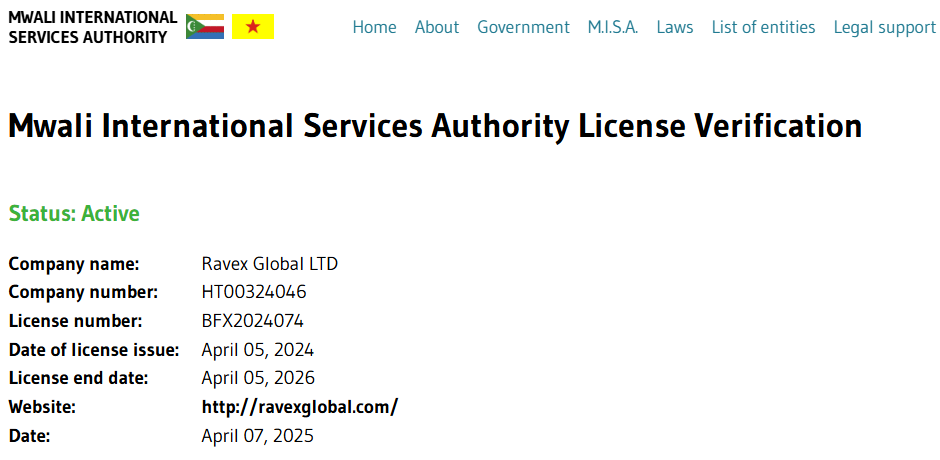
Ravex is incorporated as RAVEX Global Ltd. in the Comoros Islands (Mwali) and operates under the Mwali International Services Authority (MISA). While this provides the company with a legal framework to conduct business, traders should not confuse it with robust financial regulation. MISA is known for being a light-touch regulator, worlds apart from respected authorities such as the FCA (UK), CySEC (Cyprus), or ASIC (Australia).
Why Do Brokers Choose Offshore Jurisdictions?
The main reason companies like Ravex register offshore is cost and convenience. Setting up in places like Mwali or Saint Vincent and the Grenadines is fast, inexpensive, and comes with few regulatory obligations. Unlike tier-one jurisdictions, offshore regulators do not demand:
- Large capital reserves to ensure brokers can withstand market volatility.
- Independent financial audits to verify transparency.
- Strict requirements for client fund segregation.
- Participation in compensation schemes that protect traders if the broker fails.
For brokers, this means fewer barriers to entry and the ability to offer high leverage, bonuses, and flexible terms. For traders, however, it means far weaker protections and limited recourse if things go wrong.
What MISA Oversight Actually Provides
MISA registration confirms Ravex’s legal existence but falls short of providing true investor safeguards. There are:
- No compensation schemes if the company becomes insolvent.
- No guarantees on fund segregation, meaning deposits could be mixed with operating capital.
- Minimal dispute resolution, leaving traders with little legal support if conflicts arise.
Safety Features That Are Missing
Ravex does not state whether it offers negative balance protection or proper segregated client accounts—two features that are legally required under EU and UK rules. Without these, traders risk losing more than their deposits or having funds tied up if the broker mismanages capital.
Brokers often choose offshore jurisdictions to avoid strict rules, and while this may benefit them, it comes at a direct cost to traders. Ravex’s MISA licence may look official, but it does not guarantee fair trading conditions, secure fund handling, or effective dispute resolution.
Ravex is legally registered, but not meaningfully regulated. Traders considering this broker should weigh the risks of operating without the protections that top-tier regulators enforce.
Ravex trading platform
Setting up a trading account with Ravex is not as straightforward as with most brokers. Even when opening a demo account, traders are required to go through a verification process before gaining access. This is unusual in the industry, where demo platforms are typically offered hassle-free to let clients test the broker’s services quickly. The extra step may discourage potential clients and raises questions about why such barriers exist.
When it comes to live trading, Ravex relies solely on MetaTrader 5 (MT5), but with a limitation: the platform is available only in its desktop version. There is no browser-based WebTrader or mobile app support listed, which makes Ravex less flexible than competitors offering full cross-device access.
Functionally, MT5 remains a top-tier platform. Traders benefit from advanced charting across 21 timeframes, support for up to 100 open charts at once, and more than 80 built-in indicators. The Depth of Market (DOM) tool provides real-time liquidity data, while a variety of order types—market, limit, stop, and trailing stops—allow for flexible execution. MT5 also supports hedging and netting, algorithmic trading with Expert Advisors (EAs), and access to the MQL5 marketplace for custom scripts, indicators, and social trading signals.
Despite these advantages, traders should not confuse a strong platform with broker reliability. MT5 is licensed by MetaQuotes, not Ravex, which means the platform’s robustness says little about execution fairness or the safety of deposits. With Ravex’s offshore regulatory status, the risks of slippage, delayed withdrawals, or poor transparency remain significant.
Ravex offers a powerful but limited MT5 desktop experience. For traders who want mobile or web access—or who value regulatory safeguards—the platform setup may feel restrictive and risky compared to what well-regulated brokers provide.
Ravex Trading accounts
Ravex offers an unusual mix of account options, combining a proprietary-style trading challenge with several live account tiers. While this variety might look appealing, the lack of transparency around spreads, commissions, and leverage—and the broker’s offshore regulatory setup—means traders should approach each account with caution.
Standard Account – Entry Level
The Standard Account is pitched as Ravex’s most accessible live option, requiring a $100 minimum deposit. It advertises “prime variable spreads” and applies a 100% margin call with a 30% stop-out level. This account is designed for entry-level traders looking for a low-cost way to get started, though the absence of clear information on actual spread ranges or leverage makes it difficult to evaluate its real value.
Prop Trading Account – “Trader Wanted Challenge”
For $199, traders can join Ravex’s prop-style challenge, starting with a $10,000 funded account. The rules include trading at least 5 days per month, not losing more than $1,000, and progressive withdrawal limits—20% in month one, 30% in month two, and 50% from month three. Ravex also advertises account scaling up to $250,000 for consistent profitability. While these terms appear generous, it’s worth remembering that payouts depend entirely on Ravex’s discretion, as this is not a regulated prop firm.
Silver Account – Mid-Level Access
The Silver Account requires a $500 deposit and offers “prime variable spreads.” It carries the same margin call (100%) and stop-out (30%) as the Standard account. The lack of details on spreads, commissions, and leverage makes it hard to determine whether it provides better value than the entry tier.
Gold Account – Lower Spreads, Higher Entry
With a $1,000 minimum deposit, the Gold Account promotes “ultra-low variable spreads.” Conditions remain similar to the Silver account, though Ravex provides no hard data on spreads or execution quality. The higher deposit requirement may deter cautious traders.
Expert Account – Premium Features
Also requiring a $1,000 deposit, the Expert Account is marketed with “priority support” and “advanced tools.” Spreads are again described as ultra-low, but with no independent verification or contract specifications available, traders are left to rely on Ravex’s marketing.
Ravex’s lineup—from the low-barrier Standard Account to the higher-tier Gold and Expert levels—may look flexible, but the missing details on core trading conditions undermine its credibility. In an offshore environment, even a $100 deposit carries outsized risk. The prop challenge adds a layer of intrigue but is ultimately based on Ravex’s internal policies rather than any regulated payout structure.
Ravex Trading Instruments
When reviewing Ravex as a forex broker, one of the most striking issues is the absence of clarity around its market offering. Unlike most brokers that highlight the exact instruments available—such as the number of forex pairs, the range of commodities, or whether stock CFDs are included—Ravex leaves traders entirely in the dark.
There is no breakdown of supported asset classes, no specifications of spreads per market, and no indication of leverage limits or margin requirements. Even basic details like contract sizes or trading hours are not disclosed. For anyone considering opening an account, this omission creates a significant barrier: without knowing what you can trade, it is impossible to judge whether the broker can meet your needs.
This kind of non-disclosure would not be acceptable under tier-one regulators such as the FCA, ASIC, or CySEC, where publishing product lists and conditions is mandatory. The fact that Ravex operates under Mwali’s MISA licence—a light-touch offshore authority—means it faces no such obligation, and that lack of accountability shows.
In practical terms, the absence of information on trading instruments leaves clients relying purely on trust, which is not a solid foundation when dealing with an untested offshore broker. Until Ravex publishes a transparent instrument list and contract details, traders are left speculating rather than making informed choices—a risk that could easily be avoided by choosing a broker with clear and verifiable disclosures.
Ravex Trading Conditions
One of the most important details traders look for in a broker review is spread transparency. Unfortunately, Ravex does not disclose any information about its spreads across forex, commodities, indices, or other CFDs. This lack of visibility makes it impossible to know how competitive the broker really is. For scalpers and short-term traders, even a fraction of a pip can decide whether a strategy is profitable, so hiding this data is more than just an oversight—it raises concerns about possible hidden costs. Well-regulated brokers are required to publish average spreads or real-time pricing benchmarks, which allows clients to make informed decisions. Ravex, operating under an offshore licence, provides no such assurances.
Leverage is another cornerstone of trading conditions, yet Ravex does not publish any figures regarding maximum leverage ratios. In contrast, brokers regulated in Europe or the UK must clearly state leverage caps (typically 1:30 for retail clients under ESMA rules). By withholding this information, Ravex forces traders into a blind commitment: you don’t know the risk exposure you’ll be taking on until after you’ve signed up and deposited. In an offshore environment, this lack of disclosure is a significant red flag, as it leaves the door open to excessive leverage levels that can quickly drain accounts.
Without transparency on spreads or leverage, Ravex fails to meet even the most basic expectations of a forex broker. The silence around trading costs and risk parameters forces traders to operate in the dark, which is particularly dangerous in the absence of strict regulatory oversight. For anyone considering Ravex, the reality is simple: you won’t know your costs or risks until after you’re already exposed.
Ravex Payment Methods
When it comes to funding and withdrawals, Ravex offers only a narrow set of options compared to what traders typically expect from a global forex broker. The broker accepts payments via Tether (USDT), MasterCard, Google Pay, Apple Pay, and Rial deposits. While this list covers both digital and card-based channels, it falls short of the wider selection of bank transfers, e-wallets, and multi-currency solutions that regulated brokers usually provide.
The reliance on USDT (Tether) may appeal to crypto traders seeking fast and low-cost transfers, as deposits are generally processed instantly. However, the irreversible nature of blockchain transactions makes this particularly risky in the context of an offshore broker. If Ravex were to delay or refuse a withdrawal, clients would have no realistic way to recover their funds.
Card-based methods like MasterCard, Apple Pay, and Google Pay bring more convenience, but here too, chargeback protection is uncertain when dealing with a company under weak regulatory oversight. The mention of Rial deposits further suggests Ravex is targeting traders in select regions, rather than offering a truly global funding framework.
Perhaps the biggest issue is lack of transparency. Ravex does not publish any details on deposit or withdrawal fees, minimum and maximum transfer amounts, or processing timelines. For traders, this means going in blind—there’s no clarity on how much it will actually cost to move money in and out of the platform, nor on how quickly funds will be released.
While Ravex technically supports both crypto and card payments, the combination of limited choices, missing fee schedules, and irreversible USDT transfers presents significant risks. In an industry where clear withdrawal policies are often the best test of a broker’s reliability, Ravex’s vague approach should be a major red flag for anyone considering depositing larger sums.
Ravex Education and Trading tools
One area where Ravex falls completely short is trader support. The broker does not provide any form of educational resources or in-house trading tools. Unlike regulated competitors that typically offer webinars, video tutorials, trading guides, or even daily market analysis, Ravex leaves clients to rely entirely on external sources for their learning and strategy development.
For beginners, this lack of education is a major disadvantage. New traders often need structured content to understand risk management, technical indicators, or how to navigate platforms like MT5. Without such resources, they are far more likely to make costly mistakes — especially when trading with high leverage in an offshore environment.
As for trading tools, Ravex offers nothing beyond the standard features built into the MT5 platform. While MT5 itself is powerful, it is not unique to Ravex and is available at nearly every forex broker. The absence of broker-specific add-ons — such as calculators, sentiment indicators, VPS hosting details, or advanced analytics dashboards — makes Ravex’s offering feel bare-bones compared to industry standards.
The lack of both educational content and proprietary trading tools highlights Ravex’s minimal investment in client support. This not only makes the broker less competitive but also raises questions about how much it prioritizes trader success. For those seeking a long-term trading partner, the absence of these fundamental services is a serious drawback.
Ravex Bonus
Ravex does not currently advertise or provide any deposit bonuses, trading credits, or promotional incentives. At first glance, this might seem like a missed opportunity compared to many offshore brokers that aggressively market high-risk bonus schemes. However, in practice, the absence of bonuses may actually be a positive.
Bonuses often come with hidden turnover requirements, withdrawal restrictions, or trading volume conditions that can trap inexperienced traders into overtrading. By not offering such promotions, Ravex avoids creating those added complications.
That said, the lack of bonuses also underscores the broker’s bare-minimum approach to its overall offering. With no extra incentives, no education, and no proprietary tools, traders receive little beyond access to MT5 and basic account tiers. For those comparing options, regulated brokers often provide loyalty programs, cash rebates, or safer promotional offers with transparent conditions — benefits Ravex does not match.
Ravex’s “no bonus” stance keeps trading straightforward, but it also reflects how limited its value proposition really is. Traders looking for meaningful incentives or added perks will likely find stronger offers elsewhere.
Final thoughts
Ravex may advertise itself as a modern forex and CFD broker with MetaTrader 5 access and various account options, but the reality tells a different story. The company is registered offshore in the Comoros Islands under MISA, a regulator known for its minimal oversight and lack of trader protections. This alone places Ravex in a high-risk category compared to brokers regulated by the FCA, ASIC, or CySEC.
The problems don’t stop there. Ravex fails to publish essential information such as spreads, leverage limits, available instruments, and withdrawal rules—basic details that any transparent broker should provide upfront. Instead, traders are left in the dark, relying only on the company’s internal claims. Combine this with crypto-based funding methods that are irreversible and unprotected, and the risks become obvious: once you deposit, there’s no guarantee you’ll be able to withdraw smoothly, or at all.
Education, client tools, and support are practically non-existent, making Ravex’s offering bare-bones at best. Even its prop account model, while flashy in marketing, is entirely dependent on Ravex’s internal discretion, with no independent oversight to guarantee payouts.
The bottom line is simple, Ravex is legally registered but not meaningfully regulated, and its lack of transparency, weak protections, and offshore setup make it an untrustworthy choice for traders. If you value fund security and fair conditions, you are far better off with a properly regulated broker that provides clear terms and proven safeguards.
Notes from the author:
After looking closely at Ravex, I can say this broker does not inspire trust. The fact that it is registered under MISA in the Comoros Islands already sets the tone—this is one of the weakest forms of “regulation” in the industry. It’s essentially a business license, not a real safeguard for traders. There are no capital requirements, no investor compensation schemes, no independent audits. If something goes wrong, you are on your own.
The second red flag is transparency—or the lack of it. A serious broker publishes its spreads, leverage, withdrawal policies, and full list of instruments. Ravex publishes almost nothing. You don’t know what you’re really trading, how much it will cost, or how quickly you’ll get your money out. In my experience, when a broker hides this type of information, it’s not an oversight—it’s intentional.
The account structure doesn’t improve things either. A $100 Standard Account may seem attractive, but when higher-tier accounts ask for $500 or $1,000 without any concrete proof of tighter spreads or better execution, it starts to feel like smoke and mirrors. The so-called “prop challenge” looks flashy, but it has no third-party oversight. Payouts rely entirely on Ravex’s internal policies, which is a risk most traders should avoid.
Ravex might look polished on the surface, but it’s built on a foundation of weak regulation and missing disclosures. This is not the kind of broker you trust with serious capital. At best, it’s a place for high-risk experimenting with tiny sums. But if you’re serious about trading, you’re better off with a broker under FCA, ASIC, or CySEC—firms that publish their conditions clearly and are held accountable by real regulators.


