





Azul Markets Review
Azul Markets has entered the forex and CFD industry with notable leadership credentials — the broker is co-founded by the former CEO of Scope Markets. Licensed by the Mauritius Financial Services Commission (FSC), the firm operates under a regulatory framework that provides formal recognition but falls short of the rigorous client protection standards imposed by top-tier authorities.
Despite its fresh entry, Azul Markets currently feels more like a project in development than a fully established brokerage. The website offers little clarity on core essentials such as account structures, trading conditions, and payment methods. Even onboarding deviates from industry norms: instead of a streamlined online sign-up, prospective clients must reach out directly to a company representative. For a broker launching in 2025, this lack of accessibility and transparency is unusual — and potentially concerning.
On the surface, the inclusion of MetaTrader 5 (MT5) and a multi-asset CFD lineup spanning forex, metals, commodities, equities, indices, and cryptocurrencies suggests ambition to compete with established players. However, without detailed disclosures on spreads, leverage, or execution, traders are left to speculate on whether Azul Markets can deliver a competitive trading environment.
In its current state, Azul Markets raises as many questions as it answers. The leadership background and regulatory registration may give the firm a degree of credibility, but the absence of transparency leaves its offering incomplete. For now, traders may be intrigued — but cautious — as this broker attempts to establish itself in a highly competitive marketplace.
Azul Markets Regulation
Azul Markets is registered in Mauritius and licensed by the Financial Services Commission (FSC). On the surface, this provides the company with a legal foundation to operate and onboard international clients. However, it is critical to separate formal registration from robust oversight.
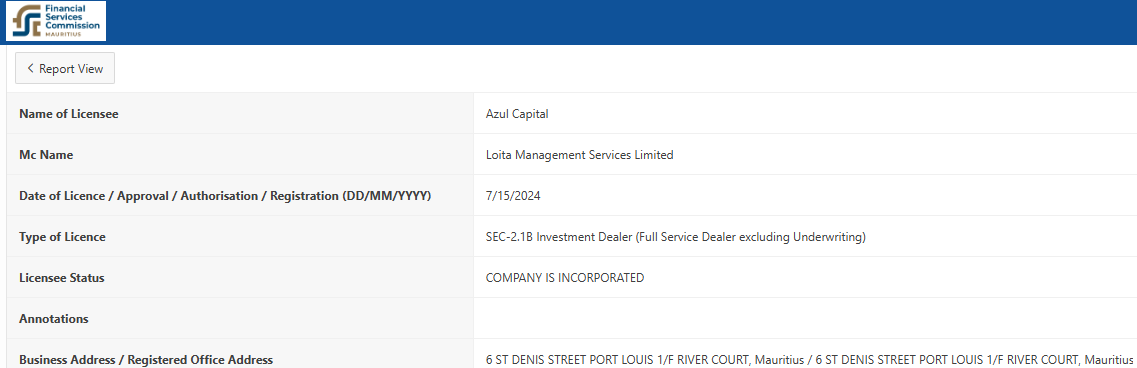
The FSC is broadly categorized as an offshore or mid-tier regulator. Its framework is far lighter than the strict regimes enforced by authorities such as the FCA (UK), ASIC (Australia), or CySEC (EU). For traders, this difference is not just technical — it directly affects the level of protection available.
Under FSC supervision:
- No compensation scheme exists if the broker collapses. By contrast, EU and UK regulators guarantee client funds up to a set limit.
- Enforcement is weaker, meaning capital requirements and operational checks are less stringent.
- Dispute resolution is limited, leaving traders with fewer legal channels if conflicts arise.
- High leverage and flexible conditions are allowed, which may attract some clients but also expose them to higher risks.
In practice, the FSC license may be enough to give Azul Markets a veneer of legitimacy, but it does not provide the investor safeguards that serious traders typically expect. Compared with top-tier regulated brokers, Azul Markets operates with far fewer obligations to protect clients.
For anyone considering Azul, the key trade-off is clear: greater flexibility and easier access, but significantly weaker safety nets. In a market where trust is everything, this places the broker at a disadvantage against established, tightly regulated competitor.
Azul Markets Trading Platform
The choice of trading platform often sets the tone for a broker’s reliability. Azul Markets advertises MetaTrader 5 (MT5), which is widely recognized as the global benchmark for forex and CFD trading. On paper, this looks reassuring: MT5 is trusted by millions, offers advanced features, and is supported by an extensive ecosystem of tools and strategies.
However, the way Azul Markets delivers MT5 highlights some concerning gaps. The broker only provides access to the desktop version of MT5. In contrast, virtually every established broker today offers MT5 across desktop, web, and mobile to ensure that traders can access their accounts anytime, anywhere. By limiting the platform to desktop alone, Azul Markets falls behind what is now considered the bare minimum in the industry.
What MT5 Desktop Provides
- Comprehensive charting tools – Multiple timeframes, 30+ indicators, and drawing objects for technical analysis.
- Automated trading – Support for Expert Advisors (EAs) and custom MQL5 strategies, with built-in backtesting.
- Flexible execution models – Market and pending orders, stop orders, trailing stops, and both netting and hedging modes.
- Multi-asset trading – Access to forex, indices, commodities, metals, equities, and cryptocurrencies from one terminal.
These features make MT5 an industry favorite — but they are not unique to Azul Markets.
The Trust Factor – Why Azul Falls Short
- With Azul Markets – Clients are restricted to desktop use only, losing the flexibility of trading on the go. This is particularly problematic in 2025, when market access from mobile devices is standard and often essential.
- With regulated competitors – Brokers typically offer MT5 on all platforms, often alongside proprietary apps, ensuring continuity of trading and reinforcing professionalism.
The takeaway is clear: while Azul Markets has chosen the right platform, its limited implementation makes the offering feel unfinished and raises questions about the broker’s ability to meet modern trading expectations. A trustworthy broker would ensure full accessibility from day one; Azul has not.
Azul Markets Trading Accounts
One of the first things traders look for when evaluating a broker is the account structure — minimum deposits, available tiers, and what trading conditions apply to each. In the case of Azul Markets, this information is completely absent. The broker does not disclose account types, funding thresholds, or key features such as spreads, leverage levels, or additional perks tied to higher deposit levels.
Why This Matters
- With reputable brokers – Account information is laid out clearly on the website, often in side-by-side comparison tables. Traders can instantly see whether the broker offers entry-level accessibility (e.g., $50–$100 minimums) or caters to professionals with higher thresholds. This level of clarity builds trust and allows clients to make informed decisions before registering.
- With Azul Markets – Prospective clients are left guessing. Without published details, it is impossible to know whether Azul is beginner-friendly or targeting high-net-worth traders. Instead of a simple online sign-up, interested clients are instructed to contact a company representative directly. This manual process is not only inconvenient but also uncommon among serious brokers in 2025.
Implications for Traders
The absence of account transparency is more than an oversight — it’s a red flag. Brokers that avoid publishing basic details such as deposit requirements and trading conditions often do so because their offerings are not competitive. For traders, this lack of clarity means higher uncertainty, more friction in the onboarding process, and fewer guarantees about what to expect after funding an account.
Until Azul Markets provides full disclosure on account types and minimum deposits, the safest assumption is that the broker is still in an early, unfinished stage of development. By comparison, established and well-regulated competitors publish all conditions upfront — a key marker of professionalism and trustworthiness.
Azul Markets Trading Instruments
Azul Markets advertises access to several major asset classes, including forex, metals, commodities, equities, indices, and cryptocurrencies. At first glance, this suggests a broker aiming to provide multi-asset coverage that appeals to both traditional traders and those seeking exposure to newer markets like digital assets.
However, the way this information is presented raises concerns. The product lineup is outlined only in broad categories, with no accompanying details such as:
- The exact number of currency pairs available.
- Whether equities span global markets or are limited to select regions.
- Which commodities are included (energy, agriculture, or both).
- Which indices are offered and from which economies.
- Whether cryptocurrencies extend beyond Bitcoin and Ethereum to a fuller range of altcoins.
Why This Is Problematic
- With established brokers – Product offerings are typically disclosed in full, often with detailed contract specifications, tick sizes, trading hours, and margin requirements. This level of clarity helps traders compare offerings and decide whether the broker suits their strategy.
- With Azul Markets – The lack of detail makes it impossible to know the real scope of the instruments. Without transparency, the claim of offering multiple asset classes remains more of a marketing line than a verifiable feature.
What Traders Should Take Away
A multi-asset lineup on paper is appealing, but without hard numbers and specifications, it is impossible to judge whether Azul Markets is competitive. Until the broker publishes a comprehensive instrument list with trading conditions, traders should treat the advertised coverage as aspirational rather than guaranteed.
This lack of detail once again reinforces the impression of Azul Markets as a broker still in its early development stage — and not yet on par with established competitors that disclose everything upfront.
Azul Markets Trading Conditions
One of the most critical aspects of trading conditions is pricing — specifically, the spreads that traders pay on each transaction. At the time of writing, Azul Markets has not published any information about its spreads. There are no figures for forex majors, metals, indices, equities, or cryptocurrencies. This omission is significant.
- With established brokers – Spread data is typically displayed clearly on the broker’s website, often broken down by account type, instrument, and even time of day. This transparency allows traders to compare costs and determine whether conditions are competitive.
- With Azul Markets – The absence of published spreads forces traders to operate in the dark. Without clarity, there is no way to know whether Azul’s pricing aligns with industry averages or whether clients are being charged significantly more.
For traders, this lack of disclosure is a serious red flag, as hidden or unfavorable spreads are a common risk when dealing with offshore or underdeveloped brokers.
Leverage – Another Unknown
The same transparency gap exists with leverage. Azul Markets provides no details about maximum leverage levels for forex, CFDs, or any other instruments.
This creates two major problems:
- Uncertainty over risk exposure – Traders cannot know whether leverage is capped at conservative levels (e.g., 1:30 in the EU/UK) or pushed to extremely high offshore-style ratios (e.g., 1:500), which can magnify losses as quickly as gains.
- Unclear compliance standards – Most credible brokers disclose leverage limits upfront as part of their regulatory obligations. Azul’s silence suggests either poor disclosure practices or deliberately opaque policies.
Spreads and leverage are the foundation of trading conditions. Without clear information, traders cannot make informed decisions about costs or risk management. By comparison, reputable, well-regulated brokers present this data openly, reinforcing trust and accountability.
Until Azul Markets publishes transparent, verifiable figures for both spreads and leverage, potential clients should assume the worst — that conditions may be uncompetitive, high-risk, and potentially unfavorable once an account is opened.
Azul Markets Payment Methods
Funding and withdrawals are among the most important aspects of a broker’s service, as they directly affect how easily traders can access their money. Yet at this stage, Azul Markets provides no information about its payment methods. There are no details on which deposit channels are accepted, what fees may apply, or how long it takes for funds to be processed.
Why This Matters
With established brokers – Payment policies are disclosed clearly on the website, typically covering cards, bank transfers, and e-wallets, along with transparent timelines (e.g., instant deposits, withdrawals processed within 1–3 business days) and any associated fees. This level of detail reassures clients that their funds will be handled smoothly and predictably.
Traders are left entirely in the dark. Without published information, there is no way to know whether funding is quick and cost-effective, or whether clients could face hidden charges and long delays.
The Risk for Traders
The absence of transparency on deposits and withdrawals is a major red flag. Offshore and underdeveloped brokers often delay publishing this information because their processes are not competitive or because they reserve the right to impose hidden costs. For traders, this creates significant uncertainty — not only about convenience but also about the safety of their capital once deposited.
Until Azul Markets clearly outlines its payment options, fees, and processing times, potential clients should remain cautious. A broker that withholds such essential details is not yet operating at the level of professionalism expected in 2025. By comparison, trustworthy brokers make their funding policies completely transparent, giving traders confidence that their money can move in and out of accounts without friction.
Azul Markets Education and Trading Tools
At the time of writing, Azul Markets does not offer any educational materials or trading tools. There are no tutorials, webinars, market analysis reports, or research features available through the broker’s website. Likewise, traders do not have access to risk management calculators, sentiment indicators, or third-party integrations that are standard in many established platforms.
Why This Puts Azul Behind
With reputable brokers – Even entry-level brokers typically provide a learning center with articles, video tutorials, or webinars aimed at beginners. More advanced firms go further, offering in-depth market research, daily analysis, and integrated tools to support decision-making. These resources not only help clients but also demonstrate that the broker is invested in their long-term success.
With Azul Markets – The complete absence of education or tools reinforces the impression of a broker still in its early, underdeveloped stage. Traders receive only a bare-bones platform experience, with no additional support to build skills or improve strategy.
Why It Matters
For beginners, the lack of guidance can make the entry into trading unnecessarily difficult and riskier. For experienced traders, the absence of analytical tools means relying entirely on external resources, reducing the convenience of keeping everything under one roof.
Azul Markets provides no educational content or value-added trading tools, setting it apart from more established brokers that integrate these resources as part of their standard service. This omission further underlines the concern that Azul is not yet positioned as a trustworthy or competitive option for serious traders.
Azul Markets Bonus
Azul Markets does not currently advertise any bonuses, promotions, or incentive programs for new or existing clients.
Industry Context
- With some offshore brokers – Bonuses are often used as aggressive marketing tools, such as deposit matches or trading credits. However, these promotions usually come with restrictive conditions, including high-volume requirements that make withdrawals difficult.
- With regulated brokers in tier-one jurisdictions – Bonuses are generally banned altogether, as they are seen as misleading and potentially harmful to traders.
What This Means for Traders
While the absence of a bonus may seem like a disadvantage at first, it is not necessarily negative. It prevents traders from being lured in by potentially unfair conditions. However, given Azul Markets’ overall lack of transparency in other areas, the absence of both promotions and clear core features reinforces the impression of a broker that is underdeveloped and offering little added value at this stage.
Final Thoughts
Azul Markets enters the market with strong leadership credentials and a recognizable name behind it, but the broker remains far from ready to be considered a trustworthy option. While it holds a license from the Mauritius FSC, this is an offshore regulator that does not provide the same safety nets or investor protections found in tier-one jurisdictions such as the UK, EU, or Australia.
Across nearly every core area — accounts, trading conditions, instruments, payments, education, and tools — transparency is missing. Traders are not told what spreads to expect, how much leverage is offered, what the minimum deposit is, or even how deposits and withdrawals are processed. Instead of a professional, streamlined onboarding process, clients must contact the broker directly just to open an account — a highly unusual practice in 2025.
The inclusion of MT5 is one of the few positives, but even here, Azul Markets restricts access to the desktop version only, leaving out web and mobile trading that almost every competitor now provides. Combined with the lack of educational support, trading tools, or any added value, the broker currently offers little more than a bare-bones setup.
Azul Markets may be legally registered, but it is not operating at the level of professionalism or transparency expected of a safe broker. For traders, this means higher uncertainty, higher risk, and very little assurance that their funds will be protected. Until Azul Markets publishes full details of its accounts, trading conditions, and payment processes — and demonstrates stronger compliance standards — it is far safer to stick with established, well-regulated brokers.
Notes from the author:
Azul Markets feels like a company that has launched too early, without putting the fundamentals in place. On paper, there are elements that could eventually make it a competitive player — a leadership team with prior industry experience, a license from the Mauritius FSC, and the inclusion of MT5 as a trading platform. These are not insignificant. But in practice, the offering is still far too underdeveloped for traders to approach with confidence.
The lack of transparency is the biggest concern. When a broker does not disclose its account types, minimum deposits, spreads, or leverage, it leaves traders in the dark about the most important factors that shape the trading experience. Most established brokers go out of their way to present this information clearly, because it demonstrates professionalism and helps clients make informed decisions. Azul Markets has not done this yet, and that should raise caution.
The reliance on desktop-only MT5 also speaks to an unfinished setup. In 2025, traders expect mobile and web access as standard, and the absence of these options limits flexibility. Likewise, the lack of information on payment methods and the complete absence of educational resources or tools makes the service feel bare-bones.
In short, Azul Markets might develop into a more reliable broker in the future, but right now, it is not there yet. For serious traders, the risks outweigh the potential. My honest advice is to wait until the company provides full transparency on trading conditions, funding, and regulation before considering it as a viable alternative to established, tier-one brokers.


