





Amari Capital Review
Amari Capital is one of the newest entrants to the forex and CFD trading industry, incorporated in Mauritius and supervised by the Financial Services Commission (FSC). On paper, this registration gives the company legal status to operate, but traders should understand that the FSC is considered an offshore, mid-tier regulator—not in the same league as authorities like the FCA (UK), ASIC (Australia), or CySEC (EU).
The broker promotes an ambitious package: access to the MetaTrader 5 (MT5) platform, leverage up to 1:500, and a broad range of tradable instruments spanning forex, indices, commodities, cryptocurrencies, and US stocks. It also advertises negative balance protection and segregated accounts, features designed to reassure clients.
The question is whether these offerings are enough to outweigh the risks of trading with an offshore-regulated broker. In this Amari Capital review, we’ll examine its regulation, platform, account structure, trading conditions, instruments, funding, and overall reliability.
Amari Capital Regulation
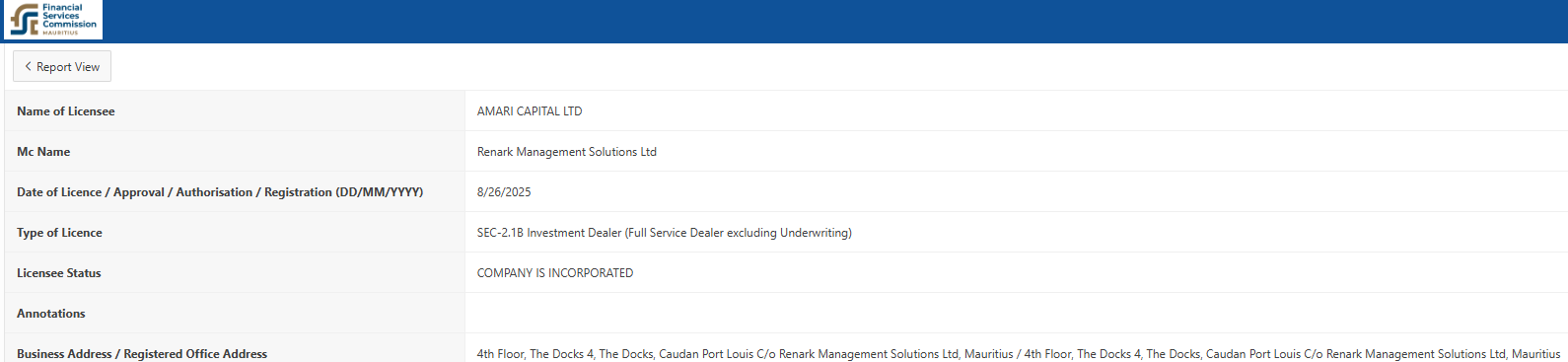
Amari Capital presents itself as a regulated forex and CFD broker through the Financial Services Commission (FSC) of Mauritius, while its registered office is listed in Dubai. At first glance, this may sound reassuring — regulation gives the broker legal operating status. But here’s the reality: an FSC license is not the same as approval from top-tier authorities like the UK’s Financial Conduct Authority (FCA), Australia’s ASIC, or the EU’s CySEC and BaFin.
Why FSC Oversight Falls Short
For traders, the real question is not whether a broker is “licensed” but how strong that license is. The FSC is widely regarded as an offshore regulator with light-touch supervision. Unlike tier-1 watchdogs that impose strict capital requirements, regular audits, and investor compensation schemes, the FSC framework is far more lenient. This creates lower barriers to entry for brokers but also less protection for clients.
- No compensation scheme – Unlike the FCA’s FSCS (£85,000 coverage) or Cyprus’ ICF (€20,000 coverage), Mauritius offers zero reimbursement if a broker goes insolvent.
- No mandatory third-party audits – Client funds may be advertised as “segregated,” but there is no external verification. Traders must take the broker’s word for it.
- Limited legal recourse – In case of disputes or withdrawal issues, pursuing action against an FSC-licensed broker is complicated, cross-border, and rarely in the trader’s favor.
- Low capital thresholds – Tier-1 regulators require brokers to hold millions in reserve to withstand volatility. In Mauritius, those requirements are far lighter.
Safety Features – Promises, Not Guarantees
Amari Capital does claim to provide negative balance protection and segregated client accounts. On paper, that’s reassuring. But under FSC rules, these are voluntary policies, not legally enforced standards. In practice, whether these safeguards are honored depends entirely on the broker’s internal discipline.
The Bigger Picture
Mauritius has become a popular base for offshore brokers because it’s cheap, fast, and easy to get licensed. That doesn’t automatically mean Amari Capital is dishonest — but it does mean the level of investor protection is far weaker than with FCA, ASIC, or CySEC-regulated brokers. For traders, that translates to higher risk if problems arise around withdrawals, platform fairness, or fund handling.
Amari Capital’s FSC license may tick the “regulated” box, but it doesn’t deliver the robust investor protection many traders expect. There’s no compensation scheme, no strict audit process, and limited dispute resolution. For those trading small amounts, this might seem acceptable, but anyone committing serious capital should recognize the risks of offshore regulation. If safety and accountability are your top priorities, brokers under tier-1 supervision remain the more secure choice.
Amari Capital Trading Platform
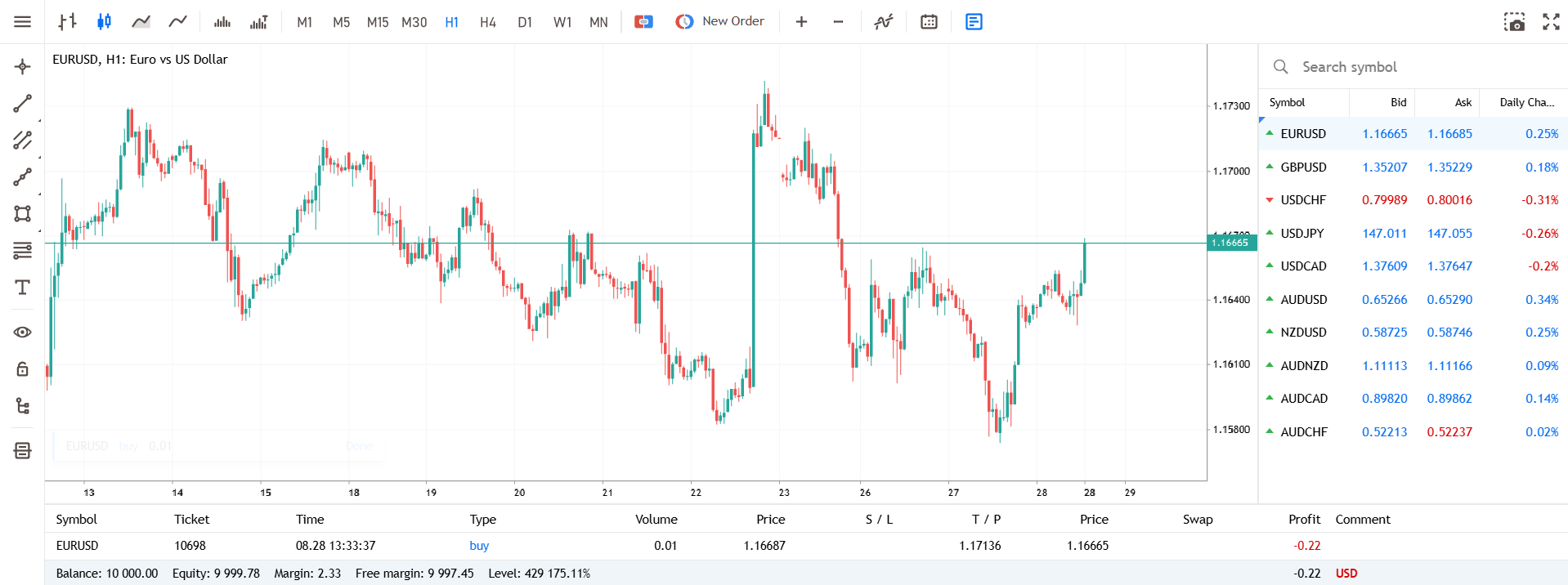
Amari Capital gives clients access to the MetaTrader 5 (MT5) platform, one of the most widely used trading terminals in the industry. MT5 is known for its advanced charting, automated trading support, and multi-asset functionality, making it a favorite among experienced traders who value flexibility and technical depth.
Who MT5 Works Best For
MT5 is often marketed as an upgrade over MT4, with 21 timeframes, faster execution, and integrated economic tools. For seasoned traders, these features can be invaluable when running complex strategies or managing a diverse portfolio. But for beginners, MT5 can feel overly complex. Many new traders still gravitate toward MT4 for its simplicity, wider educational content, and lighter learning curve.
Platform Access at Amari Capital
The broker offers MT5 across standard formats:
- Desktop (Windows) – Full access to advanced charting, strategy backtesting, and Expert Advisors (EAs).
- Web Terminal – Browser-based trading with no installation, but fewer tools than the desktop version.
- Mobile App (iOS/Android) – Core functionality on the go, allowing order execution and account monitoring.
Key MT5 Features Provided
Amari Capital’s MT5 package includes:
- Advanced charting with dozens of built-in indicators
- Depth of Market (DOM) for liquidity monitoring
- Multiple order types including pending and trailing stops
- Hedging and netting modes for position management
- Access to the MQL5 marketplace for signals, scripts, and automated tools
The Drawback – Nothing Unique
Unlike some well-established brokers that enhance MT5 with proprietary tools, analytics dashboards, or integrated signals, Amari Capital offers a bare-bones version of MT5. There are no exclusive add-ons, educational tie-ins, or value-added features to distinguish its platform from countless other brokers.
Amari Capital provides access to a powerful, industry-standard platform. But that’s where the story ends. With no unique enhancements and weaker regulatory backing compared to FCA- or ASIC-supervised brokers, traders may wonder why they should choose Amari Capital at all. If you want MT5, plenty of better-regulated brokers offer the same platform—with stronger fund protections and more reliable client support.
Amari Capital Trading Accounts
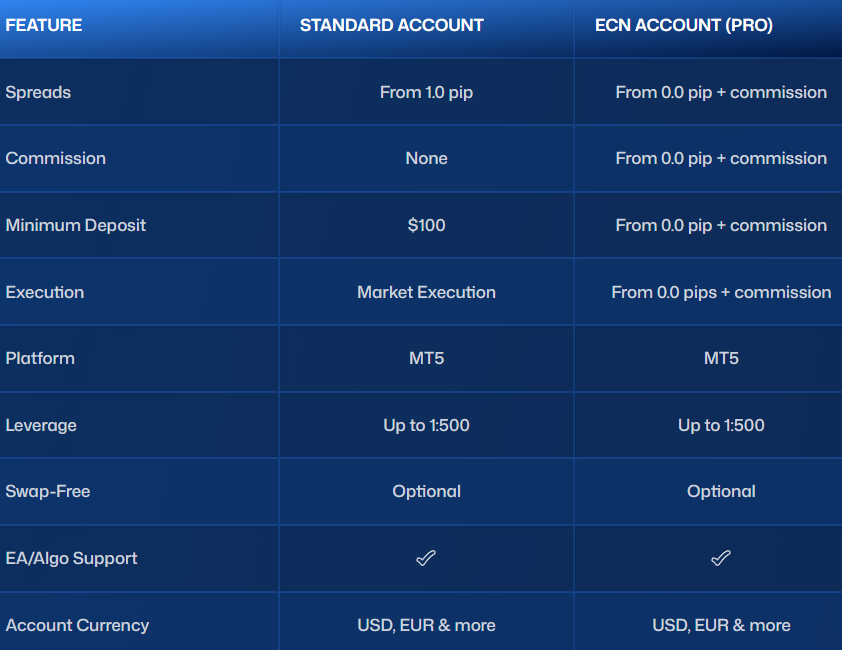
Amari Capital structures its offering around two live account types — a Standard Account and an ECN (Pro) Account. Both accounts run on the MetaTrader 5 (MT5) platform and support high leverage up to 1:500, but they differ in pricing models and entry requirements.
Standard Account – Low Barrier Entry
The Standard Account requires just a $100 minimum deposit, making it accessible for beginners and those who want to test the broker with a small balance. Spreads start from 1.0 pip with no commission charges, meaning costs are rolled entirely into the spread.
This account is likely to appeal to newer traders seeking simplicity, but spreads are not the tightest in the market. Under offshore regulation, there is also no independent guarantee that pricing remains consistent during volatile conditions.
ECN Account (Pro) – Raw Spreads for Active Traders
For more experienced traders, the ECN Account (Pro) promises raw spreads from 0.0 pips, paired with a commission per lot traded. The minimum deposit is higher (undisclosed in some broker material, but typically above $1,000 for this type of setup) and the account is marketed toward scalpers, day traders, and high-volume strategies.
While raw spreads sound competitive, the lack of transparent commission details and the broker’s offshore license mean traders should remain cautious. Without top-tier oversight, there is no guarantee that “0.0 pip” conditions will be delivered consistently.
Common Features Across Accounts
- Leverage: Both accounts provide leverage up to 1:500, which can magnify both profits and losses.
- Execution: Market execution is standard, with no guaranteed stop-loss policies mentioned.
- Swap-Free Option: Islamic accounts are available on request.
- EA/Algo Support: Both accounts support Expert Advisors and algorithmic trading via MT5.
- Account Currencies: USD, EUR, and potentially others are supported.
Amari Capital’s account structure is straightforward, offering one spread-only model and one raw spread + commission setup. While this looks competitive on paper, the combination of high leverage, offshore oversight, and limited transparency on fees means traders should approach with caution. For those who want similar conditions under stronger regulation, there are safer alternatives with FCA, ASIC, or CySEC brokers.
Amari Capital Trading instruments
Amari Capital advertises a multi-asset lineup designed to give traders access to popular global markets through CFDs. On paper, the range looks broad enough to cover most strategies — from short-term forex trading to longer-term speculation on equities.

Here’s what’s included:
- Forex: The broker provides access to the global foreign exchange market, with major, minor, and possibly exotic pairs available. While forex remains the most liquid market in the world and the core of most brokers’ offerings, Amari Capital does not publish an exact list of available pairs or average spreads — a lack of transparency that makes it difficult to compare conditions with top-tier brokers.
- Indices: Clients can trade CFDs on major stock indices such as the S&P 500, NASDAQ, or Dow Jones, giving exposure to entire markets rather than individual companies. Index trading is popular among traders who want broad market exposure, but again, Amari Capital does not disclose contract specifications, margin requirements, or trading hours.
- Commodities: The broker includes commodities like oil, gold, and other raw materials, allowing traders to hedge or speculate on global economic trends. Commodity CFDs are highly volatile and usually require clear margin and leverage disclosures — information Amari Capital does not provide upfront.
- Cryptocurrencies: Amari Capital also promotes access to crypto CFDs, including leading coins like Bitcoin and Ethereum. These markets are known for extreme volatility, and without negative balance protection guaranteed by regulation, clients could face serious risks when trading with high leverage.
- US Stocks: A selection of US stock CFDs is listed, letting traders speculate on share price movements of well-known companies without owning the underlying assets.
While Amari Capital advertises a diverse product lineup — forex, indices, commodities, cryptocurrencies, and US stocks — it provides very little detail on actual market availability or contract terms. In comparison, regulated brokers are required to publish full product lists, spreads, and trading conditions. The lack of transparency here should be a red flag, as traders cannot fully evaluate whether Amari’s instruments are competitive or even reliable.
Amari Capital Trading conditions
Amari Capital structures its trading environment around two account types — a Standard Account and an ECN (Pro) Account — both available on the MetaTrader 5 platform. On paper, the conditions appear competitive, but traders should look beyond the marketing headlines, especially given the broker’s offshore regulation.
Spreads & Commissions
- Standard Account: Spreads are advertised from 1.0 pip with no commission fees, making it a spread-only model. While this may seem straightforward for beginners, spreads of 1.0 pip or higher are not the most competitive in today’s market, particularly compared to well-regulated brokers offering tighter pricing.
- ECN (Pro) Account: Marketed as the broker’s premium option, this account advertises spreads starting from 0.0 pips, but charges an unspecified commission per trade. The lack of transparency on exact commission rates makes it impossible to assess the real cost of trading, and offshore brokers often hide fees within unclear structures.
Leverage
Both accounts offer leverage of up to 1:500, which is significantly higher than what is permitted under tier-one regulators like the FCA, ASIC, or CySEC (where retail leverage is capped at 1:30). While high leverage can magnify profits, it just as easily accelerates losses. Without strong regulatory safeguards such as enforced risk warnings, negative balance protection, and mandatory margin checks, 1:500 leverage is more of a risk than a benefit for inexperienced traders.
Execution & Risk Controls
Amari Capital advertises market execution for all trades, meaning orders are filled at the next available price. However, there is no transparency regarding slippage, requotes, or execution speed — factors that can significantly impact real trading outcomes.
The broker also mentions optional swap-free accounts, but does not provide detailed conditions. Additionally, while negative balance protection is claimed, it is not mandated under the FSC of Mauritius, meaning traders must rely solely on Amari Capital’s internal policies.
On paper, Amari Capital’s trading conditions appear attractive: spreads from 0.0 pips, commission-based pricing, and leverage up to 1:500. But without transparency on commissions, execution quality, or independent regulatory oversight, these advertised conditions cannot be fully trusted. For traders, the reality is simple: competitive-looking numbers mean little without the backing of a strong, top-tier regulator to enforce them.
Amari Capital Payment Methods
One of the most surprising gaps in Amari Capital’s offering is the complete lack of disclosure regarding payment methods. The broker does not specify how clients can fund their accounts or withdraw profits—whether through credit/debit cards, bank transfers, e-wallets, or cryptocurrencies.
For traders, this absence of information is more than an inconvenience; it’s a serious red flag. Funding and withdrawals are the backbone of any trading relationship, and reputable brokers are upfront about available channels, processing times, fees, and limits. Without these details, clients are essentially depositing money blind, with no certainty about how quickly—or if—they will be able to retrieve their funds.
In well-regulated markets, payment transparency is mandatory. Brokers under CySEC, FCA, or ASIC oversight must clearly state minimum deposit requirements, withdrawal policies, and expected timelines. By failing to publish this information, Amari Capital exposes a common weakness among offshore brokers: flexibility for the company, but uncertainty for the client.
Why This Matters for Traders
- Hidden fees: Without published terms, traders could face unexpected deductions on deposits or withdrawals.
- Delays: Processing times could range from instant to weeks, and without clear policies, there’s no accountability.
- Limited recourse: If withdrawals are denied or delayed, offshore regulation under Mauritius’ FSC provides minimal protection compared to top-tier regulators.
Amari Capital’s silence on its deposit and withdrawal methods undermines trust from the outset. No matter how appealing the spreads or leverage may look, a broker that fails to publish clear funding policies cannot be considered reliable. For traders, this should serve as a major caution: if payment transparency is missing, the biggest question becomes whether your funds are truly safe.
Amari Capital Education and Trading tools
Amari Capital does not provide any educational resources for its clients. There are no beginner guides, tutorials, webinars, or market analysis updates available on its website. This is a notable drawback compared to well-regulated brokers that usually invest in trader education to help clients improve their skills and manage risks more effectively. For beginners, the absence of structured learning materials means turning to external sources for training — a gap that can increase the likelihood of costly mistakes.
Where Amari Capital attempts to add value is through PAMM accounts and social trading, both of which are integrated into MetaTrader 5 (MT5).
PAMM Accounts
Amari Capital’s Percentage Allocation Management Module (PAMM) system allows traders to allocate funds to professional managers and share in the results of their strategies. Clients can browse a verified list of PAMM managers with live performance statistics, invest any amount, and monitor results in real time.
Key PAMM features include:
- Real-time performance tracking – Transparent results updated instantly.
- Segregated funds – Claims of secure investment structures, though not independently verified.
- Profit-based fees – Fees apply only on profits, based on the high-water mark.
- Flexible withdrawals – No lock-ins; clients can withdraw or reallocate funds at will.
- MT5 integration – Seamless setup without external plugins.
While PAMM can offer diversification and passive income opportunities, its reliability ultimately depends on the broker’s execution quality and transparency — both of which remain questionable under offshore oversight.
Copy Trading
Amari Capital also promotes copy trading, enabling clients to mirror the trades of top-performing traders in real time. Investors can filter strategy providers by performance, drawdown, and risk profile, then automatically replicate their trades within MT5.
Features include:
- Verified trader profiles with track record visibility.
- Instant replication of trades, without delays.
- Custom risk controls, including max loss and allocation settings.
- Full MT5 integration, avoiding third-party platforms.
- No lock-in periods, allowing clients to stop copying anytime.
On the surface, copy trading and PAMM management look attractive for those seeking hands-off strategies. However, in the context of an offshore broker with weak regulatory oversight, traders must be cautious. The lack of external audits or investor protection means there is no guarantee that published results or fund safety claims are accurate.
Amari Capital provides no education at all, leaving new traders without guidance, but it does offer advanced features like PAMM and copy trading through MT5. While these tools may look appealing, they carry heightened risks given the broker’s offshore license and limited accountability. For traders who want to explore managed strategies safely, regulated brokers with independently verified copy trading platforms are a far more reliable choice.
Amari Capital Bonus
Amari Capital vaguely advertises that traders who open a Standard account can “enjoy bonuses that boost your trading ability and help protect your capital.” However, the broker provides no further details about the type of bonuses, how they are applied, or the terms and conditions attached.
For traders, this lack of transparency is a red flag. In the forex industry, bonuses are often tied to strict turnover requirements or withdrawal restrictions that make it nearly impossible to access profits until large volumes of trades are completed. Reputable regulators such as CySEC (EU) or the FCA (UK) have banned deposit bonuses entirely, recognizing that they encourage excessive risk-taking and can trap inexperienced traders into overtrading.
The fact that Amari Capital only mentions bonuses vaguely — without publishing exact percentages, eligibility rules, or withdrawal policies — raises concerns about hidden conditions. Traders risk finding out too late that the “bonus” is more of a marketing hook than a genuine benefit.
Bonuses may sound appealing, but with no transparent information and under an offshore regulatory framework, Amari Capital’s promotional claims should be treated with caution. For traders who value fairness and clarity, the absence of proper disclosure makes these offers more of a liability than a true advantage.
Final Thoughts
Amari Capital enters the forex and CFD industry with big promises: MT5 access, leverage up to 1:500, hundreds of instruments, and features like PAMM and copy trading. On the surface, this looks like a well-rounded offering that could appeal to both beginners and more active traders.
But the reality is more complicated. The broker is regulated only by the FSC of Mauritius, an offshore authority that does not impose the strict requirements seen under FCA (UK), ASIC (Australia), or CySEC (EU). That means no compensation fund, no mandatory third-party audits, no strict capital rules, and very limited legal recourse if things go wrong. Even claims of segregated accounts or negative balance protection are not independently enforced, which makes them more of a promise than a guarantee.
Transparency is another weakness. Amari Capital fails to clearly disclose details on payment methods, commissions, or product specifications, leaving traders in the dark about costs and funding processes. While PAMM and copy trading tools might sound attractive, using them under weak oversight exposes clients to higher risk than with regulated brokers offering similar services.
The bottom line is simple: Amari Capital may check some boxes on paper, but it does not meet the standards of reliability and protection that serious traders expect. If you’re testing with a very small deposit, the risks might feel manageable. But for anyone committing significant capital or looking for long-term trust, better-regulated alternatives are the safer choice.
Notes from the author:
When I look at Amari Capital, I see a broker that wants to appear modern and competitive on the surface—MT5 access, high leverage, PAMM accounts, copy trading, and a broad list of markets. For many traders, these are attractive selling points. But when you dig deeper, the cracks start to show.
The biggest concern is regulation. Yes, Amari Capital is registered with the FSC in Mauritius, but that doesn’t hold the same weight as a license from the FCA, ASIC, or CySEC. In practice, this means no compensation scheme if the broker fails, no strict audits to confirm segregated funds, and very little recourse in the event of withdrawal issues. I’ve seen countless brokers hide behind offshore regulation while clients struggle to get their money out—and that’s a risk I can’t ignore here.
Another issue is transparency. Details about spreads, commissions, payment methods, and even bonus terms are vague or missing altogether. Any serious broker knows that traders base their decisions on clarity of costs and policies. When a broker doesn’t publish this information, it feels less like an oversight and more like a deliberate choice.
Yes, Amari Capital offers PAMM and copy trading, which might appeal to traders who want a more passive approach. But those tools are only as trustworthy as the broker behind them. Without independent oversight, there’s no way to know if the performance metrics shown are reliable, or if client funds are truly protected.
In short, Amari Capital is not in the same league as reputable, well-regulated brokers. While it may tempt traders with high leverage and flashy features, the lack of transparency and weak regulation make it hard to recommend for anyone serious about long-term, secure trading.


