


Covenance Review
Covenance is a newly launched forex and CFD broker based in Thailand and operating under offshore regulation. The broker positions itself as a multi-asset trading hub, offering access to the MetaTrader 5 (MT5) platform and a diversified portfolio of instruments — including forex pairs, global stocks, commodities, indices, and cryptocurrencies.
While the offering may appeal to traders seeking a flexible, cross-market trading environment, the lack of oversight from any major financial authority is a notable concern. Offshore regulation often comes with limited transparency, weak investor protection, and minimal recourse in the event of disputes.
This review takes a closer look at Covenance’s overall reliability, trading environment, and key features — helping traders weigh its potential benefits against the risks that come with an offshore setup.
Covenance Regulation
Covenance operates through Covenance Limited, a company incorporated in the Comoros Islands under registration number HT00725069. The broker holds a license from the Mwali International Services Authority (MISA), under license number BFX2025087.
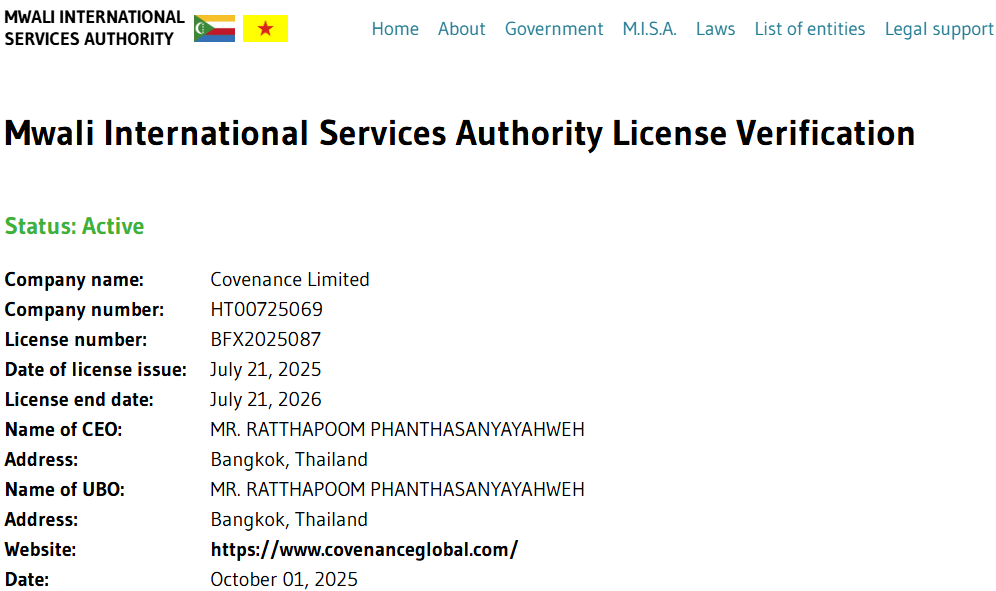
While this registration allows Covenance to legally offer trading services, it is important to understand what such offshore regulation entails. MISA is not a top-tier financial authority like the FCA (UK), ASIC (Australia), or CySEC (Cyprus). Instead, it provides a relatively simple registration framework with limited ongoing supervision or investor protection mechanisms.
Oversight and Limitations
MISA-licensed brokers are not subject to the same strict operational standards as those regulated in major financial jurisdictions. Typically, this means:
- No mandatory segregation of client funds, which could expose traders to risks if the company encounters financial difficulties.
- No guaranteed negative balance protection, allowing the possibility of losses exceeding deposited amounts.
- No requirement for independent financial audits, leaving the broker’s solvency largely unverified.
- No investor compensation scheme, meaning clients have no claim for reimbursement in case of insolvency.
- Limited dispute resolution mechanisms, which may complicate the handling of customer complaints.
What This Means for Traders
While a MISA license gives Covenance legal status as a financial service provider, it does not offer the same safeguards or accountability associated with brokers regulated by established authorities. Traders choosing to open an account should be aware that offshore registration generally implies higher operational flexibility for the broker, but also higher risk exposure for the client.
As a result, those seeking robust protection for their funds or access to formal dispute resolution channels may find offshore-regulated brokers less suitable than those licensed in stricter jurisdictions.
Covenance Trading Platform
Covenance provides access to a single trading platform — MetaTrader 5 (MT5). Known for its reliability and multi-asset functionality, MT5 remains one of the most widely used platforms in the retail trading industry. However, the absence of alternative platforms such as cTrader, TradingView, or a proprietary web interface limits the broker’s flexibility and appeal to traders with different needs or experience levels.
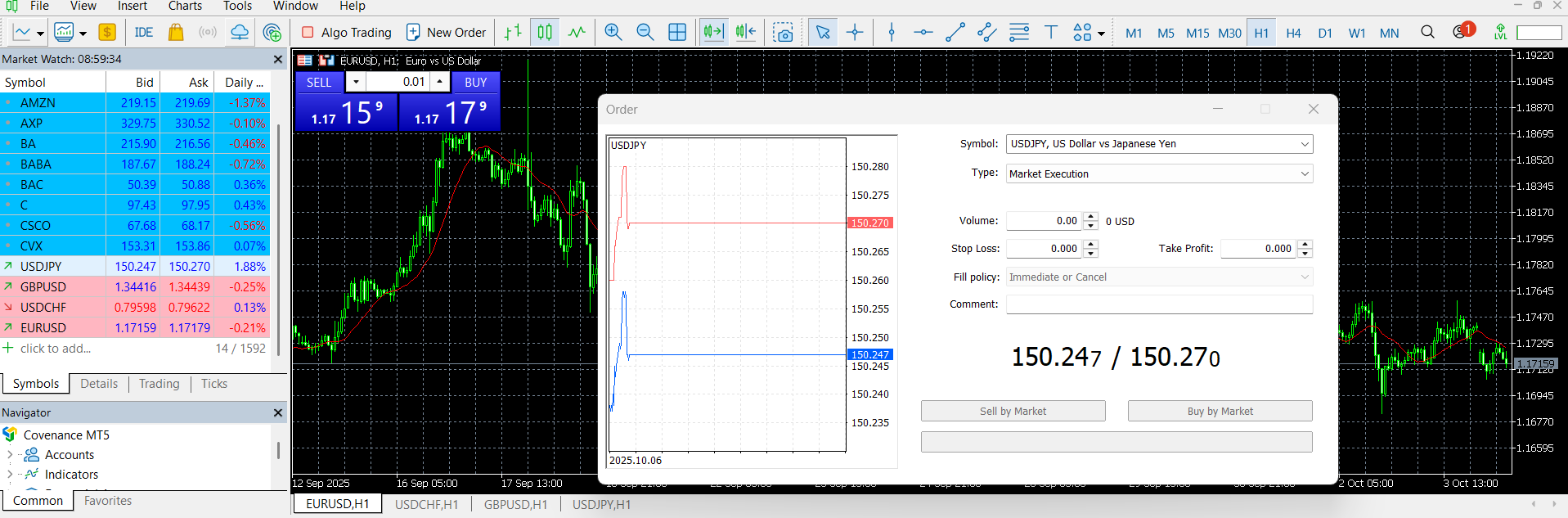
Developed by MetaQuotes, MetaTrader 5 offers a comprehensive toolkit suitable for both manual and automated traders. Covenance’s version of MT5 includes all the core features expected from the platform, yet there is no clear indication of added value—such as enhanced plugins, proprietary analytics, or platform integration—that would differentiate it from the standard MT5 setup.
Key Features Available:
- Multi-Asset Access: Trade across forex, commodities, indices, metals, cryptocurrencies, and more from a single interface.
- Advanced Charting Suite: Access up to 21 timeframes, over 80 built-in indicators, and multiple chart layouts. Users can also develop and integrate their own tools using the MQL5 programming language.
- Depth of Market (DOM): Analyze liquidity and price levels to fine-tune order execution.
- Order Types and Execution: MT5 supports market, limit, stop, and trailing stop orders, as well as both netting and hedging modes (subject to broker policy).
- Expert Advisors (EAs): Full support for algorithmic strategies, automated trading, and backtesting through the built-in strategy tester.
- Social and Copy Trading: Integration with MetaTrader Signals allows traders to follow or replicate other strategies—though results can vary widely and are not independently verified.
Accessibility and Infrastructure
The MT5 platform can be used via desktop, web, and mobile devices, offering cross-platform synchronization for convenience. Covenance also advertises VPS hosting support for traders running automated systems; however, the broker provides limited information regarding its VPS partner, latency levels, or uptime guarantees.
Security-wise, the platform uses encrypted connections and supports two-factor authentication (2FA)—both of which are standard industry practices designed to protect user data and trading accounts.
While MetaTrader 5 remains a solid choice for most retail traders, Covenance’s single-platform approach may feel underwhelming in a market where many brokers offer multiple options or enhanced MT5 integrations. The platform itself is technically capable, but the broker’s lack of innovation or additional tools suggests a basic setup rather than a fully optimized trading environment.
For experienced MT5 users, this might be sufficient. However, traders seeking a more user-friendly or customizable platform experience may find Covenance’s offering somewhat limited in scope.
Covenance Trading Accounts
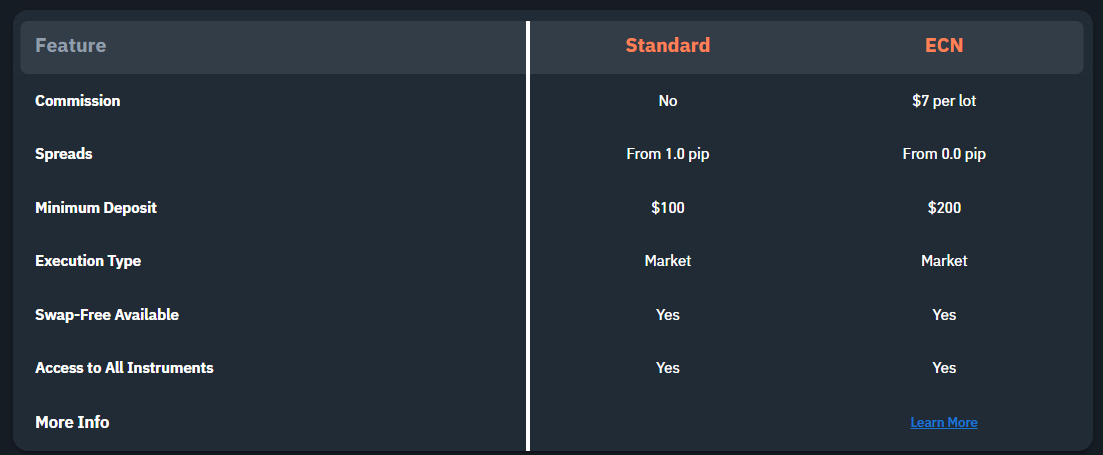
Covenance offers two primary account types designed to suit different trading styles and levels of experience — the Standard Account and the ECN Account. Both accounts operate on the MetaTrader 5 (MT5) platform and provide access to the same range of trading instruments, including forex, commodities, indices, metals, and cryptocurrencies. The main differences lie in pricing structure, execution model, and minimum deposit requirements.
Standard Account – Simplicity for Beginners
The Standard Account is aimed at traders who prefer an all-inclusive pricing model without paying commissions. Spreads start from 1.0 pip, which is reasonable for an offshore broker, though slightly higher than the raw spreads typically offered by ECN accounts. With a minimum deposit of $100, it offers a relatively accessible entry point for new traders or those looking to test the broker’s services before committing larger capital.
This account type is generally suited for:
- Beginners and casual traders.
- Those trading smaller volumes.
- Individuals who prefer simplicity over tight spreads and commission-based pricing.
ECN Account – Tighter Spreads, Professional Setup
The ECN Account caters to more experienced traders who prioritize market execution and access to raw spreads. Spreads begin at 0.0 pips, with a $7 commission per lot (round turn). While the trading conditions are more transparent, the required minimum deposit of $2007 is notably high for an offshore broker, which could deter retail traders looking for flexibility.
This account type is better suited for:
- High-volume or professional traders.
- Those using automated trading systems or scalping strategies.
- Traders who require direct access to tighter pricing and faster execution.
Covenance’s dual-account structure provides basic differentiation between casual and professional traders. However, the unusually high minimum deposit for the ECN option may restrict accessibility, especially considering the broker’s offshore status and lack of top-tier regulatory oversight.
For most users, the Standard Account offers a reasonable starting point, while the ECN Account will appeal only to those comfortable committing larger funds in exchange for potentially better trading conditions.
Covenance Trading Instruments
Covenance gives traders access to a wide selection of CFDs across major global markets, all available through the MetaTrader 5 (MT5) platform. The product range includes both traditional financial instruments and modern digital assets, allowing for diversified trading opportunities.
- Forex – Trade a variety of major, minor, and exotic currency pairs with leverage up to 1:500. The forex market remains the broker’s main focus, offering high liquidity and flexible position sizing.
- Commodities – Includes key commodities such as gold, silver, crude oil, and natural gas, enabling traders to diversify beyond currencies and benefit from macroeconomic trends.
- Indices – Access leading global indices like the S&P 500, NASDAQ, FTSE 100, and DAX, which reflect the performance of major economies and sectors.
- Stocks – Trade CFDs on company shares from global markets, allowing speculation on price movements without owning the underlying assets.
- Cryptocurrencies – Offers popular digital assets such as Bitcoin, Ethereum, and Litecoin, providing exposure to the volatile but rapidly growing crypto market.
While this instrument variety may appear attractive, traders should remember that Covenance operates under offshore regulation with limited investor protection. This means that, despite the broad asset offering, trading with the broker involves elevated risks, particularly concerning fund safety, transparency, and dispute resolution.
In short, Covenance delivers market diversity, but not the level of regulatory security and oversight typically expected from a well-established, licensed broker.
Covenance Trading Conditions
Covenance provides a fairly standard set of trading conditions, with variable spreads, leverage options, and account features aligned with what is typically offered by offshore brokers. However, the absence of core safety measures—such as negative balance protection—should be carefully considered by potential clients.
Spreads
The broker’s spreads depend on the account type selected:
- Standard Account: Spreads start from 1.0 pip, with no added commission.
- ECN Account: Spreads start from 0.0 pips, but a $7 commission per lot (round turn) applies.
While these spreads appear competitive, traders should note that actual trading costs may vary depending on market volatility and liquidity. Since Covenance operates without top-tier regulatory oversight, there is no independent verification of its pricing transparency or execution quality.
Leverage
Covenance offers maximum leverage of up to 1:100 across its trading accounts. This level is considerably lower than what many other offshore brokers advertise but still significantly higher than the limits imposed by major regulators (e.g., 1:30 under ESMA in the EU or 1:50 under the U.S. CFTC).
High leverage can amplify potential profits, but it also increases exposure to rapid losses—particularly in volatile markets such as forex or cryptocurrencies. Since negative balance protection is not provided, traders may end up owing more than their initial deposit if markets move sharply against their positions.
Covenance’s trading conditions—tight spreads, access to leverage up to 1:100, and ECN-style execution—may seem appealing to active traders. However, the lack of negative balance protection, pricing transparency, and regulatory safeguards means that clients bear greater financial risk compared to trading with a fully regulated broker.
Covenance Payment Methods
Covenance’s payment system is limited exclusively to cryptocurrency transactions, which is a significant factor for traders to consider. While crypto payments allow for quick and borderless transfers, the absence of traditional payment options such as bank transfers, credit cards, or regulated e-wallets raises serious concerns about transparency and safety.
Deposits – Crypto Only
The broker allows deposits solely in digital currencies such as USDT (ERC-20) and other unspecified crypto assets. Deposits are processed almost instantly, with no stated fees and a minimum requirement of $30.
Deposit Details:
- Accepted methods: Cryptocurrency only
- Minimum deposit: $30
- Processing time: 1–120 seconds
- Fees: None listed
While instant crypto deposits can be convenient, they also come with limited traceability and no chargeback protection, leaving traders with no recourse if funds are misdirected or withheld.
Withdrawals – Crypto Only
Withdrawals follow the same rule: only cryptocurrency transfers are supported. The broker claims to process requests within 1–120 seconds, using the same wallet address that was used for the initial deposit.
Withdrawal Details:
- Accepted methods: Cryptocurrency only
- Minimum withdrawal: $30
- Processing time: 1–120 seconds
- Fees: None listed
Although fast on paper, crypto-only withdrawals mean traders cannot rely on traditional financial systems for fund recovery or dispute resolution. If the broker refuses or delays a withdrawal, there is no banking institution or regulator to intervene.
The exclusive reliance on cryptocurrencies is a common red flag among offshore brokers, as it often eliminates financial accountability. Reputable brokers typically offer a mix of regulated payment methods — including bank cards, wire transfers, and e-wallets — to ensure verifiable transactions and compliance with anti-money-laundering (AML) standards.
In Covenance’s case, crypto-only payments suggest limited transparency, lack of regulatory oversight, and higher fund recovery risks. Traders should be cautious when depositing, as once crypto funds are sent, they cannot be reversed.
In short, while the payment process may seem fast and easy, it comes at the expense of security, traceability, and client protection.
Covenance Education and Trading Tools
Covenance does not provide any educational resources or trading tools, which is a major drawback — especially for beginners who rely on broker-provided materials to improve their skills and decision-making.
There are no tutorials, webinars, articles, or market analysis available on the broker’s website. Similarly, there are no in-house tools such as economic calendars, trading calculators, sentiment indicators, or risk-management widgets that many reputable brokers typically offer as part of their client support package.
For traders, this means:
- No guidance for beginners to understand the basics of forex or CFD trading.
- No analytical support for market research or strategy development.
- No third-party integrations like Autochartist or Trading Central.
While the MetaTrader 5 (MT5) platform itself includes some built-in analytical tools, these are part of the platform’s default package and not developed or customized by Covenance.
In short, Covenance offers trading access but no trader support infrastructure. Those seeking education, analytical tools, or learning materials will need to rely entirely on external sources — a clear indication that the broker prioritizes trading activity over trader development.
Covenance Bonus
Covenance does not offer any bonuses or promotional programs at this time. There are no deposit bonuses, cashback campaigns, referral rewards, or loyalty programs mentioned on the broker’s website.
While some offshore brokers use aggressive bonus schemes to attract clients, Covenance’s lack of promotions could be seen in two ways: on one hand, it avoids the misleading terms often tied to bonus trading restrictions; on the other, it offers no additional incentives or benefits for traders choosing the platform.
In short, traders should not expect any form of welcome bonus, trading credit, or rebate program when opening an account with Covenance. The broker’s offering focuses solely on direct trading access — without extra financial perks or marketing-driven promotions.
Final Thoughts
Covenance is a newly launched offshore broker that offers access to the MetaTrader 5 platform and a range of CFDs, but little beyond that. Its registration under the Mwali International Services Authority (MISA) in the Comoros Islands provides no real regulatory protection — there’s no fund segregation, negative balance protection, or investor compensation.
While MT5 is a solid platform, Covenance adds no educational content, tools, or value features, and its trading conditions are average at best. The crypto-only payment system is a major red flag, removing transaction transparency and leaving traders without recourse if issues arise.
In short, Covenance provides market access but lacks safety, support, and credibility. Traders looking for a secure, transparent environment will find far better options with properly regulated brokers.
Notes from the author:
Covenance is a textbook example of a broker that looks acceptable on the surface but fails to inspire real trust once examined closely. It delivers the basics — a working MT5 platform, access to popular CFD markets, and straightforward account types — yet lacks the essential components that define a reliable trading environment.
The first red flag is its offshore registration under MISA in the Comoros Islands, which provides little to no regulatory oversight. Unlike brokers licensed by authorities such as CySEC, FCA, or ASIC, Covenance is not required to segregate client funds, conduct regular audits, or participate in investor protection schemes. This absence of accountability means that if something goes wrong, traders have limited or no recourse.
Another concern is the exclusive use of cryptocurrency for deposits and withdrawals. While fast, crypto transactions are irreversible and untraceable — once you send your funds, you rely entirely on the broker’s honesty to get them back. For experienced traders familiar with offshore risk, this might be acceptable, but for most retail clients, it’s a serious drawback.
On the positive side, MT5 is a dependable platform, and Covenance’s spreads and leverage are within a reasonable range. However, the broker provides no educational materials, analysis tools, or support for trader development, which further limits its credibility.
In my view, Covenance is not outright fraudulent, but it is not trustworthy either. It operates in a gray area where traders assume all the risk with minimal protection in return. If you value fund safety, transparent payments, and real regulatory oversight, this broker simply doesn’t meet the mark. There are plenty of well-regulated alternatives that offer the same features — and much stronger peace of mind.


