





ITC Pros Review
Launched in 2025, ITC Pros is a newly established forex and CFD broker that provides access to the popular cTrader platform—an advanced trading terminal favored by many for its intuitive interface and transparent execution. While the platform offering is a notable strength, the broker’s overall proposition appears limited in scope, with a relatively narrow range of tradable assets and no clear indication of robust client protection mechanisms.
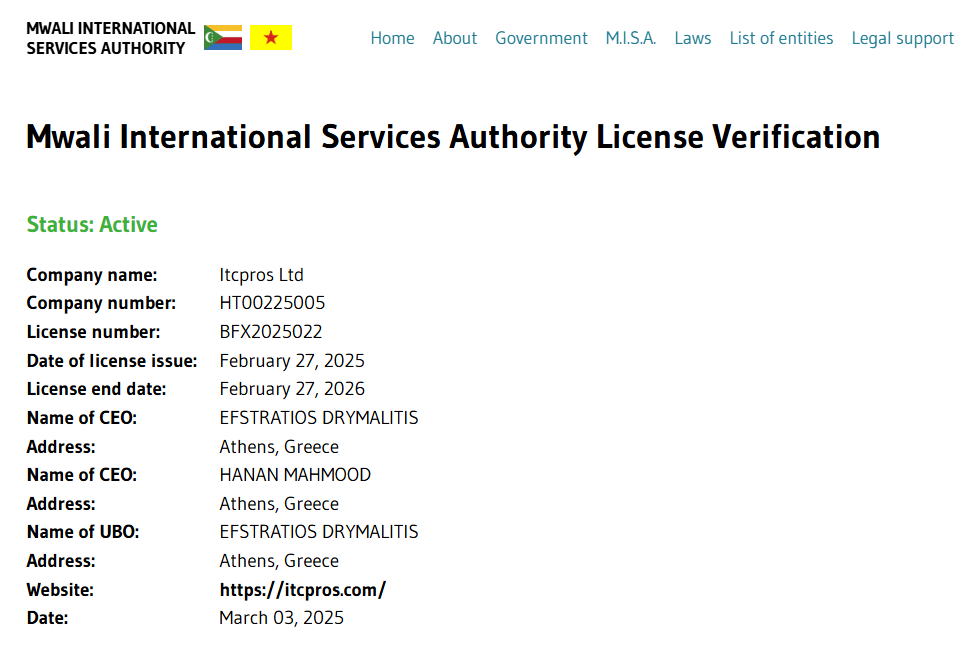
ITC Pros is operated by Itcpros Ltd., a company registered and licensed in Mwali (Comoros Union) under the oversight of the Mwali International Services Authority. Although this offshore jurisdiction enables easier market entry and global client onboarding, it lacks the regulatory rigor and investor safeguards enforced by top-tier financial authorities such as the FCA (UK), ASIC (Australia), or CySEC (Cyprus).
This review takes a critical look at ITC Pros to assess its credibility, trading conditions, platform features, pricing structure, and operational transparency. We examine the broker’s regulatory framework, account types, spreads and commissions, leverage, deposit and withdrawal processes, and overall risk profile—so you can make an informed decision before opening an account.
If you’re considering trading with ITC Pros, read on to understand the key benefits and potential red flags of this offshore broker.
ITC Pros Regulation
ITC Pros is operated by Itcpros Ltd., a company registered in the Comoros Union and licensed by the Mwali International Services Authority (MISA) under license number BFX2025022. While this offshore license technically grants the broker legal permission to offer trading services globally, it does not offer the same degree of regulatory oversight or client protection as licenses issued by tier-1 authorities like the FCA (UK), ASIC (Australia), or CySEC (Cyprus).
What Mwali Regulation Really Entails
The Comoros Union—specifically MISA—has become a popular destination for brokers looking to minimize regulatory constraints. However, this regulatory regime lacks key protective mechanisms:
- No investor compensation scheme is in place to protect client funds in case the broker becomes insolvent.
- No mandatory capital requirements are enforced to ensure the broker’s financial stability.
- Limited supervision means there is no strict requirement for external audits or operational transparency.
- No guarantee of negative balance protection, which could leave traders exposed to losses exceeding their initial deposits.
- Client funds may not be segregated, raising additional questions around fund safety in the event of mismanagement or legal disputes.
While being licensed in Mwali allows ITC Pros to operate globally and offer potentially more flexible trading conditions, this setup leaves traders without many of the safety nets found under stricter regulatory jurisdictions. For those prioritizing fund security, legal protection, or overall broker transparency, the offshore nature of ITC Pros warrants careful consideration.
ITC Pros Trading Platform
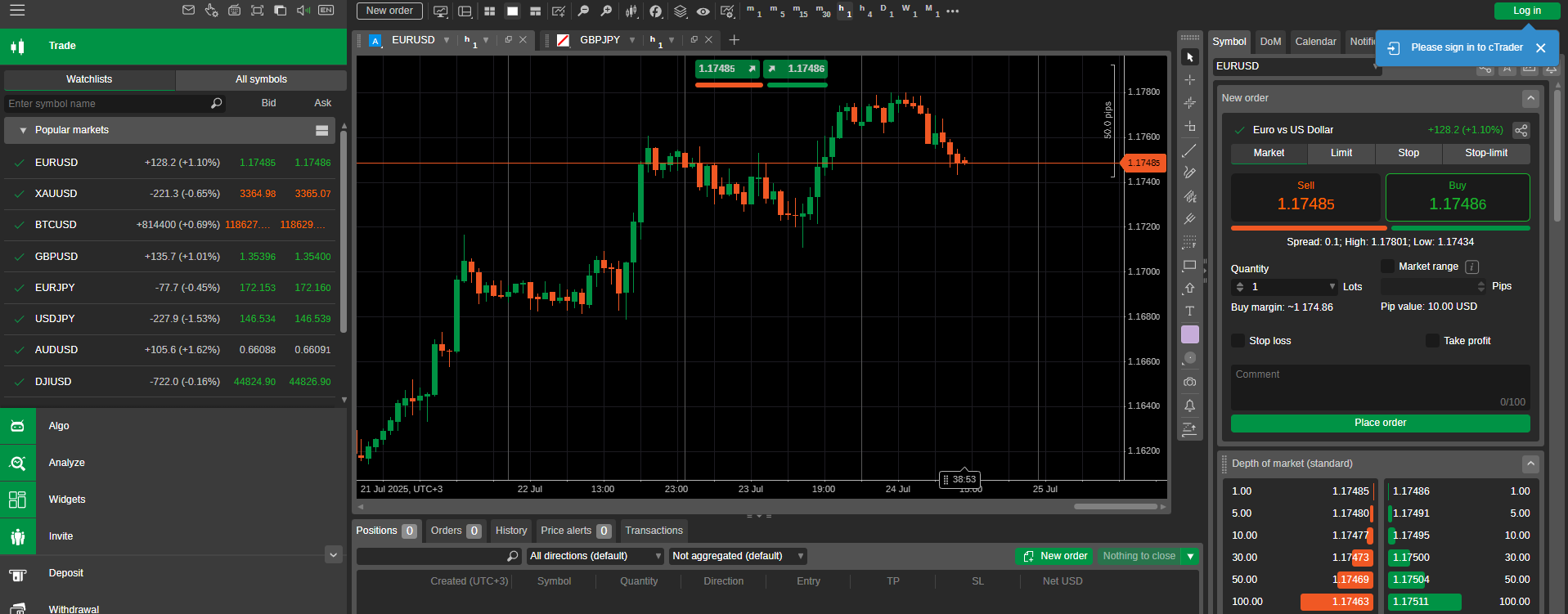
ITC Pros has positioned itself around cTrader, a high-performance trading platform often favored by professional and algorithmic traders. Unlike the more common MetaTrader 4 and 5 platforms offered by most retail brokers, ITC Pros exclusively supports cTrader—suggesting a deliberate appeal to more advanced users who value precision execution, granular charting, and automated strategy development.
cTrader Features at ITC Pros
Available across desktop (Windows), mobile (iOS/Android), and web, cTrader offers a powerful trading environment with:
- Low-latency execution suited for scalping and high-frequency strategies
- Advanced charting with 26 timeframes, 50+ built-in indicators, and multi-chart layouts
- Customizable risk management tools including one-click trading, trailing stops, and SL/TP adjustments
- Algorithmic trading via cTrader Automate, enabling traders to code and test cBots using C#
- Integrated analytics that allow traders to review performance metrics and fine-tune strategies
- Built-in educational resources, providing a smoother onboarding for those new to cTrader
Limitations for MetaTrader Users
While cTrader is a strong platform by industry standards, its exclusivity may alienate users accustomed to MetaTrader. The lack of MT4 or MT5 means traders lose access to a massive library of Expert Advisors (EAs), custom indicators, and third-party integrations built around the MetaTrader ecosystem.
Platform Strength vs. Broker Trustworthiness
It’s worth emphasizing that a sophisticated platform does not necessarily equate to a trustworthy broker. While cTrader offers an excellent technical experience, ITC Pros remains lightly regulated through Mwali—a jurisdiction with minimal investor protection and limited oversight. Traders should not mistake platform capability for institutional-grade safety or transparency.
ITC Pros Trading Accounts
ITC Pros offers a three-tier account structure aimed at different trader profiles—ranging from entry-level participants to experienced and high-volume clients. All accounts require a minimum deposit of $200, a relatively accessible threshold, though not the lowest in the industry.
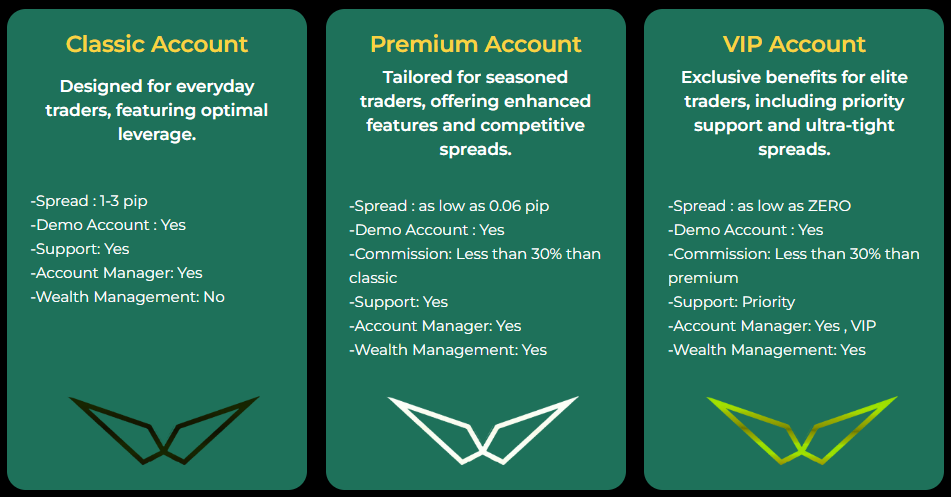
While the account names—Classic, Premium, and VIP—imply a clear progression of features and benefits, the actual distinctions between tiers raise some questions around cost transparency and added value, especially considering the broker’s offshore status.
Classic Account
- Designed as the broker’s standard option, the Classic account caters to general retail traders and offers basic trading conditions.
- Spreads: 1.0 – 3.0 pips (above industry average for standard accounts)
- Commissions: Not specified
- Demo Account: Available
- Support: Standard
- Account Manager: Included
- Wealth Management: Not available
The spread range here is notably wide, and without disclosed commission details or execution quality metrics, it’s difficult to assess overall trading costs accurately.
Premium Account
- Marketed toward more active or experienced traders, the Premium account introduces tighter spreads and access to additional features.
- Spreads: From 0.06 pips
- Commission: Claimed to be “30% lower” than the Classic account—though the exact fee structure remains unclear
- Demo Account: Available
- Support: Standard
- Account Manager: Included
- Wealth Management: Available
The promise of improved conditions is appealing, but again, the lack of transparent commission data limits comparability with other brokers.
VIP Account
- The top-tier offering promises ultra-low spreads and priority service, catering to high-net-worth individuals or institutional-style traders.
- Spreads: As low as 0.0 pips
- Commission: 30% lower than the Premium account
- Demo Account: Available
- Support: Priority access
- Account Manager: Dedicated VIP
- Wealth Management: Included
While the VIP account features sound attractive on paper, there is little public detail on trading volume requirements, actual commission charges, or the criteria for upgrade—raising concerns about account accessibility and cost-effectiveness.
Although ITC Pros offers structured account types and includes desirable features like demo access and account managers, the lack of transparent commission breakdowns, hidden fees, and detailed terms is a red flag—particularly given the broker’s offshore registration and limited regulatory oversight. Traders should seek direct clarification from support before committing capital.
ITC Pros Trading Instruments
ITC Pros provides access to a modest selection of tradable assets across several major classes, allowing clients to diversify their strategies to some extent. While the offering covers the essentials—forex, stocks, commodities, metals, and cryptocurrencies—it falls short of the broad instrument range seen with more established brokers.
Available Asset Classes at ITC Pros:
- Forex: Includes major, minor, and select exotic currency pairs. Forex remains the broker’s core offering, and it’s likely where the most competitive spreads and liquidity reside.
- Stocks: Individual equity CFDs are available, though ITC Pros does not publish a full list of supported tickers or exchanges. It’s unclear whether U.S., European, or Asian equities are included, or if leverage is offered.
- Commodities: Likely includes popular soft and hard commodities such as oil, gas, and agricultural products, but again, no comprehensive list is provided on the website.
- Precious Metals: Trading in gold and silver is likely supported, though further details—such as spreads, leverage, or rollover conditions—are absent.
- Cryptocurrencies: A growing market segment that includes major coins like Bitcoin and Ethereum. However, ITC Pros does not clarify which tokens are supported or how crypto trading is structured (e.g., weekend availability, margin levels).
ITC Pros offers a surface-level multi-asset portfolio, sufficient for basic diversification but lacking the transparency and instrument depth typically found at top-tier brokers. The absence of a publicly available asset list or detailed specifications limits traders’ ability to evaluate risk, cost, and opportunity before signing up.
Until more clarity is provided, traders should assume that while major markets are likely covered, niche assets, advanced products (e.g., ETFs, bonds), or region-specific equities may be unavailable. This is yet another reason to approach ITC Pros with caution—particularly if you’re seeking broader exposure or more specialized trading strategies.
ITC Pros Trading Conditions
ITC Pros offers trading conditions that, on the surface, appear competitive—particularly for higher-tier account holders. However, when examined closely, several red flags emerge, particularly around risk management and transparency.
Spreads by Account Type
The broker provides a tiered spread structure across its three account types:
- Classic Account: Spreads range between 1 to 3 pips, which is relatively wide and less suitable for active or short-term traders.
- Premium Account: Advertised spreads start from 0.6 pips, offering a noticeable improvement. However, this account comes with commission fees—though the broker vaguely claims these are 30% lower than on the Classic account.
- VIP Account: Marketed with spreads from 0.0 pips, making it the most cost-effective in theory. Again, commissions apply but are said to be lower than on the Premium account.
The exact commission structure isn’t disclosed on the website, leaving traders without clear cost expectations. This lack of transparency is concerning, especially for a broker operating offshore.
Leverage
ITC Pros offers leverage of up to 1:200, significantly above the limits imposed by regulators in the EU (1:30), UK (1:30), and Australia (1:30). While higher leverage can amplify profits, it also magnifies risk, particularly for inexperienced traders.
What’s especially troubling is the absence of negative balance protection—a safeguard common among regulated brokers. Without it, clients may lose more than their initial deposit in volatile market conditions.
While ITC Pros advertises tight spreads and generous leverage, the tradeoff is reduced client protection and unclear fee structures. For serious traders, particularly those outside the VIP tier, these conditions demand careful consideration and robust risk management.
Unless the broker clarifies its commission model and implements basic safeguards like negative balance protection, traders should remain cautious—especially given the offshore regulatory environment.
ITC Pros Paymetn Methods
ITC Pros supports a range of standard deposit and withdrawal methods, including:
- Credit/Debit Cards
- Bank Wire Transfers
- Cryptocurrencies
While the availability of crypto deposits may appeal to some traders seeking speed and privacy, this feature is also commonly associated with offshore brokers operating in loosely regulated environments—raising concerns about traceability and fund recovery in the event of disputes.
Fees and Processing Times
No fees are advertised for deposits or withdrawals, which sounds appealing on paper. Additionally, the broker claims to cover all bank wire transfer fees for transactions over $200.
Withdrawal requests are said to be processed “instantly” by the broker’s Back Office System, with funds typically arriving same day or within 2 to 5 business days, depending on the method and banking institution.
While these timeframes are fairly standard across the industry, there is no independent verification or third-party audit of ITC Pros’ processing practices—another caveat when dealing with offshore entities.
A Word of Caution
Despite the seemingly smooth payment infrastructure, we strongly advise against depositing funds with ITC Pros. The broker lacks reliable regulatory oversight, does not offer basic client protections like fund segregation, and presents numerous red flags in terms of operational transparency.
While ITC Pros offers fast, fee-free transactions through familiar channels, payment convenience should not be mistaken for broker credibility. With no external regulation to hold the broker accountable, traders face real risks that cannot be offset by same-day withdrawals or waived fees.
ITC Pros Education and trading tools
ITC Pros offers a modest educational section aimed at beginners, featuring surface-level material across several topics:
- Forex Basics
- Cryptocurrency Markets
- Fund Management Principles
- Trading Academy Modules
While the content may help newcomers understand basic terminology and concepts, it falls short of offering a structured learning path or actionable trading strategies. There’s no indication of expert-led webinars, real-time coaching, or in-depth market research—features typically expected from more established and trusted brokers.
Trading Tools: Copy Trading & Automation Features
The broker promotes a range of trading tools designed to attract different types of users:
- Automated Trading: Supports algorithmic strategies, likely through its cTrader Automate interface.
- Copy Trading: Allows less experienced traders to replicate the strategies of more seasoned users.
- Falcon Bot: An in-house branded solution, though no technical details or track record are provided, raising questions about its reliability and transparency.
- PAMM/MAM Accounts: Passive investment options that delegate trade execution to a money manager—popular among offshore brokers but often lacking the regulatory safeguards found in licensed asset management environments.
While ITC Pros makes an effort to offer a mix of trading tools and beginner-level educational content, the quality and credibility of these resources remain unverified. Tools like Falcon Bot and PAMM/MAM accounts are common with offshore brokers, and often marketed without sufficient oversight or transparency. Traders should approach these features with caution and avoid relying solely on them without fully understanding the risks involved—especially when the broker itself operates under a light-touch offshore license.
ITC Pros Bonus
Currently, ITC Pros does not provide any bonuses, promotions, or special offers to its clients. Unlike many brokers who use welcome bonuses, deposit matches, or trading contests to attract and retain traders, ITC Pros has chosen not to offer such incentives at this time. While the absence of bonuses can be seen as a positive from a transparency and fairness perspective—avoiding complicated terms and conditions tied to bonus usage—it also means traders do not receive any extra capital or trading credits to boost their initial deposits or trading activity.
For traders, especially beginners who often rely on broker bonuses to extend their trading runway, the lack of promotional offers may be a downside. It also means ITC Pros competes solely on its trading conditions, platform features, and service quality, rather than through marketing incentives.
Given ITC Pros’s offshore regulatory status and other risk factors outlined in this review, the absence of bonuses neither adds nor detracts significantly from the overall trading proposition, but it does reflect a conservative approach to client acquisition.
Final Thoughts
Launched in 2025, ITC Pros presents itself as a modern forex and CFD broker centered around the advanced cTrader platform, which is a definite strength for traders seeking speed, flexibility, and professional-grade tools. The broker’s tiered account offerings provide options for different trading styles, and its range of tradable assets covers the basics across forex, stocks, commodities, metals, and cryptocurrencies.
However, the overall proposition comes with notable caveats. ITC Pros operates under an offshore license from the Mwali International Services Authority in the Comoros Union, a jurisdiction known for its minimal regulatory oversight and limited investor protections. This means the broker does not offer standard safeguards such as client fund segregation, negative balance protection, or participation in compensation schemes common with regulated brokers. The lack of transparent commission structures, vague asset lists, and inconsistent disclosures further contribute to an opaque trading environment.
While ITC Pros offers competitive spreads—especially in its higher-tier accounts—and a technologically sophisticated platform, these positives do not fully offset the risks tied to its regulatory status and operational transparency. Traders considering ITC Pros should weigh the convenience of its features against the broker’s limited credibility and the inherent risks of dealing with a lightly regulated offshore entity.
In summary, ITC Pros might appeal to traders attracted to cTrader’s capabilities and flexible trading conditions, but it remains a high-risk choice better suited to those with experience and a strong risk tolerance. For traders prioritizing security, reliability, and comprehensive client protections, more established brokers regulated by top-tier authorities are advisable.
Notes from the author:
On paper, the broker brings some appealing elements to the table—most notably its exclusive use of the cTrader platform, which is respected among advanced traders for its speed, precision, and extensive functionality. The tiered account structure also shows an attempt to cater to different trader profiles, from beginners to high-volume clients.
However, the positives are overshadowed by significant concerns, primarily related to the broker’s regulatory standing and overall transparency. ITC Pros is licensed in the Comoros Union, a jurisdiction known for its light regulatory touch and lack of investor protections. This means clients are exposed to greater risks, including no negative balance protection, no segregation of funds, and no investor compensation scheme—safety nets that most traders expect and rely on from brokers regulated by tier-1 authorities.
Furthermore, the broker’s opaque fee structure makes it difficult for traders to accurately calculate trading costs. Spread information is provided, but commissions remain vague, which can mask the true expenses of trading, especially for active traders who must manage every pip and dollar carefully.
The limited asset selection and absence of MetaTrader platforms may also restrict some traders who prefer broader market access or who rely on the extensive third-party tools available in the MetaTrader ecosystem. While the educational materials and trading tools like copy trading and PAMM accounts offer some value, their effectiveness is hard to verify without transparent performance data.
In conclusion, while ITC Pros might suit certain traders looking for an offshore broker with cTrader access, it falls short on critical aspects of security, transparency, and regulatory assurance. For traders serious about protecting their capital and ensuring fair treatment, I would recommend seeking brokers with stronger regulation and clearer operational standards. Caution and thorough due diligence are essential before engaging with ITC Pros.


