





NTW Markets Review
NTW Markets is a recent entrant to the online forex and CFD trading space, operated by NTW Markets Ltd., a company registered in Saint Lucia. This Caribbean jurisdiction is widely regarded as an offshore zone, offering very limited regulatory oversight compared to top-tier financial hubs.
The broker provides access to the popular MetaTrader 5 (MT5) platform, along with a diverse selection of tradable instruments such as forex currency pairs, global indices, commodities, individual shares, and precious metals. On the surface, its marketing emphasizes flexibility, broad market coverage, and a modern trading experience.
However, the lack of strong regulation and the offshore registration raise important caution flags. For newer traders in particular, the potential risks tied to weaker client protections and oversight should be weighed carefully before committing funds.
NTW Markets Regulation
NTW Markets Ltd. is the company behind the NTW Markets brand, holding Company Registration Number 2025-00138 and based at Top Floor, Rodney Court Building, Rodney Village, Rodney Bay, Gros-Islet, Saint Lucia. While this registration may sound official, it does not mean the broker is subject to robust regulation or strong investor safeguards.

The Reality of Saint Lucia Registration
Saint Lucia has become a common base for offshore forex and CFD brokers because it offers minimal licensing requirements and very light oversight. Setting up a brokerage there is fast, inexpensive, and far less demanding than operating under a top-tier regulator’s watch.
For traders, this ease of entry for brokers comes with significant drawbacks:
- No investor compensation scheme – If NTW Markets became insolvent, clients would have no guaranteed reimbursement, unlike in the UK or EU.
- No independent dispute resolution – Withdrawal disputes or account issues would have to be resolved directly with the broker, with limited legal recourse.
- No transparency obligations – The broker is not required to publish audited financial reports or disclose operational practices.
- No capital adequacy oversight – There is no authority confirming the broker maintains sufficient liquidity to cover client obligations in extreme market events.
How This Compares to Top-Tier Oversight
Regulators such as the UK’s FCA, Australia’s ASIC, or Cyprus’s CySEC enforce strict rules to protect clients, including:
- Mandatory segregation of client funds in Tier-1 bank accounts
- Compensation schemes (e.g., FSCS in the UK up to £85,000)
- Guaranteed negative balance protection
- Regular audits, compliance checks, and public reporting
- Heavy penalties for misconduct and proactive enforcement
These measures provide a level of accountability that simply does not exist in Saint Lucia, where enforcement is minimal and penalties are often weak.
Claimed Protections – But No Independent Verification
NTW Markets claims to offer segregated client accounts and negative balance protection. However, because the broker operates under an offshore jurisdiction with no strong regulator to enforce these policies, traders are relying solely on the company’s internal commitment. If the broker chose to change or ignore these safeguards, there would be no external authority to intervene.
While NTW Markets advertises certain client protections, their offshore registration means these promises are not legally binding or externally verified. Traders looking for genuine security should consider brokers regulated by top-tier authorities where such measures are mandatory and enforceable.
NTW Markets Trading Platform
NTW Markets gives clients access to MetaTrader 5 (MT5), a powerful and widely respected multi-asset trading platform. Known for its depth of features, MT5 caters to experienced traders who rely on technical analysis, complex order types, and automated strategies. While the platform itself is industry-leading, it’s important to remember that having a good trading tool doesn’t offset the risks tied to NTW Markets’ offshore status and lack of strong regulatory oversight.
For newcomers, MT5 may also feel overwhelming. Without broker-provided training materials or a simplified interface, the steep learning curve could be a challenge—especially for traders who may already be taking on added risk by dealing with an unregulated offshore entity.
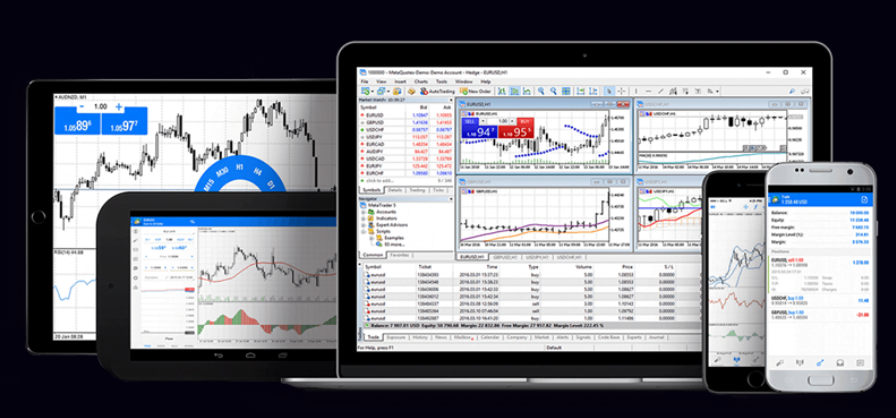
MT5 Access with NTW Markets
- MT5 Desktop (Windows) – Full feature set, ideal for Expert Advisors (EAs), advanced charting, backtesting, and multi-monitor workspaces.
- MT5 Web Terminal – Browser-based trading without downloads, suitable for quick position checks and order placement.
- MT5 Mobile (iOS & Android) – On-the-go access with streamlined execution and basic risk management tools.
MT5 Features Available
- 21 chart timeframes and over 80 built-in indicators
- Depth of Market (DOM) and one-click execution
- Hedging and netting modes supported
- Automated trading via MQL5 scripting
- Six types of pending orders
- Built-in economic calendar and news feed
NTW Markets Copy Trading – Convenience with Caution
The broker also offers Copy Trading, letting users replicate trades from selected signal providers. While this can be appealing to those lacking time or expertise, in an offshore setting it comes with its own risks—primarily around the reliability of strategies and the absence of strong dispute resolution if something goes wrong.
How it works:
- Create an Account – Register with NTW Markets.
- Choose Traders to Follow – Select signal providers from the Copy Trading list.
- Fund Your Account – Minimum $100 deposit required.
- Monitor & Adjust – Track performance and make changes when necessary.
MT5’s capabilities are well-established, but traders should not confuse platform quality with broker safety. With NTW Markets’ offshore registration and minimal protections, the real question isn’t whether MT5 works—it’s whether you’re comfortable using it under these conditions.
NTW Markets Trading Accounts
NTW Markets offers three live account types—Standard, VIP, and Corporate—all providing access to the same range of instruments, including forex majors, crosses, and minors, spot metals, CFDs on indices, and individual shares. While the tiered structure may look flexible, the differences mainly come down to minimum deposit requirements, leverage limits, and spreads.
It’s important to remember that these account conditions are offered by an offshore-registered broker with minimal oversight, meaning there’s no guarantee the terms will remain consistent or that disputes will be handled by an independent authority.
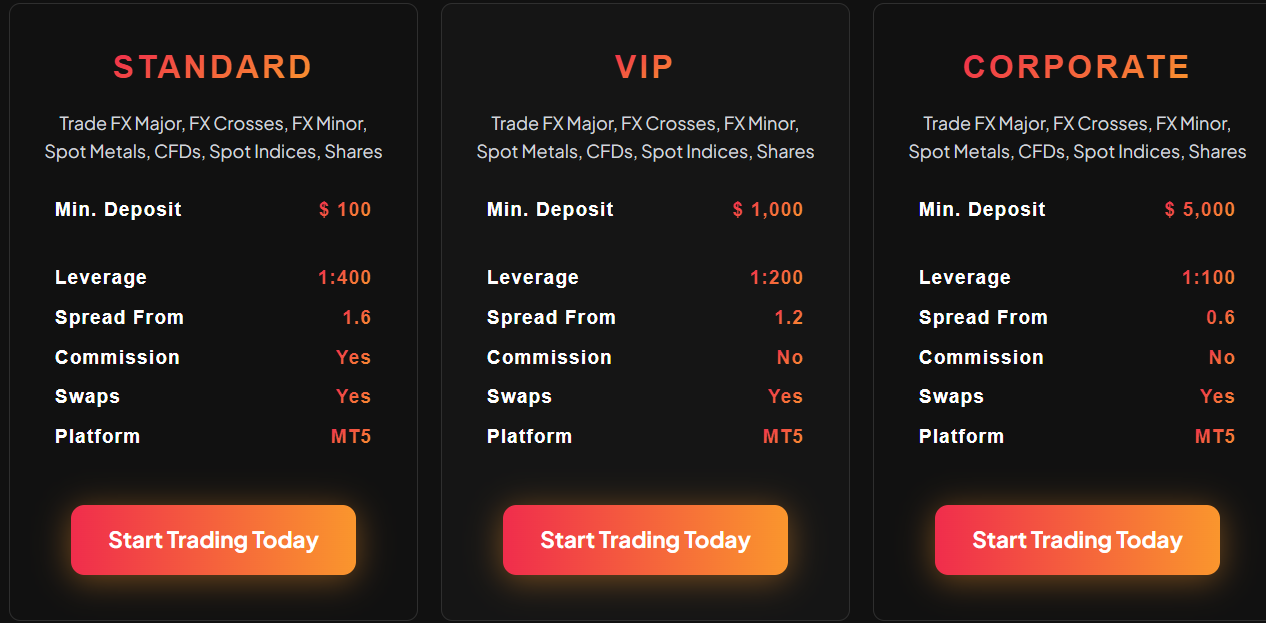
Standard Account
- Minimum Deposit: $100
- Leverage: Up to 1:400
- Spreads: From 1.6 pips
- Commission: Yes
- Swaps: Applicable
- Platform: MT5
The Standard account’s high leverage is tempting for small-capital traders but comes with significant risk—especially without strong regulatory protections in place.
VIP Account
- Minimum Deposit: $1,000
- Leverage: Up to 1:200
- Spreads: From 1.2 pips
- Commission: None
- Swaps: Applicable
- Platform: MT5
Lower spreads and no commission may appeal to more active traders, but the reduced leverage doesn’t fully offset the risks tied to trading with an unregulated offshore entity.
Corporate Account
- Minimum Deposit: $5,000
- Leverage: Up to 1:100
- Spreads: From 0.6 pips
- Commission: None
- Swaps: Applicable
- Platform: MT5
This account targets higher-value traders with tighter spreads, yet the lack of safeguards such as segregated accounts and negative balance protection remains a key concern—particularly when larger deposits are at stake.
While NTW Markets’ account types cater to different budgets and trading styles, the offshore regulatory setup means traders are ultimately relying on the broker’s internal policies rather than enforceable, third-party protections. For many, that will be too big a risk, regardless of the account tier.
NTW Markets Trading Instruments
NTW Markets advertises a reasonably diverse portfolio of instruments, covering several major asset classes. Clients can trade via CFDs on forex, commodities, indices, metals, and shares, all through the MT5 platform. While the variety is competitive on paper, it’s important to remember that trading these products with an offshore-registered, lightly regulated broker comes with higher operational and counterparty risks.
Forex
Over 40 currency pairs are available, spanning major, cross, and exotic pairs. This gives traders access to both liquid, widely traded markets and more volatile, niche instruments. However, exotic pairs—while offering larger price swings—can also have wider spreads and less predictable execution, particularly in an offshore environment.
Commodities
Clients can trade CFDs on popular commodities, enabling speculation on price movements in markets like energy products and agricultural goods. As with all CFD trading, there is no physical ownership—profits and losses come solely from price changes.
Indices
NTW Markets lists well-known global indices such as the NASDAQ, Dow Jones, and S&P 500, allowing traders to take positions on broad market performance rather than individual stocks.
Metals
Precious metals, including gold and silver, are available for those seeking alternative market exposure or safe-haven trading strategies. These assets often react strongly to macroeconomic events, making them appealing for both short-term speculation and longer-term hedging.
Shares
The broker offers CFDs on shares from major global companies. While this provides access to high-profile brands, it’s worth noting that trading share CFDs offshore means no entitlement to shareholder rights or dividends—only speculative exposure to price movements.
The instrument list at NTW Markets is fairly standard and versatile, but the key issue isn’t what’s on offer—it’s where and how those trades are executed. With no strong regulatory backing, the quality of trade execution, liquidity, and fund safety ultimately depends on the broker’s internal practices rather than enforceable standards.
NTW Markets Trading Conditions
NTW Markets’ trading conditions differ by account type, with variations in spreads, commissions, and leverage. On paper, the numbers appear competitive, but the broker’s offshore registration and the absence of enforceable safeguards mean traders should approach these terms with caution.
Spreads and Commissions
The Standard account starts from 1.6 pips and charges a commission on trades. The VIP account lowers spreads to 1.2 pips and removes commissions, while the Corporate account offers spreads from 0.6 pips commission-free. While tighter spreads and no commissions may seem attractive, in an unregulated offshore setup there’s no guarantee of transparent pricing or fair execution.
Leverage – A Double-Edged Sword
- Standard: Up to 1:400
- VIP: Up to 1:200
- Corporate: Up to 1:100
High leverage can magnify potential profits, but it also increases the speed and scale of losses. At 1:400, even a small market movement can wipe out an account in seconds.
NTW Markets claims to offer negative balance protection, which in theory would prevent traders from owing the broker money if losses exceed the account balance. However, because the broker operates from an offshore jurisdiction with minimal oversight, there is no regulatory mechanism ensuring this promise is honored. In contrast, top-tier regulators in the EU, UK, and Australia legally require such protection and actively enforce it.
While NTW Markets’ spreads and commission-free options may look appealing, pairing aggressive leverage with a non-binding promise of negative balance protection creates a high-risk environment—particularly for inexperienced traders. Without strong, enforceable regulation, all protections ultimately depend on the broker’s own policies, which can change without notice.
NTW Markets Payment Methods
NTW Markets supports several deposit and withdrawal methods, including bank transfers, e-wallets, credit and debit cards, and cryptocurrencies such as Bitcoin. The broker advertises zero commission fees for all transactions, but in an offshore, lightly regulated setup, the real issue isn’t the cost—it’s the reliability and security of your funds.
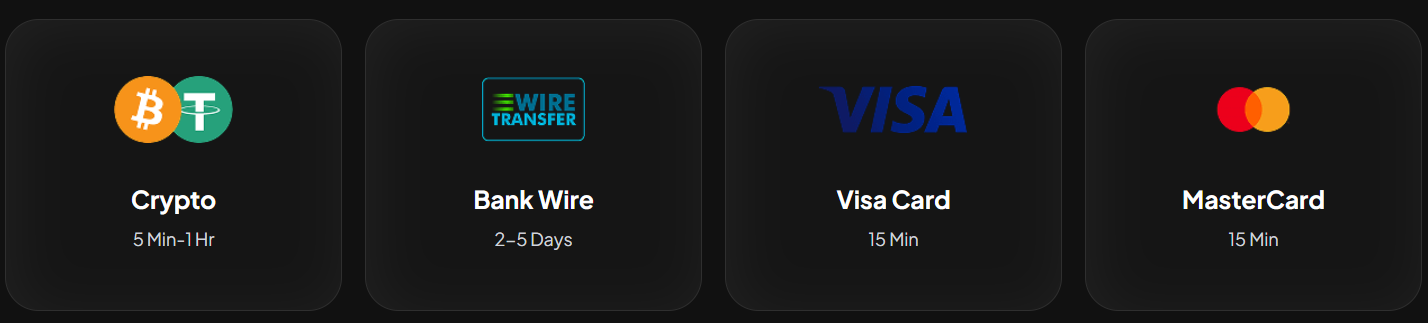
For deposits, minimum amounts vary depending on the method. Bank transfers start from $250 and can take up to 24 hours to process, while e-wallets require as little as $100 and are usually credited within one to three hours. Bitcoin deposits require at least 0.0020 BTC, with processing times between one and six hours. Card payments and other crypto methods also have a $100 minimum and similar timeframes. Larger bank transfers of $5,000 or more can take up to five days to clear.
Withdrawals follow the same structure, with bank transfers starting from $250 and taking up to 24 hours, e-wallets from $100 within one to three hours, and crypto withdrawals processed in one to six hours. High-value bank withdrawals of $5,000 or more can take up to five days.
While the timelines sound reasonable, the use of “up to” in all estimated processing times is worth noting. In offshore environments, these estimates are not always met, and delays—especially for withdrawals—are one of the most common complaints traders have about unregulated brokers.
Another concern is the lack of third-party oversight. With no regulator enforcing payout obligations, traders are entirely dependent on NTW Markets’ internal policies. This is especially risky when using cryptocurrencies, as these transactions are irreversible—once sent, they cannot be recovered if a dispute arises.
NTW Markets offers a decent variety of payment options and no transaction fees, but without strong regulation or investor protection schemes, there is no guarantee you’ll get your money back quickly—or at all—if problems occur.
NTW Markets Education and Trading Tools
When it comes to trader education, NTW Markets offers no structured learning materials. There are no tutorials, webinars, market analysis updates, or step-by-step guides for beginners. For a broker claiming to serve a wide range of traders, this absence is notable—especially since the platform offered (MT5) can be complex for newcomers without prior trading experience or guidance.
In terms of tools, NTW Markets provides two additional features: PAMM accounts and copy trading.
- PAMM Accounts – Allow traders to allocate funds to experienced money managers, whose trades are then executed across all linked accounts proportionally. While this can be appealing for passive investors, the lack of regulatory oversight means there’s no guarantee on strategy quality, performance reporting, or fund safety.
- Copy Trading – Lets clients replicate the trades of chosen signal providers. Although convenient, success depends entirely on the selected trader’s performance, and in an offshore environment, there’s no third-party verification of track records.
NTW Markets’ toolkit is minimal—there’s no educational support to help beginners learn, and while PAMM and copy trading offer potential shortcuts, they also carry significant risks when used through an unregulated, offshore broker.
NTW Markets Bonus
At present, NTW Markets does not offer any deposit bonuses, promotional credits, or trading incentives. While some offshore brokers use aggressive bonus schemes to attract clients—often with restrictive withdrawal conditions—NTW Markets has chosen not to provide such offers.
On one hand, this avoids the common issue of bonus-related turnover requirements that can trap traders’ funds. On the other, it means there are no additional incentives or value-added promotions to offset the risks of trading with an offshore, lightly regulated broker.
The absence of bonuses removes one layer of potential restriction, but it also means traders are relying solely on the broker’s core trading conditions—without any extra perks to sweeten the deal.
Final Thoughts
NTW Markets positions itself as a modern, MT5-powered broker with a reasonable range of tradable assets and account types. On paper, its spreads, leverage options, and additional tools like PAMM accounts and copy trading might appeal to a variety of traders.
However, the core issue lies not in the features offered, but in where and how this broker operates. Being registered in Saint Lucia means NTW Markets is not subject to the strict compliance, client fund protections, and transparent oversight found under top-tier regulators like the FCA, ASIC, or CySEC. While the company claims to segregate client funds and provide negative balance protection, these promises are not backed by any enforceable legal framework—leaving traders to rely solely on the broker’s internal policies.
The combination of high leverage, unverified client safeguards, lack of educational support, and absence of independent dispute resolution makes the overall risk profile significant. For inexperienced traders, these risks are amplified, as offshore brokers can change terms, delay withdrawals, or cease operations with little recourse for clients.
NTW Markets may offer the tools to trade, but it does not offer the regulatory security that serious traders should demand. Those seeking genuine protection, transparent execution, and enforceable client rights would be better served by a broker regulated in a reputable financial jurisdiction.
Notes from the author:
From my perspective, NTW Markets sits firmly in the “high-risk” category of brokers. On the surface, it checks some appealing boxes—MT5 access, a decent range of instruments, multiple account types, and extra features like PAMM accounts and copy trading. For a trader scanning through broker websites, these might seem like signs of a well-rounded offering.
But dig deeper, and the cracks become obvious. The offshore registration in Saint Lucia is the first red flag. This jurisdiction simply doesn’t have the kind of oversight, investor compensation schemes, or strict operational rules you find with top-tier regulators. NTW Markets does claim to segregate client funds and offer negative balance protection, but without regulatory enforcement, these remain promises rather than binding guarantees. In other words, you’re trusting the broker’s word—and in trading, that’s not the kind of risk management most professionals are comfortable with.
The high leverage of up to 1:400 is another double-edged sword. It can supercharge returns, but in volatile markets, it’s just as likely to accelerate losses. Without strong, enforceable safeguards, a bad day could leave a trader in a worse position than they started.
The lack of structured educational content is also telling. Brokers who genuinely want to support long-term trader success usually invest in client education. Here, the absence of such resources feels like a missed opportunity—or perhaps a deliberate omission.
Overall, NTW Markets might work for an experienced trader who understands the risks of trading with an offshore broker and is prepared to treat any funds deposited as fully at risk. For anyone else—especially newer traders—there are far safer options among brokers regulated in jurisdictions that actually enforce client protections and transparent practices.


