





OnsaFX Review
OnsaFX is a newly established forex and CFD broker based in South Africa, regulated by the country’s Financial Sector Conduct Authority (FSCA). This registration gives the company a degree of legitimacy in its home market, but traders should be aware that FSCA oversight does not carry the same weight as regulation from top-tier authorities like the FCA in the UK, ASIC in Australia, or CySEC in the EU. While the FSCA does enforce conduct rules and offers local dispute channels, it does not require brokers to maintain the same high capital reserves or provide statutory compensation schemes that traders enjoy under stricter jurisdictions.
The broker promotes a modern trading experience through the MetaTrader 5 (MT5) platform, paired with access to a reasonably broad selection of markets. Clients can trade forex, commodities, indices, shares, and even the broker’s recently introduced ETF CFDs, giving both beginners and experienced traders opportunities to diversify their portfolios within a single platform.
In this review, we’ll examine how OnsaFX measures up in terms of regulation, trading platforms, account conditions, deposits and withdrawals, and overall trustworthiness. The real question is whether its FSCA license and MT5 offering provide enough assurance for safety and fair trading, or if traders may find stronger protections with brokers regulated in top-tier jurisdictions.
OnsaFX Regulation
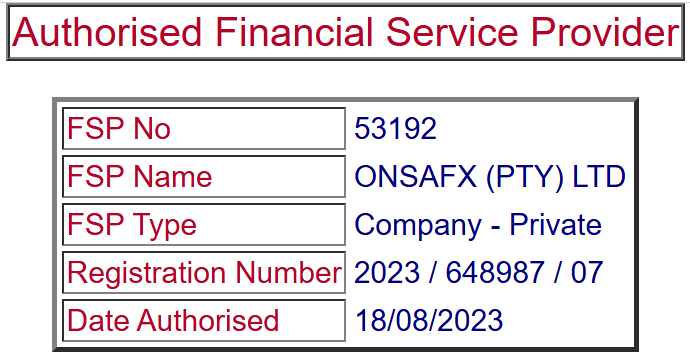
OnsaFX operates under the authorization of the Financial Sector Conduct Authority (FSCA) of South Africa, holding FSP Licence No. 53192. This licence grants the broker a formal legal presence in its home market and subjects it to local conduct requirements, including anti-money-laundering (AML) obligations and periodic reporting. While this provides a degree of oversight, traders should note that FSCA standards are less demanding than those enforced by tier-one regulators such as the FCA (UK), ASIC (Australia), or CySEC (EU).
Fund Security
The broker states that client deposits are kept in separate trust accounts. However, under FSCA rules there is no obligation for independent audits to confirm segregation, meaning traders rely heavily on the broker’s internal assurances. This is a weaker safeguard compared with stricter jurisdictions where segregation is verified by external regulators.
No Investor Compensation Scheme
Unlike the FCA’s Financial Services Compensation Scheme in the UK (up to £85,000 per client) or the EU’s Investor Compensation Fund (up to €20,000), South Africa has no statutory compensation program for retail traders. If OnsaFX were to become insolvent, clients would have no government-backed guarantee and recovery would depend solely on the broker’s balance sheet.
Leverage and Capital Standards
Because the FSCA does not impose retail leverage caps, OnsaFX is able to offer exposure as high as 1:500. While this may appeal to experienced traders, such high ratios also accelerate losses and can wipe out accounts quickly. Additionally, South Africa’s minimum capital requirements for brokers are modest compared to ASIC’s A$1 million threshold, leaving less of a financial buffer against extreme market volatility.
Optional Safeguards and Promotions
Although not legally required by the FSCA, OnsaFX states that it provides negative balance protection and segregated accounts. These measures, if applied consistently, help reduce risk, though their voluntary nature means enforcement ultimately rests with the broker itself. The FSCA also permits brokers to offer trading bonuses, and OnsaFX may run such promotions, though traders should be cautious of volume-linked conditions that can encourage excessive risk-taking.
FinCEN Registration – Added AML Oversight
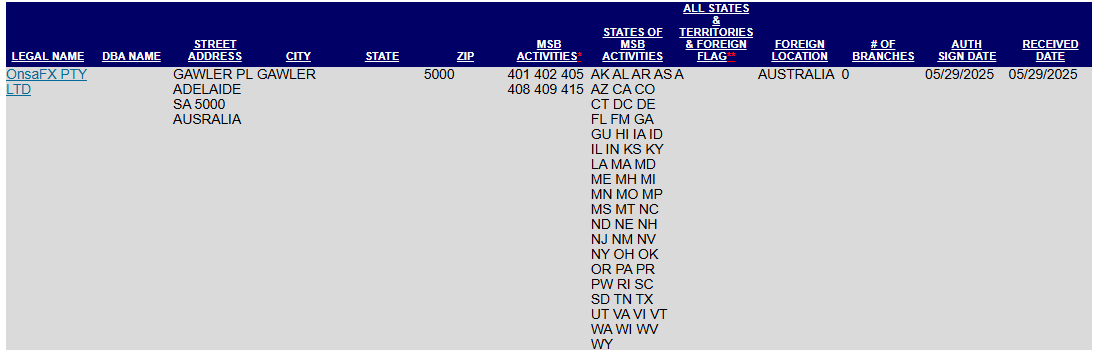
In addition to its FSCA licence, OnsaFX PTY LTD is registered with the Financial Crimes Enforcement Network (FinCEN) in the United States as a Money Services Business (MSB), under MSB Registration No. 31000301383062. This registration requires compliance with the U.S. Bank Secrecy Act (BSA), including obligations for record-keeping, customer identity verification, suspicious activity reporting, and currency transaction monitoring. While this strengthens OnsaFX’s AML and transparency framework, it does not extend the kind of retail investor protections seen under top-tier financial regulators.
OnsaFX combines local FSCA licensing with U.S. FinCEN MSB registration, giving it a stronger regulatory profile than many offshore-only brokers. However, the absence of compensation schemes, capital adequacy standards, and mandatory fund audits means traders still face more risk than they would under FCA, ASIC, or CySEC supervision. For those seeking maximum security, a broker with dual or multi-jurisdictional top-tier licenses remains the safer choice.
OnsaFX Trading Platform
OnsaFX delivers its trading services through MetaTrader 5 (MT5), the most widely adopted multi-asset platform in the retail trading space. By offering MT5 across desktop, web, and mobile, the broker provides traders with a familiar environment that supports everything from fast execution to advanced charting. Having a single login across all devices ensures continuity, making it easy to manage positions whether you’re at your desk or on the go.
Key MT5 Features at OnsaFX
- Advanced charting and analytics – More than 38 built-in indicators, 44 drawing tools, and 21 timeframes, giving traders the ability to adapt strategies from short-term scalping to long-term analysis.
- Depth of Market (DOM) – A live order book view that helps refine entries and exits by showing available liquidity in real time.
- Algorithmic trading – Support for Expert Advisors (EAs), backtesting, and optimization through the powerful MQL5 programming language.
- Comprehensive order types – Market, limit, stop, stop-limit, and trailing orders, with both hedging and netting modes available depending on strategy.
- Cross-device integration – Desktop terminals for Windows and macOS, a web-based version, plus mobile apps for iOS and Android, all synchronized for seamless trading.
There’s no question that MT5 is a robust, feature-rich trading platform and a welcome inclusion at OnsaFX. However, traders should keep in mind that platform quality does not equal broker reliability. While MT5 gives you the tools to analyze markets and execute trades effectively, the safety of your funds still depends on the broker’s regulatory strength and internal policies.
OnsaFX Trading Accounts
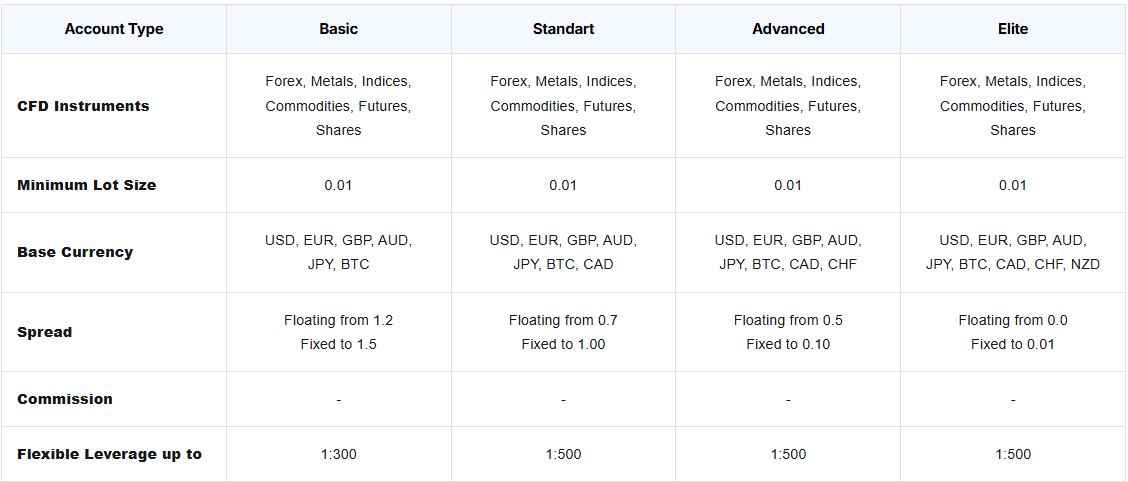
OnsaFX structures its offering across four account types — Basic, Standard, Advanced, and Elite — each designed to cater to different trader profiles. All accounts grant access to the broker’s full suite of CFD markets, including forex, metals, indices, commodities, futures, and shares, with a minimum lot size of 0.01. The key differences between tiers lie in the minimum deposits, spread conditions, base currency availability, and leverage flexibility.
Basic Account – Entry Level
With a minimum deposit of $100, the Basic account is the most accessible tier. It requires no commission and offers floating spreads starting from 1.2 pips, or fixed spreads around 1.5 pips. It supports a selection of major base currencies, including USD, EUR, GBP, AUD, JPY, and BTC, making it suitable for both fiat and crypto-funded traders. With leverage up to 1:300, this account may suit beginners, though spreads are wider compared to higher-tier accounts.
Standard Account – Balanced Conditions
The Standard account requires a minimum deposit of $1,000 and reduces trading costs with floating spreads from 0.7 pips or fixed spreads from 1.0 pip. Base currency options expand to include CAD alongside the Basic tier lineup, while leverage climbs to 1:500. This setup makes it more appealing to active retail traders seeking tighter pricing without commission charges.
Advanced Account – Lower Spreads for Active Traders
Aimed at more experienced traders, the Advanced account carries a minimum deposit of $5,000. It offers floating spreads from 0.5 pips or fixed spreads from 0.10 pip, again with no commission. CHF is added to the list of supported base currencies, and leverage remains up to 1:500. This tier is likely to appeal to scalpers or high-volume traders who prioritize narrow costs and faster execution.
Elite Account – Premium Access
At the top of the range, the Elite account requires a minimum deposit of $10,000 and offers the tightest trading conditions, with spreads as low as 0.0 pips floating or 0.01 fixed, and no commission. It supports the widest range of base currencies, including NZD in addition to all others. With leverage up to 1:500, this account is positioned for experienced traders who demand premium pricing and maximum flexibility.
OnsaFX’s account tiers provide scalable entry points, ranging from $100 for beginners to $10,000 for professionals. While the spread structure is competitive and leverage generous, traders should weigh these benefits against the inherent risks of high leverage and the more limited protections available under FSCA oversight compared with stricter global regulators.
OnsaFX trading instruments
OnsaFX offers access to a multi-asset portfolio designed to suit both beginners looking for variety and experienced traders seeking diversification. The broker’s product lineup spans forex, commodities, indices, shares, and the recently introduced ETF CFDs, all available on the MT5 platform. While the selection is competitive, traders should keep in mind that product variety does not automatically guarantee the best execution or pricing transparency.
Forex
OnsaFX provides more than 40 currency pairs, covering majors, minors, and selected exotics. This allows traders to participate in both highly liquid markets like EUR/USD and more volatile emerging-market pairs. The inclusion of exotics, while potentially offering bigger price swings, can also mean wider spreads and unpredictable execution conditions.
Commodities
Clients can speculate on global commodity markets, ranging from energy products like oil and gas to agricultural goods. Commodity CFDs are often used as diversification tools or to hedge against inflation, but they remain highly sensitive to global economic and geopolitical events.
Indices
Well-known benchmarks such as the S&P 500, NASDAQ, and Dow Jones are available, giving traders exposure to the overall performance of stock markets rather than individual companies. Index trading is popular with those who prefer broader market exposure and typically tighter spreads compared to single-stock CFDs.
Shares
OnsaFX also offers CFDs on leading international companies. This enables speculation on price movements of well-known brands without owning the underlying shares. However, as with all CFD trading, clients do not receive dividends or shareholder rights — positions are purely speculative.
ETF CFDs
A newer addition to OnsaFX’s lineup is ETF CFDs, which give traders a way to access baskets of assets — such as groups of stocks, bonds, or sector-specific funds — through a single product. While this opens up new diversification opportunities, it also adds layers of complexity and requires careful strategy, especially when traded with high leverage.
OnsaFX’s trading instruments cover the core asset classes and go a step further by including ETF CFDs, which not all brokers provide. The range is broad enough for most retail traders, but investors should remain aware that product diversity alone does not mitigate the risks of trading with high leverage or under a regulatory framework that lacks the strict protections of tier-one jurisdictions.
OnsaFX Trading conditions
OnsaFX structures its trading environment around four account tiers — Basic, Standard, Advanced, and Elite — each with different spreads, leverage settings, and currency options. While the broker highlights competitive spreads and high leverage, traders should carefully weigh these benefits against the risks that come with such aggressive trading conditions.
Spreads and Commissions
OnsaFX operates on a spread-only model, meaning there are no additional commissions charged across any account type. Instead, costs are built into the bid/ask spread.
- Basic Account: Floating spreads start from 1.2 pips or fixed spreads from 1.5 pips.
- Standard Account: Floating spreads improve to 0.7 pips, or fixed spreads from 1.0 pip.
- Advanced Account: Floating spreads from 0.5 pips and fixed spreads from 0.10 pip.
- Elite Account: The tightest pricing, with floating spreads from 0.0 pips or fixed spreads from 0.01 pip.
On paper, the Elite and Advanced accounts look highly competitive. However, without top-tier oversight, traders cannot independently verify whether spreads remain consistent in volatile market conditions — a common concern with lightly regulated brokers.
Leverage
One of OnsaFX’s most aggressive features is its flexible leverage, reaching up to 1:500 (except for the Basic account, capped at 1:300). While such high leverage can dramatically increase profit potential, it also magnifies losses. A move of just a few pips against a highly leveraged position can wipe out an account, making strict risk management essential.
Stop-Out Levels
Across all accounts, OnsaFX enforces a 50% stop-out level, meaning positions will be automatically closed once account equity falls to half of the required margin. While this provides a safety mechanism, it doesn’t prevent accounts from being drained quickly under high leverage, especially during sharp market swings.
Islamic (Swap-Free) Options
OnsaFX advertises swap-free (Islamic) accounts, with availability scaling across tiers: 25% in Basic, 50% in Standard, 75% in Advanced, and 100% in Elite. This flexibility may appeal to traders observing Sharia principles, but the broker does not provide full transparency on how financing costs are adjusted in practice.
OnsaFX promotes tight spreads and high leverage as key advantages, but traders must remember that these conditions come with heightened risks. Without the rigorous oversight of regulators like the FCA, ASIC, or CySEC, there is no independent guarantee that spreads are honored or that risk controls are enforced fairly. For beginners especially, the combination of 1:500 leverage and a 50% stop-out makes the trading environment extremely high-risk.
OnsaFX Payment Methods
OnsaFX supports a selection of payment channels, including debit/credit cards, bank wire transfers, Skrill, and cryptocurrencies. On the surface, this mix covers both traditional and digital options, giving traders some flexibility when it comes to funding their accounts.
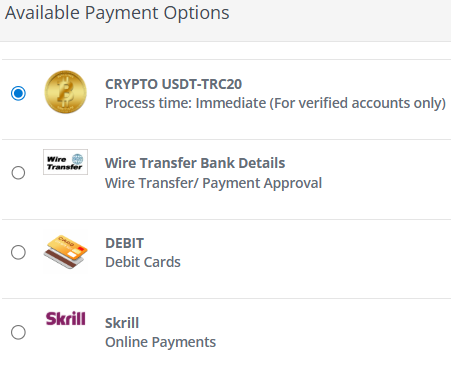
However, the broker’s website provides very little detail on how these payments are processed. Critical information such as minimum and maximum deposit amounts, withdrawal fees, processing times, and potential third-party charges is not clearly disclosed. For traders, this lack of transparency makes it difficult to plan cash flow or assess the true cost of moving funds in and out of the platform.
The inclusion of cryptocurrency payments can be attractive to some, offering fast transfers and fewer banking hurdles. But crypto transactions are irreversible—once funds leave your wallet, there’s no way to retrieve them if withdrawals are delayed or refused. In a regulatory environment that does not match the strict standards of top-tier jurisdictions, this risk becomes even more significant.
Skrill and card-based methods usually provide more security through chargeback mechanisms, but again, the broker does not clarify whether any additional conditions or restrictions apply. Wire transfers, while reliable, are typically slower and can come with added costs depending on the bank involved.
OnsaFX’s payment methods cover the essentials, but the lack of published details on fees, limits, and timelines is a red flag. A reputable broker will normally outline these terms upfront, ensuring traders know exactly what to expect. Here, clients are left to operate with limited information—adding unnecessary uncertainty to the funding and withdrawal process.
OnsaFX Education and trading tools
OnsaFX has built a Learning Center aimed at guiding traders through different stages of their development, with materials categorized for beginners, intermediate, and advanced traders. The content is fairly well-structured, covering the basics of forex trading, risk management, and strategy building. For newcomers, this can provide a useful starting point before placing real trades.
That said, while the courses are clearly organized, they remain introductory in nature. The broker does not appear to offer more advanced resources such as in-depth webinars, live market analysis, or daily research reports that many top-tier brokers now provide as standard. For experienced traders, this means the education hub is unlikely to add much beyond what is already available for free online.
In terms of trading tools, OnsaFX falls short of offering proprietary add-ons or advanced analytics. Most features available to clients come directly from the MetaTrader 5 (MT5) platform, including charting, indicators, and automated trading through Expert Advisors (EAs). While MT5 itself is powerful, the lack of extra broker-specific tools — such as calculators, sentiment trackers, or API connectivity — makes the offering less competitive compared with more established names in the industry.
OnsaFX deserves some credit for providing a structured education pathway, especially for new traders entering the forex and CFD markets. However, its materials are relatively basic, and the broker does not supplement MT5’s native features with additional trading tools. Serious traders may find the educational content too shallow and the toolset too limited to provide a real edge.
OnsaFX Bonus
Unlike many offshore or lightly regulated brokers that attract clients with aggressive bonus schemes, OnsaFX does not currently offer any deposit bonuses or promotional trading credits. While this might feel like a missed opportunity for traders looking for extra incentives, it also avoids the complications that often come with bonuses — such as strict turnover requirements, withdrawal restrictions, or hidden conditions that can trap inexperienced clients.
For traders, this means what you deposit is entirely yours to trade with, without being tied down by artificial volume targets. However, it also means OnsaFX offers no added perks beyond its standard trading conditions, making its account structure less competitive compared with brokers that provide loyalty programs or rebate schemes.
The absence of bonuses at OnsaFX keeps things straightforward but also highlights the broker’s no-frills approach. For some traders, this transparency is a positive; for others, it may feel underwhelming compared to brokers that use promotions to enhance their value proposition.
Final Thoughts
OnsaFX positions itself as a modern forex and CFD broker with FSCA oversight in South Africa and additional FinCEN registration in the United States. On paper, this dual framework sets it apart from offshore-only brokers by adding a degree of legitimacy and anti-money-laundering transparency. The availability of MetaTrader 5, a broad selection of instruments including the newer ETF CFDs, and a structured account system ranging from $100 to $10,000 deposits give it an edge in accessibility and variety.
However, the reality is more complex. The FSCA licence does not provide the same depth of protection as top-tier regulators like the FCA, ASIC, or CySEC. There are no statutory compensation schemes, limited requirements for capital reserves, and no independent audits to confirm the safety of segregated funds. The leverage levels — up to 1:500 — are aggressive and can expose inexperienced traders to rapid losses, particularly in volatile markets.
Another concern is the lack of transparency in payment processes, including unclear withdrawal policies and minimal detail on fees or timelines. While crypto and card payments add convenience, the absence of clear terms leaves clients without certainty on how their money will be handled. Education and tools are present but fairly basic, falling short of what more established brokers provide.
OnsaFX may appeal to traders in South Africa seeking a locally regulated broker with MT5 access and flexible account tiers. But for those prioritizing fund security, compensation schemes, and stricter oversight, the broker falls short of the global standards set by tier-one regulators. Ultimately, while OnsaFX is not an outright scam, it remains a higher-risk choice compared to brokers holding FCA, ASIC, or CySEC licenses.
Notes from the author:
When looking at OnsaFX, I find myself in two minds. On one hand, the broker is clearly more legitimate than the offshore outfits I come across regularly. Its FSCA licence gives it a verifiable footprint in South Africa, and the additional FinCEN registration in the U.S. suggests a degree of commitment to transparency and anti-money-laundering standards. That already puts it ahead of many brokers that exist only on paper in loosely regulated jurisdictions.
That said, regulation is always about the details — and this is where OnsaFX comes up short compared to brokers under the FCA, ASIC, or CySEC. While FSCA oversight ensures some conduct rules, it does not provide investor compensation schemes, strict capital adequacy requirements, or independent audits of segregated funds. In practice, this means client protection is limited, and much still depends on trusting the broker’s internal policies. For me, that’s not as reassuring as knowing a regulator would enforce those safeguards directly.
On the trading side, the offering is competitive. MT5 access is always a plus, spreads on higher-tier accounts look attractive, and the product range is broad enough to suit both beginners and experienced traders. I like that OnsaFX has structured its accounts to cater to different levels of capital, from $100 entry-level accounts to premium options for high-volume traders. However, the use of leverage up to 1:500 feels like a double-edged sword. While it appeals to aggressive traders, it’s a major risk factor — particularly for those who lack strong risk management.
Overall, I don’t see OnsaFX as a scam, but I also don’t see it as a broker I’d recommend without hesitation. For South African traders who want a local option, it may be worth considering. But if fund safety and maximum protection are top priorities, I’d lean toward a tier-one regulated broker instead.


