





PXBT Review
PXBT is an offshore broker that offers a fairly limited set of services. The company behind this brand is part of a group that manages other brokers such as PrimeXBT and CTS Cloud Trading, which are the subject of separate reviews.
PXBT offers only one type of trading account and only one trading platform. This does not make it unique, nor necessarily a bad broker, but the case these limitations are combined with many others. PXBT’s website lacks almost any information regarding trading conditions. Unlike most of its offshore competitors, PXBT does not offer bonuses and promotions. The broker also does not offer passive income options such as Copy Trading or PAMM accounts.
PXBT’s spreads are relatively competitive, but the number of tradable assets is quite limited. The available payment methods for depositing and withdrawing funds are also very limited. PXBT does not offer educational, analytical and research resources, and it does not have its own mobile app.
However, there are traders for whom an offshore broker offering MT5 platform and floating spread trading is more than enough.
PXBT Licenses and Regulation
The footers on the PXBT website list several legal entities based in Seychelles, Mauritius and Cyprus. But if you register a PXBT account you become a client of PXBT Trading Ltd, incorporated in Seychelles. The other companies have various other brands and have no relation to the regulatory framework in which PXBT operates.
When deciding whether to trade through an offshore forex broker based in Seychelles and licensed by the Seychelles Financial Services Authority (FSA), a trader must carefully evaluate the regulatory environment, potential risks, and benefits. Seychelles has become a popular offshore jurisdiction for forex brokers due to relaxed financial regulations, ease of company registration, and lower capital requirements, making it attractive for brokers seeking a more flexible operating environment. However, the level of investor protection and oversight provided by the Seychelles FSA is considerably lower compared to tier-1 regulatory authorities such as the Australian Securities and Investments Commission (ASIC) or the Cyprus Securities and Exchange Commission (CySEC) under EU regulations.
One of the primary concerns with Seychelles-licensed brokers is the lack of stringent client fund protection measures. Unlike EU, UK, or Australian-regulated brokers, which must comply with strict capital requirements, risk management policies, and fund segregation rules, brokers in Seychelles operate under a looser regulatory framework. The Seychelles FSA does not impose mandatory participation in investor compensation schemes, meaning that in the event of broker insolvency, traders have no recourse to recover their funds. In contrast, brokers regulated by CySEC in the EU are required to participate in compensation schemes such as the Investor Compensation Fund (ICF), which covers losses up to €20,000 per trader, while ASIC-regulated brokers must adhere to strict financial reporting and client fund segregation rules.
Another key difference lies in trading conditions and transparency. Brokers in Seychelles are not required to follow best execution policies, meaning there is less oversight on order execution quality, pricing transparency, and potential conflicts of interest. In contrast, ASIC and EU-regulated brokers must ensure fair order execution, prevent price manipulation, and provide clear risk disclosures. The lack of regulatory enforcement in Seychelles increases the risk of slippage, widening spreads, or hidden fees, particularly with brokers operating on a dealing desk (market maker) model.
Despite these risks, Seychelles brokers offer certain advantages, particularly in terms of trading flexibility and leverage. While EU and ASIC-regulated brokers are restricted to a maximum leverage of 1:30 for retail traders, offshore brokers in Seychelles often provide leverage of 1:500 or higher, allowing traders to take larger positions with smaller margin requirements. This can be appealing for experienced traders, scalpers, and high-frequency traders looking to maximize capital efficiency, but it also amplifies trading risk, making it easier to incur significant losses.
Another benefit of Seychelles-based brokers is the lack of restrictions on trading strategies. Many highly regulated brokers impose limitations on scalping, hedging, and Expert Advisors (EAs) to comply with local regulations or their own risk management policies. Offshore brokers in Seychelles typically allow all trading styles, making them attractive to traders who require greater operational freedom. Additionally, some traders are drawn to Seychelles brokers due to simpler account registration processes, reduced KYC (Know Your Customer) requirements, and support for cryptocurrency deposits and withdrawals, which may not be as readily available with tier-1 regulated brokers.
However, trading with a Seychelles-licensed broker also comes with significant risks, particularly concerning fund security, withdrawal reliability, and legal recourse. If a dispute arises between a trader and the broker, the Seychelles FSA has limited enforcement powers, meaning traders may struggle to resolve issues such as withdrawal delays, account restrictions, or unfair trade executions. In contrast, traders dealing with ASIC or EU-regulated brokers have access to financial ombudsman services that can help mediate disputes and ensure brokers adhere to ethical business practices.
Ultimately, choosing a Seychelles-based broker comes down to a trader’s risk tolerance and trading priorities. Those who prioritize fund safety, regulatory oversight, and legal protections are better off choosing a tier-1 regulated broker in jurisdictions like Australia or the European Union. However, traders seeking higher leverage, fewer trading restrictions, and lower entry barriers may find Seychelles brokers a viable alternative, provided they conduct thorough due diligence. It is essential to verify the broker’s reputation, withdrawal policies, and transparency before committing funds. Regardless of regulatory status, traders should never deposit more money than they can afford to lose, especially when dealing with offshore brokers that offer limited investor protections.
PXBT Trading Software
PXBT offers only one trading platform – MetaTrader 5. This is on the one hand limiting, but on the other hand it is the most popular software in the industry and many traders do not need alternatives.
MetaTrader 5 (MT5) is an advanced multi-asset trading platform developed by MetaQuotes Software, designed to provide traders with enhanced functionality, faster execution speeds, and expanded market access. Released in 2010 as the successor to MetaTrader 4 (MT4), MT5 offers a more sophisticated trading environment that supports not only forex and CFDs but also stocks, commodities, indices, and futures. Its technical features include an increased number of built-in indicators and analytical tools, expanded timeframes, an integrated economic calendar, and market depth (DOM) functionality, making it more suitable for traders who require access to a broader range of financial instruments and institutional-grade trading capabilities.
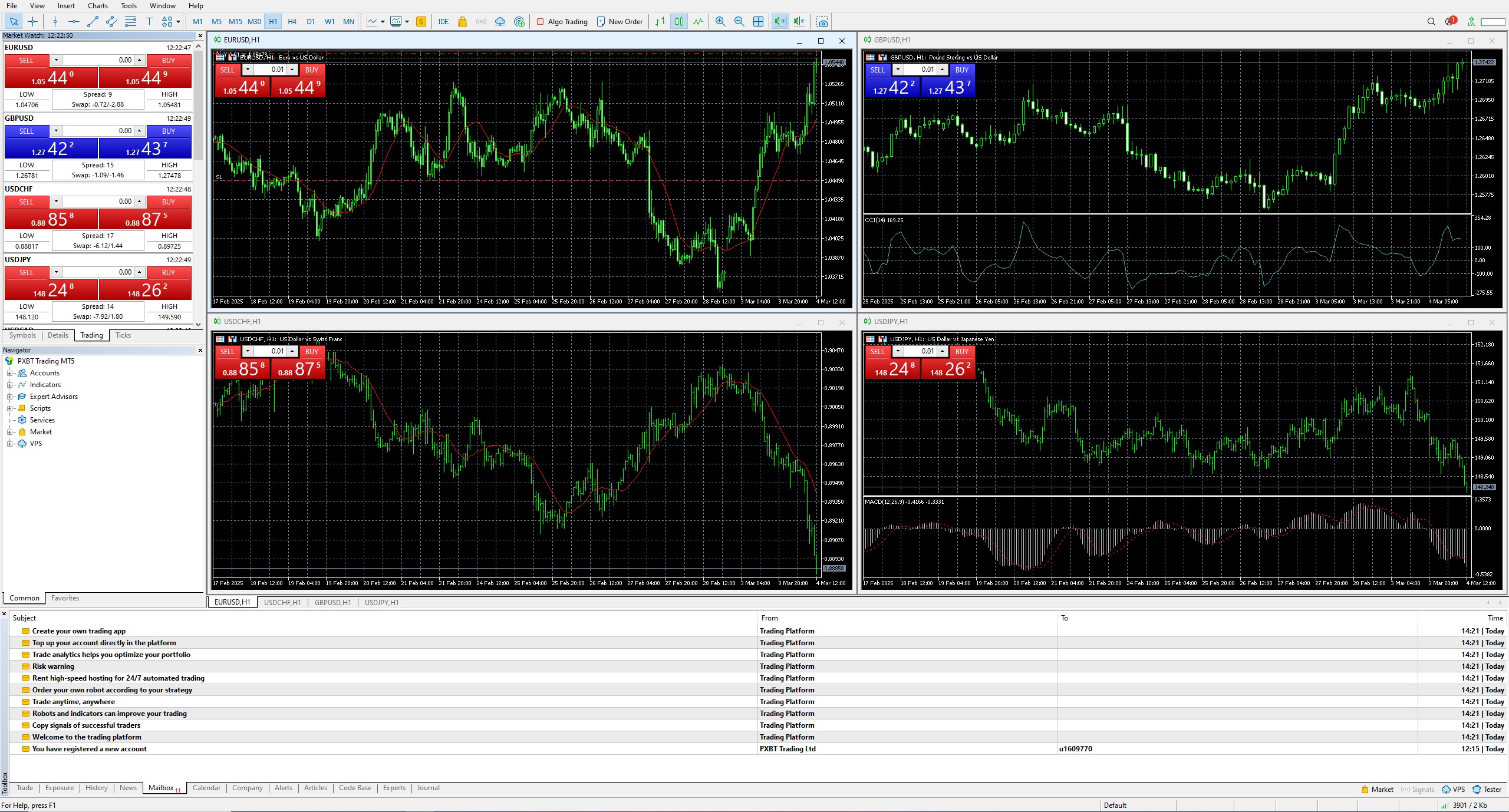
One of the key reasons MetaTrader software has become the standard for forex trading is its flexibility, customizability, and automation capabilities. The platform supports algorithmic trading through Expert Advisors (EAs), which allow traders to automate their strategies using MetaQuotes’ proprietary programming language. While MT4 uses MQL4, MT5 runs on MQL5, which is more powerful, supports object-oriented programming, and allows for more complex and efficient trading scripts. Additionally, MT5 includes an improved strategy tester that enables traders to conduct multi-threaded, multi-currency, and real tick data backtesting, providing more accurate performance evaluations for automated strategies.
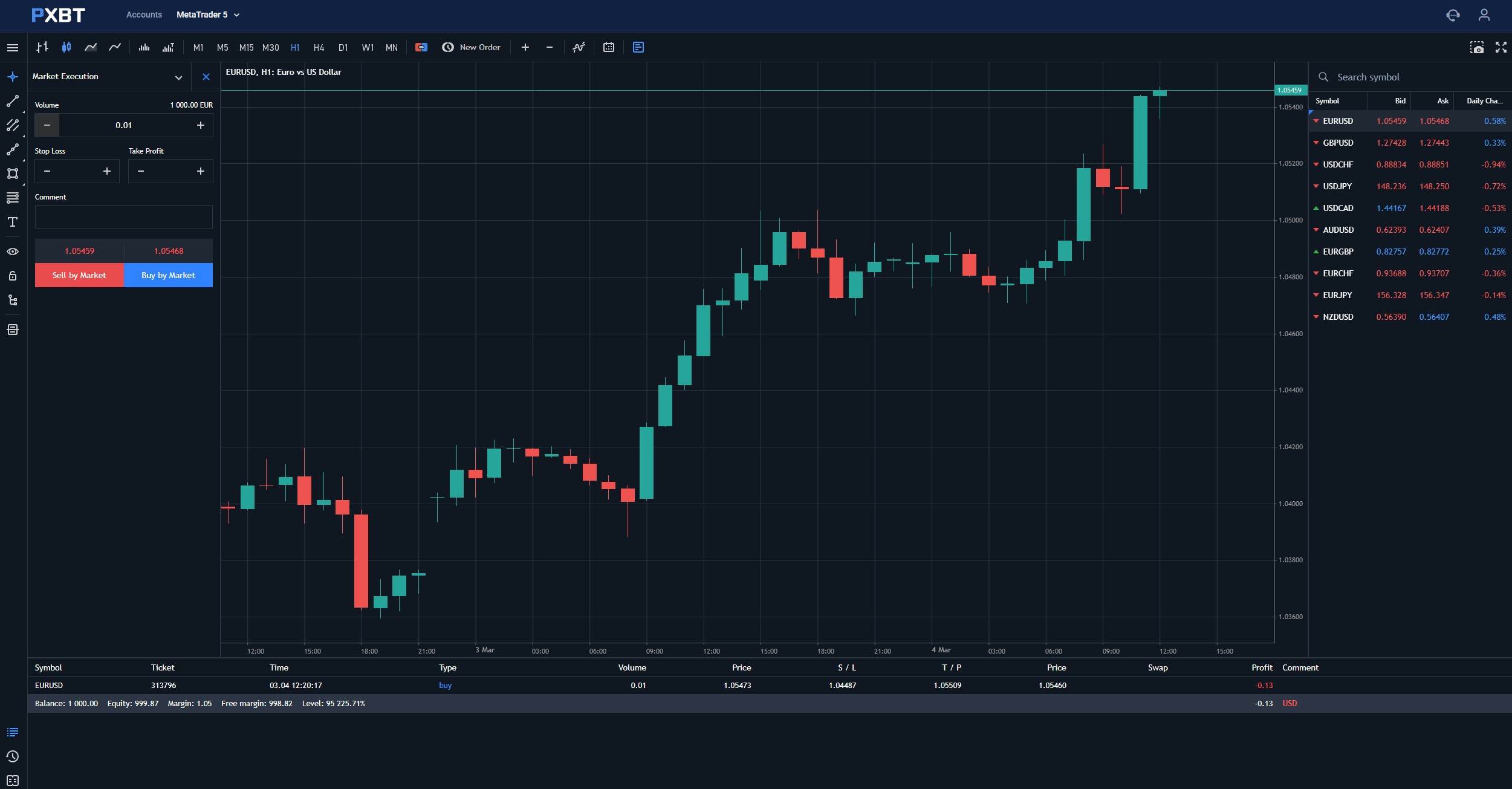
MT5 is available in desktop, web, and mobile versions, each with its own set of advantages and limitations. The desktop version provides the most comprehensive trading experience, offering full access to custom indicators, trading robots, and advanced order execution settings. The web-based version allows traders to access their accounts from any browser without requiring software installation, making it more convenient for those who trade on multiple devices. However, it has some limitations, particularly in supporting custom scripts and EAs. The mobile version, available for both iOS and Android, enables traders to execute trades, monitor the market, and use basic charting tools on the go, but it lacks the full range of technical analysis tools and automation features found on the desktop platform.
Despite the technical superiority of MT5, many traders still prefer the older MT4 platform. One of the main reasons for this is familiarity. MT4 has been widely adopted since its launch in 2005, and many traders and brokers have built their infrastructure around it. The transition to MT5 has been slow because MQL5 is not backward compatible with MQL4, meaning that indicators, scripts, and trading robots developed for MT4 do not work on MT5 without significant modifications. Additionally, while MT5 was initially designed to comply with regulations requiring a netting system for certain asset classes, its early versions did not support hedging. This limitation was later addressed, but by then, many traders had already chosen to remain with MT4.
A forex broker that offers only MT5 but not MT4 may face certain drawbacks. Since many traders have built their strategies and trading tools around MT4, they may be reluctant to switch to MT5, particularly if they rely on custom-built EAs and indicators that are incompatible with the newer platform. Additionally, while MT5 is more advanced, its increased complexity may be overwhelming for beginners who find MT4’s simpler interface easier to navigate. Some brokers that only offer MT5 may also have limited third-party integration options, as many liquidity providers and bridge solutions were initially developed for MT4.
Overall, MetaTrader 5 is a powerful and versatile trading platform that enhances the trading experience through improved technical features, multi-asset support, and more efficient automation tools. However, the widespread preference for MT4 means that brokers offering only MT5 may struggle to attract traders who are accustomed to the older platform. While MT5 is gradually gaining traction, the decision between MT4 and MT5 ultimately depends on a trader’s specific needs, technical expertise, and willingness to adapt to a newer system.
PXBT Account types and trading conditions
Most forex and CFD brokers offer several account types, offering different pricing models, base currencies, leverage levels and other specifics aimed at a range of trader types. PXBT offers only one account type, and the website lacks detailed information on trading parameters.
The only base currency option is USD. The maximum leverage is 1:1000. This is a typical level for offshore brokers, but PXBT does not provide information on maximum leverage levels for individual asset classes. The highest level of 1:1000 by default applies only to major currency pairs. It is common for brokers to apply dynamic leverage formulas where maximum leverage is capped for accounts with exposures above certain levels. But it is not clear whether and what such scheme PXBT applies.
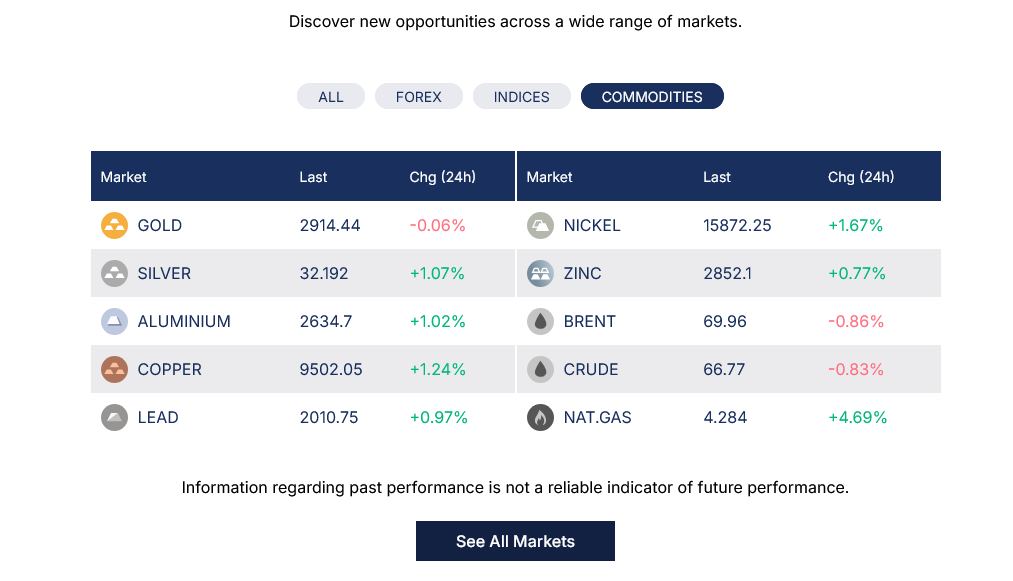
The website has information on about 40 forex pairs, a dozen raw materials and as many more commodities. However, more symbols are included in the MT5 platform, including CFDs on EU and US stocks, as well as cryptocurrencies. But even so, the tradable instruments offered by PXBT do not impress either in terms of quantity or variety.
In the trading platform, we saw a spread of 0.9 pips for the benchmark currency pair EUR/USD and spreads between 1.5 and 2 pips for the other major currency pairs. This is a relatively competitive level if we accept PXBT’s assurances that it does not charge additional trading commissions.

A forex broker that offers only one type of account with floating spreads and does not provide different account types with alternative pricing models, such as ECN accounts with raw spreads and fixed commissions, presents both advantages and disadvantages depending on the trader’s strategy and preferences.
One of the main disadvantages of a single floating spread account structure is the lack of flexibility for traders with different trading styles. Many brokers offer multiple account types to accommodate the needs of various traders, such as standard accounts with spread-based pricing and ECN accounts that provide raw spreads with fixed commissions. Without an ECN option, traders who prefer tighter spreads and direct market access may find the broker’s offering unsuitable, particularly high-frequency traders, scalpers, and algorithmic traders who rely on consistent, ultra-low spreads and transparent transaction costs.
Another downside is that floating spreads can widen significantly during market volatility, particularly around major economic events, low-liquidity periods, or sudden price spikes. This makes it difficult for traders to predict execution costs, as spreads may fluctuate widely and increase effective trading costs at critical moments. In contrast, ECN accounts provide raw spreads, often close to zero pips, with a fixed commission per lot traded, making cost calculations more predictable. The absence of an ECN model means that traders who prioritize precision, transparency, and deep liquidity access may find it challenging to execute trades under optimal conditions.
The lack of multiple account types may also indicate that the broker operates a dealing desk (market maker) model, where it takes the opposite side of client trades rather than passing orders directly to liquidity providers. While this is not inherently negative, it raises concerns about potential conflicts of interest, as the broker may benefit from client losses rather than facilitating direct market access. Many traders prefer ECN accounts because they eliminate the broker’s role as a counterparty, ensuring that trades are executed against real market participants with minimal interference.
However, there are also some advantages to having a single floating spread account. This simplifies the trading process, making it easier for beginners to understand their cost structure without worrying about commission calculations. In an ECN model, traders must factor in both the raw spread and a per-lot commission, which may not always be intuitive, especially for those who trade small volumes. A floating spread account consolidates all costs into a single spread, making it more straightforward for casual traders who do not require ultra-tight spreads or institutional-grade execution.
Another potential advantage is that some brokers offering only floating spread accounts compensate for the absence of ECN pricing by keeping spreads unusually low and competitive. If the broker can maintain tight floating spreads under normal conditions, this may offset the need for a separate ECN account, particularly for swing traders and longer-term traders who are less sensitive to minor spread fluctuations. Additionally, a single account type often comes with lower minimum deposit requirements, making it more accessible to traders with limited capital.
Ultimately, the decision depends on the trader’s style, frequency, and cost sensitivity. Traders who prioritize predictable costs, direct market access, and ultra-low spreads will find the lack of an ECN option a major drawback. However, traders who prefer a simple fee structure, competitive floating spreads, and a more accessible trading environment may find a single floating spread account sufficient. Before committing to a broker with only one account type, traders should analyze historical spread data, execution quality, and potential trade restrictions to ensure the broker’s pricing model aligns with their trading needs.
PXBT categorizes as inactive an account that has no trading or deposit/withdrawal activity for 90 days, and that has a balance below EUR 20. The inactivity fee is also EUR 20. It is strange that the fee is in this currency, given that the base currency of the account is USD.
PXBT Deposit and Withdraw Methods
PXBT does not provide any information on its website regarding available payment methods, fees and transaction terms. The legal documentation has information on withdrawal fees for individual payment methods, but there is a discrepancy with the actual options available in the deposit menu.
In the deposit menu, the available payment methods vary by jurisdiction, but in most cases the choice is between bank transfer, bank card and the VOLET e-wallet. In some jurisdictions there is no option for bank transfer or card, but there is an option to deposit via Biance Pay.
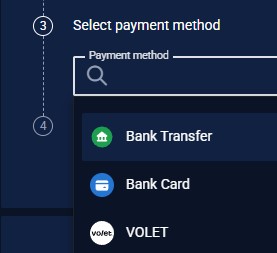
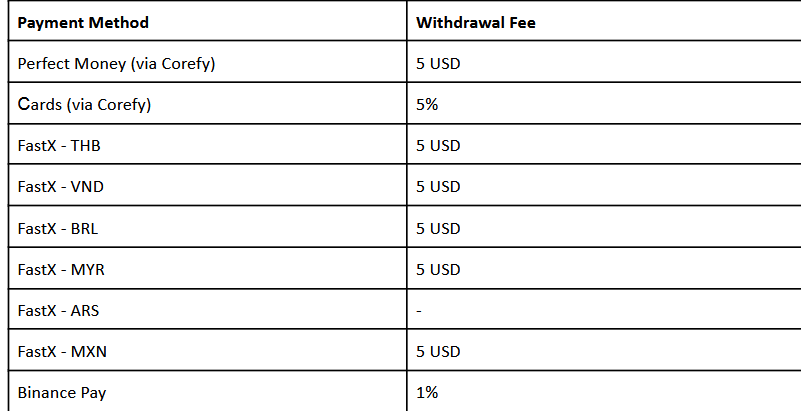
The text of the Terms and Conditions specifies the following withdrawal fees – 5 USD for the Perfect Money e-wallet, which is not actually available, 5% for cards through the obscure payment processor Corefy, 5 USD for withdrawals via bank transfer in the currencies TBH, VND, BRL, MYR and MXN, and a 1% fee when withdrawing via Biance Pay.
| Deposit method | Minimum | Maximum | Processing time | Fee |
| Bank | Unspecified | Unspecified | Unspecified | Unspecified |
| Credit/Debit Card | Unspecified | Unspecified | Unspecified | Unspecified |
| Withdrawal method | Minimum | Maximum | Processing time | Fee |
| Bank | Unspecified | Unspecified | Unspecified | $5 |
| Credit/Debit Card | Unspecified | Unspecified | Unspecified | $5 |
PXBT Bonuses and Promotions
When evaluating an offshore forex broker that does not offer bonuses and promotions, a trader should carefully assess whether the absence of such incentives is a reflection of the broker’s business model, regulatory obligations, or overall commitment to fair trading conditions. Many offshore brokers use bonuses and promotional offers to attract new traders and encourage higher trading volumes, but these incentives often come with restrictive conditions, such as high trading volume requirements before withdrawals can be made or limitations on accessing bonus funds. While traders may find bonuses appealing, they should always examine the terms and conditions to determine whether these promotions truly provide added value or simply serve as a marketing tool with hidden restrictions.
A broker that chooses not to offer bonuses and promotions may be focused on providing a more transparent and ethical trading environment, where clients are not influenced by marketing incentives but instead make trading decisions based on spreads, commissions, execution quality, and overall reliability. In some cases, offshore brokers avoid offering bonuses to maintain a reputation for legitimacy and compliance, as many highly regulated jurisdictions, such as the EU, UK, and Australia, prohibit or heavily restrict trading incentives to prevent misleading marketing tactics. The absence of promotions may indicate that the broker prioritizes trading conditions and fair execution over aggressive client acquisition strategies.
For traders considering such a broker, it is essential to compare key trading conditions against competitors that do offer bonuses. If the broker provides tight spreads, low commissions, reliable execution, and strong fund security measures, then the absence of promotions should not be a major concern. Traders should also evaluate whether the broker offers additional value in other ways, such as advanced trading tools, market research, educational resources, or better customer support.
One potential downside of choosing a broker without promotions is that traders do not receive additional capital incentives, which can be beneficial for those with small deposits looking to leverage bonus funds to increase their trading potential. However, relying on bonuses can often lead to higher risk exposure, as traders may take larger positions than they would with their own capital, leading to increased potential losses.
PXBT Tools and Education
A forex broker that fails to provide educational and research resources places its traders at a clear disadvantage, particularly beginners and those seeking to refine their strategies. Without access to structured learning materials such as trading guides, webinars, video tutorials, and market analysis, novice traders are forced to rely on external sources, which can lead to misinformation or the adoption of ineffective strategies. Education plays a crucial role in forex trading success, equipping traders with the knowledge to interpret technical analysis, manage risk effectively, understand market psychology, and analyze fundamental economic factors. Without these resources, traders may struggle to make informed decisions, increasing their reliance on speculation rather than strategic planning.
Beyond education, the absence of research tools such as economic calendars, market news updates, trading signals, and sentiment analysis leaves traders at a disadvantage when navigating market fluctuations. Many brokers collaborate with leading financial analysis providers like Trading Central or AutoChartist to offer insights that help traders spot opportunities and manage risk more effectively. Without integrated research tools, traders must seek market data from external sources, which can result in delays in decision-making and missed trading opportunities. A lack of real-time market insights can be particularly problematic in fast-moving markets where swift execution is essential.
For more advanced traders, the unavailability of in-depth research reports, technical indicators, and real-time market commentary further limits their ability to conduct comprehensive market analysis. Professional traders often depend on institutional-grade research to validate their strategies, and without access to these insights, they may face increased uncertainty in their trades. The absence of sentiment analysis or algorithmic insights can also make it more difficult to anticipate market reactions to major economic events, putting traders at a competitive disadvantage.
A broker that prioritizes education and market research not only helps traders develop their skills but also fosters credibility and trust. The absence of these resources may indicate a lack of commitment to client success and long-term trader retention, suggesting that the broker’s focus is purely on trade execution rather than supporting traders in making well-informed decisions. This lack of investment in trader development can make such brokers less appealing, particularly when many competitors offer extensive educational materials, detailed market analysis, and real-time research tools as part of their service.
Ultimately, trading with a broker that does not provide educational and research support makes the trading experience more challenging, particularly for those still learning or refining their strategies. Without these resources, traders face a fragmented and inefficient learning process, increasing the likelihood of costly mistakes. In contrast, brokers that invest in trader education and provide valuable market research create a more informed, disciplined, and ultimately more successful trading community, benefiting both the trader and the brokerage in the long run.
Notes from the author:
It's hard to comment on a broker who offers almost nothing. PXBT is just such a case. What is somewhat distinctive is that PXBT is part of a group of brokers that are virtually identical but use different brands. This in itself is rather suspicious insofar as none of these brands are well established. PXBT offers only one platform - MT5, only one type of account for floating spread trading and leverage of 1:1000. The tradable spread trades are relatively few in number, but still cover the most volatile assets. This may be enough for many traders. But PXBT doesn't have anything to differentiate it from its competitors. The price ana trading is competitive but not the lowest you can find. Although it is an offshore broker, PXBT does offer bonuses and promotions. The broker also does not offer any ancillary isntruments, imaging materials or analytical and research resources. Depositing and withdrawing funds is only possible with 2-3 payment names. So overall the broker does not leave a good impression.


