





Swissquote Review
Swissquote is the brand name of a Swiss financial group offering a wide range of financial and brokerage services. The group started in 1996 in Switzerland, and nowadays the Swissquote has offices in Cyprus, Luxembourg and Dubai. The forex and CFDs broker license in Cyprus is relatively new – as of 2022. This review will focus on these brokerage services of the Swissquote, rather than investment and banking services. Having a banking license and authorization from a respected financial regulator like the Cyprus Securities and Exchange Commission (CySEC) means a very high level of transparency, accountability and protection for the clients of this broker. Through its Swiss branch, Swissquote also offers financial and brokerage services outside the EU and EEA in jurisdictions where local regulations allow. The broker offers quite a potential set of trading software – MetaTrader 4, MetaTrader 5, as well as its own web trading platform and mobile app. This gives clients the opportunity to apply even the most sophisticated trading strategies.
Swissquote’s investment business offers literally millions of tradable assets. In terms of forex and CFDs trading, the choice is more limited but still respectable – around 600 symbols. But some asset classes like cryptocurrencies are not available if you use the MetaTrader 4 platform.
The broker allows you to create Demo accounts, but these accounts only give you access to the trading platforms and not the Client Area of the website. Each Demo account requires a separate registration, so you need to make three registrations to test all three available trading platforms. This is quite inconvenient and does not match industry standards. There is also no clarity on which type of accounts the spreads we see in the demo trading servers apply to.
Retail customers of the Swiss-based company can leverage up to 1:100, compared to the regulatory limit of 1:30 applicable to customers of the Cypriot company. Clients of the Cyprus office of Swissquote have a choice between floating spread and fixed commission accounts. However, other Swissquote clients can only trade with a floating spread. Broker spreads and commissions for EU clients are relatively competitive, but spreads for non-EU clients are higher than usual.
Another parameter, which exceeds the industry norm, is the minimum deposit required by the Swissquote – EUR 1000 or equivalent. This broker does not seem to be targeting beginners or casual traders. Like most brokers with a banking license, Swissquote also allows deposits and withdrawals with a very limited range of payment methods. In fact, the Cypriot company’s customers can only use bank transfer, while others can use bank transfer and credit/debit card. Swissquote does not offer live chat to contact the customer support. The interface of the Swissquote websites is available in several European and Asian languages depending on the target audience.
Swissquote Licenses and Regulation
The main legal entity behind the Swissquote brand is Swissquote Group Holding Ltd. The companies that manage the brokerage business directly are its subsidiaries.
Swissquote Capital Markets Limited is authorised and regulated by the Cyprus Securities and Exchange Commission (CySEC) under license number CIF 422/22. This license generally authorizes the company to serve customers throughout the European Union and the European Economic Area, but Swissquote specifies that its services are not intended for residents of Belgium, along with the standard restrictions for residents of the United States and Canada. The company operates through the domains swissquote.eu, swissquote.cy and swissquote.com/en-eu.
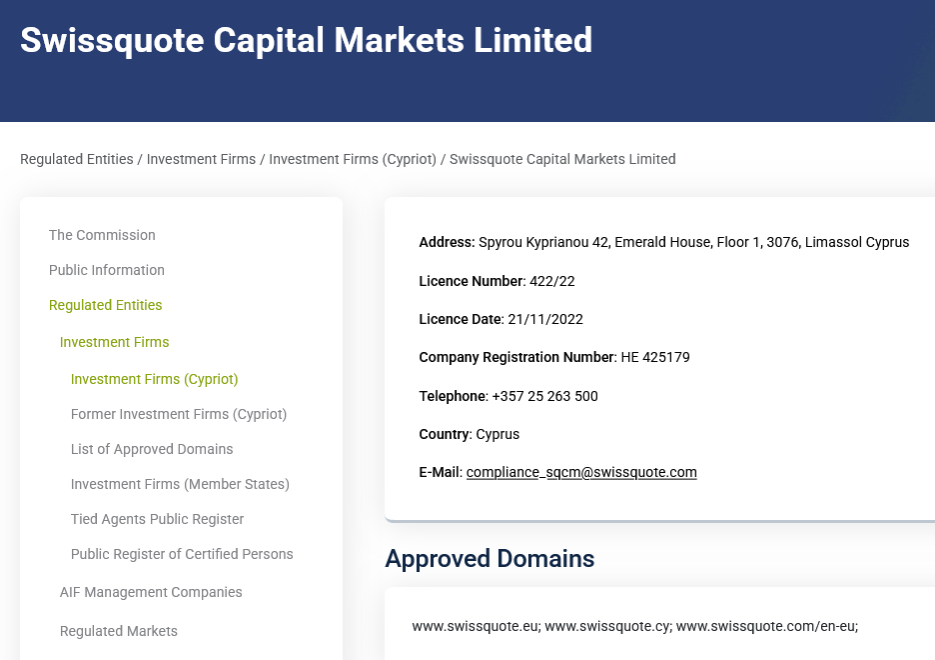
The Cypriot company offers forex and CFDs trading. In Europe, the Swissquote’s other investment services are managed by the company Swissquote Bank Europe SA, licensed by the Commission de Surveillance du Secteur Financier (CSSF) of Luxembourg. This company offers its services through the swissquote.lu domain. This part of Swissquote’s business will not be the subject of this review.
Swissquote MEA Ltd is regulated by Dubai Financial Services Authority and operates through the swissquote.com/en-mea domain.
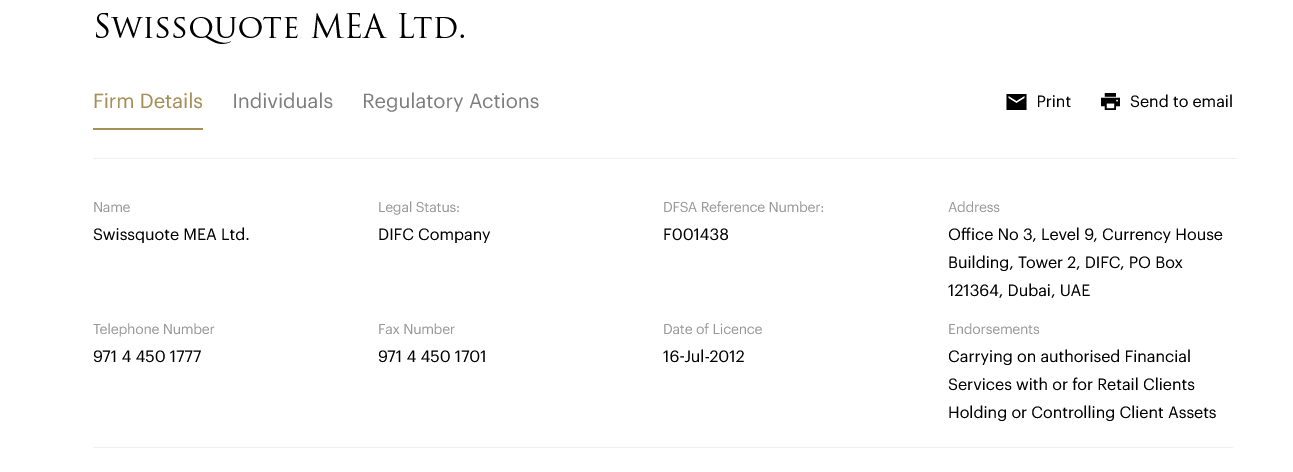
In Switzerland and the rest of the world, the CFD trading, investment and other financial services of Swissquote are managed by the Swiss bank Swissquote Bank Ltd. Clients in Switzerland are served through the swissquote.com/en-ch domain and those in the rest of the world through the swissquote.com/en-row domain. Swissquote states that it does not accept clients from the USA, Canada, United Kingdom, Germany, Italy, France, Russian Federation, Japan and Turkey.
For clients outside Switzerland and the EU, a different type of CFD trading account is offered than those offered by the Cypriot company. The subsidiary in Dubai offers identical trading services to those offered by the broker in Switzerland.
Understanding the regulatory environment is crucial for anyone engaged in forex trading for several key reasons, which impact both the safety of their investments and the overall trading experience. Forex markets are particularly vulnerable to fraudulent activities due to their vast size and global nature. Reliable regulatory frameworks help protect traders by ensuring that brokers adhere to strict operational standards and ethical practices. Knowing about these regulations helps traders select brokers who are compliant and thereby reduces the risk of falling victim to scams.
A large number of forex and CFDs brokers operating in the EU have chosen Cyprus as their base due to the developed financial and accounting infrastructure in the island country. This makes Cyprus Securities and Exchange Commission (CySEC) one of the most important and competent financial regulators in the world. The CySEC license enables companies to offer their services throughout the European Economic Area.
Within the EU, forex and CFD brokers are regulated primarily under the Markets in Financial Instruments Directive (MiFID II) and the Markets in Financial Instruments Regulation (MiFIR). Forex brokers are subject to rigorous regulatory standards, including capital adequacy requirements and participation in investor compensation funds.
These regulations have several fundamental objectives Firstly, they ensure transparency by requiring clear disclosures about the nature and risks of CFD products to investors. Forex brokers are also required to submit regular reports on their financial health, including audits of their financial statements and disclosures of their risk management procedures.
Depending on the nature of their operations, forex brokers are required to have an initial capital ranging from EUR 50,000 to EUR 730,000. The exact amount depends on the broker’s risk exposure and the types of financial instruments they deal with. Brokers must continually manage risks associated with their business, including market, credit, and operational risks, and adjust their capital as necessary. Brokers must maintain sufficient liquidity to cover their immediate obligations and ensure they can operate under various stress scenarios.
EU regulations also aim to protect the individual retail customer of brokers. These protections include setting caps on the amount of leverage that retail investors can use, reducing the potential losses that can accrue from volatile market movements. The maximum leverage that retail investors can trade with is 1:30 for major currency pairs and lower levels for other asset classes.
EU retail traders are also guaranteed negative balance protection. This ensures that retail clients cannot lose more money than they have deposited in their accounts. Licensed brokers are required to participate in Investor compensation schemes that are designed to protect investors if a forex broker becomes insolvent or ceases trading. Under EU regulations, these schemes guarantee that covered clients can recover a portion of their funds – up to €20,000 per investor. All retail investors and small businesses are typically eligible for compensation if they are unable to recover their funds due to broker failure.
Forex and CFD brokers operating in Switzerland are subject to stringent regulatory oversight by the Swiss Financial Market Supervisory Authority (FINMA). Switzerland is known for its well-regulated financial sector, and brokers offering forex and CFDs must meet rigorous standards to ensure the safety and protection of clients. Forex and CFD brokers in Switzerland must obtain a Securities Dealer License from FINMA. This license allows them to operate as regulated financial institutions and provide forex, CFD, and other financial services to clients. Swiss brokers must meet strict capital adequacy requirements. The minimum required capital is typically CHF 20 million or higher, depending on the scope of their operations. This high capital requirement ensures that brokers have enough financial resources to absorb market risks and protect clients’ funds.
One of the key regulatory requirements is that brokers must keep client funds in segregated accounts separate from the broker’s own operating funds. This ensures that client assets are protected and cannot be used by the broker for any internal business activities. Swiss brokers are required to have robust compliance and risk management systems in place. This includes monitoring market risks, implementing internal controls, and ensuring the firm operates in a financially stable manner. Switzerland does not have an investor compensation scheme similar to the Investor Compensation Fund (ICF) in the European Union or the Financial Services Compensation Scheme (FSCS) in the United Kingdom. However, the country’s strict financial regulations and high capital requirements are designed to minimize the risk of broker defaults and protect clients from financial loss.
Although there is no mandatory negative balance protection requirement in Switzerland, most reputable Swiss brokers offer this feature to retail clients. Negative balance protection ensures that traders cannot lose more than the amount they have deposited, protecting them from falling into debt due to market volatility.
Switzerland does not impose specific leverage restrictions on retail forex trading, unlike the European Union, where retail leverage is capped at 1:30 for major currency pairs. However, Swiss brokers are generally conservative with their leverage offerings, and leverage typically ranges from 1:50 to 1:100 for retail clients.
As Dubai seeks to establish itself as a financial center, local regulators impose identical regulatory standards to those in Europe. So virtually all Swissquote clients can rely on an exceptionally high level of protection, transparency and compliance with best business practices.
Swissquote Trading Software
Swissquote offers a very flexible and versatile suite of platforms for trading – its proprietary CFXD platform, available in a web version and as a mobile app, MetaTrader 4 (MT4) and MetaTrader 5 (MT5), and now, full TradingView integration, positioning the broker as one of the most platform-diverse providers in the industry.
The CFXD platform immediately impresses with its intuitive, modern and customizable interface, as well as greater functionality than usual for web platforms. The latter is mostly due to the integration of tools from established third-party providers. The platform integrates advanced charting functions. from TradingView, which provides over 50 intelligent charting tools and over 80 technical indicators. The platform also integrates the functionalities of the acclaimed Autochartist market scanner The app scans markets automatically and identifies trading opportunities. PowerStats, Volatility Analysis and forecasts help the trader gain a clearer picture of the market movements. The trade setups can be customized to match your preferred trading instruments and timeframes.
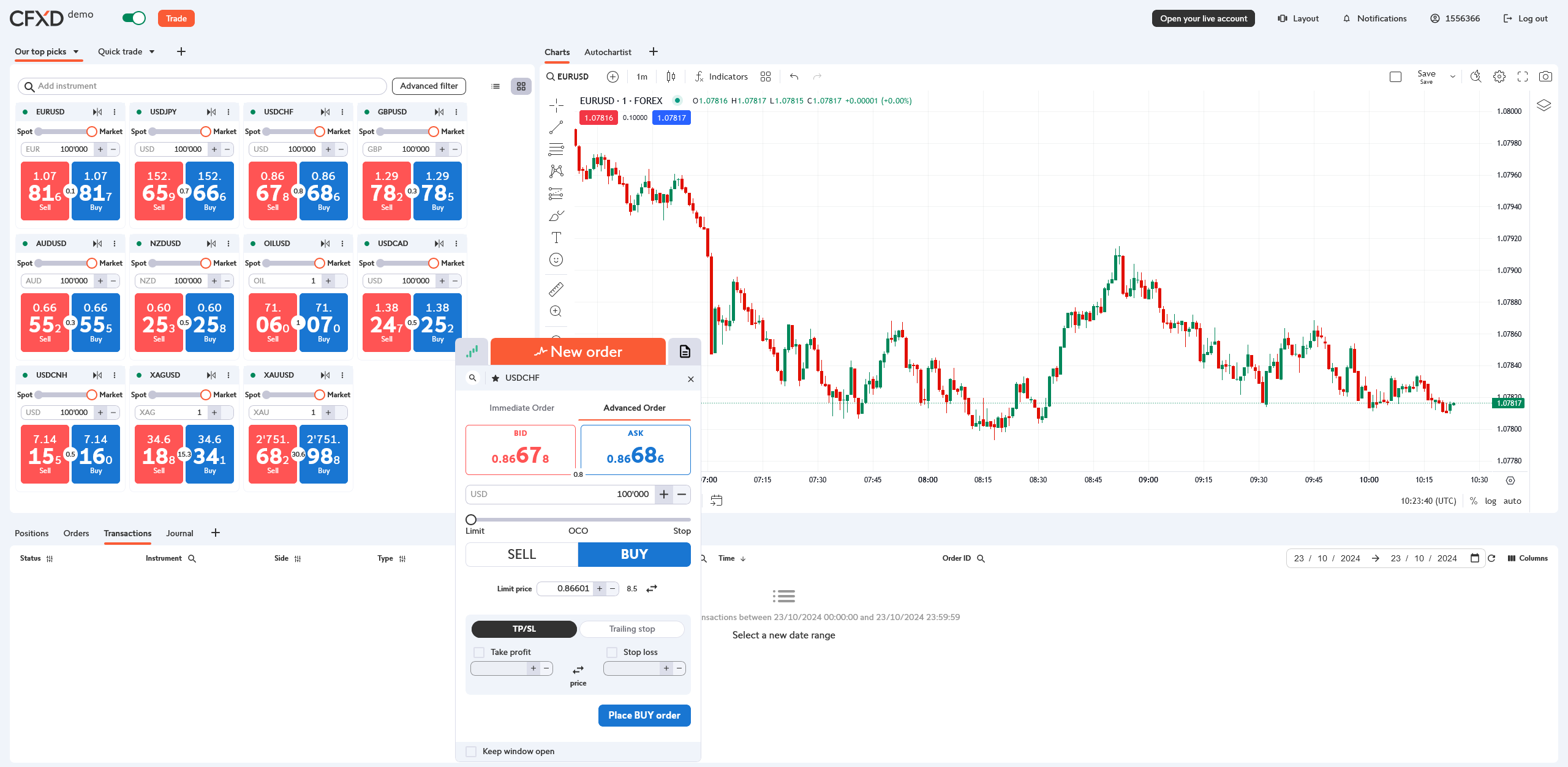
In addition to the basic market and pending order types, the CFXD platform allows the execution of complex order types rarely found in other web platforms. These include:
Order Cancels Other (OCO) – Combines a stop order with a limit order. When one is executed, it automatically cancels the other.
IF-DONE – A two-step order where the second step cannot be executed until the conditions of the first are met.
If-OCO – A variant of the IF-DONE order where an OCO is placed after the order has been executed in the IF part.
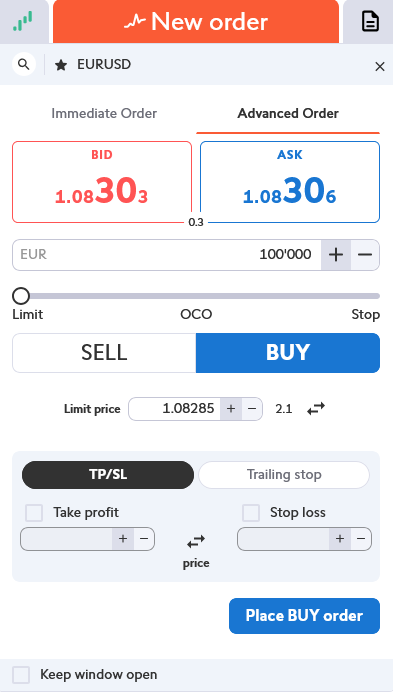
The platform interface is easily configurable, with most components able to be moved by simple drag and drop. Charts, graphing tools and indicators also allow for customization. Your personal layout can be saved. But in spite of all this, the CDC platform lacks advanced features that are available in full-fledged desktop platforms such as MetaTrader 4 and 5.
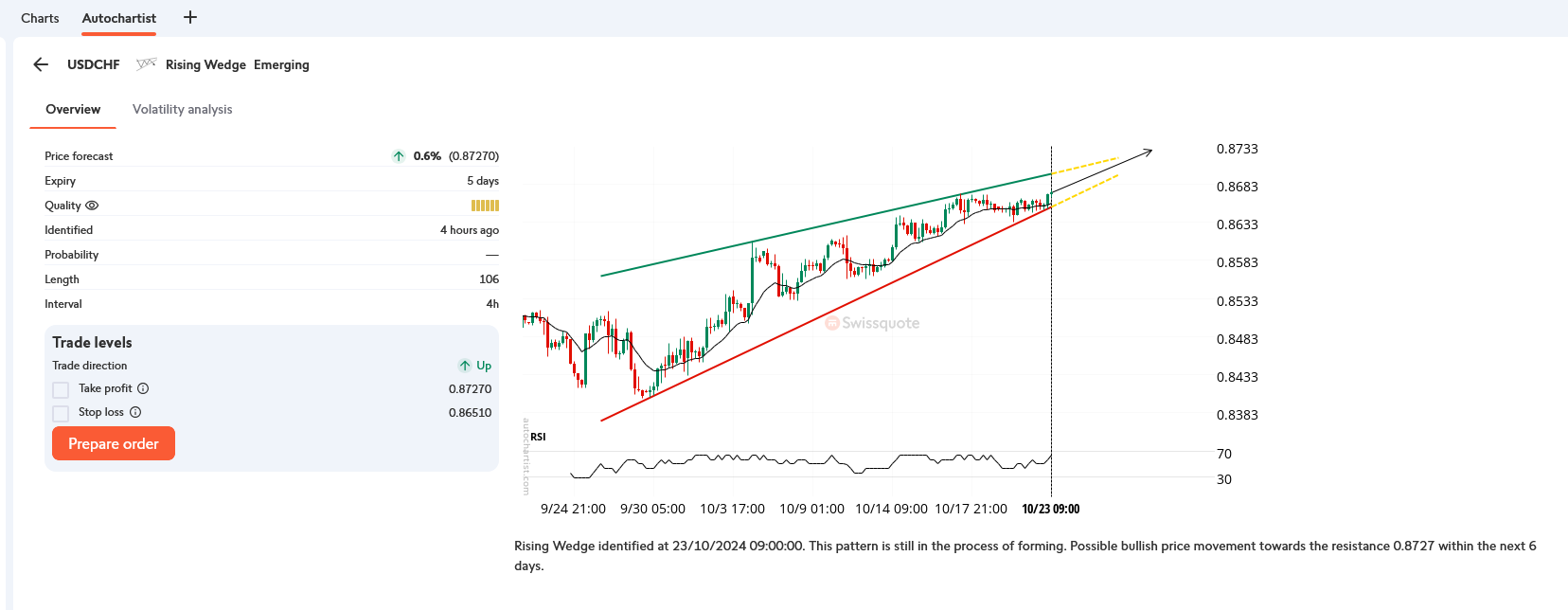
Swissquote Integrates with TradingView (NEW)

In a significant upgrade to its platform lineup, Swissquote has integrated directly with TradingView, the globally renowned charting and social trading platform used by over 50 million traders. This integration allows Swissquote clients to trade more than 400 CFDs and forex instruments directly from TradingView’s charts, without leaving the interface.
Traders can connect their Swissquote accounts within the TradingView trading panel, access real-time execution, and benefit from spreads starting at 1.1 pips, with average execution speeds of just 9 milliseconds. Leverage is available up to 1:100 (or 1:30 for EU clients under ESMA guidelines).
This move underscores Swissquote’s commitment to offering multi-platform flexibility, combining its regulated infrastructure with TradingView’s technical analysis capabilities and social features. It’s particularly attractive for traders who want chart-based execution, social strategy sharing, and cloud-based accessibility across devices.
MetaTrader 4 (MT4) is a highly popular trading platform primarily used for Forex trading, as well as for CFDs (contracts for differences) and futures markets. Developed by MetaQuotes Software and released in 2005, MT4 is renowned for its advanced trading capabilities, robust security, and accessibility for traders of all skill levels. MT4 features an intuitive interface that allows traders to efficiently manage their trades and analyze markets. It offers multiple chart setups and supports various time frames, enabling traders to make more informed decisions. The platform is equipped with a comprehensive set of technical analysis tools, including over 30 built-in indicators, more than 2,000 free custom indicators, and 700 additional indicators available for purchase. These tools assist traders in analyzing price dynamics of financial instruments.
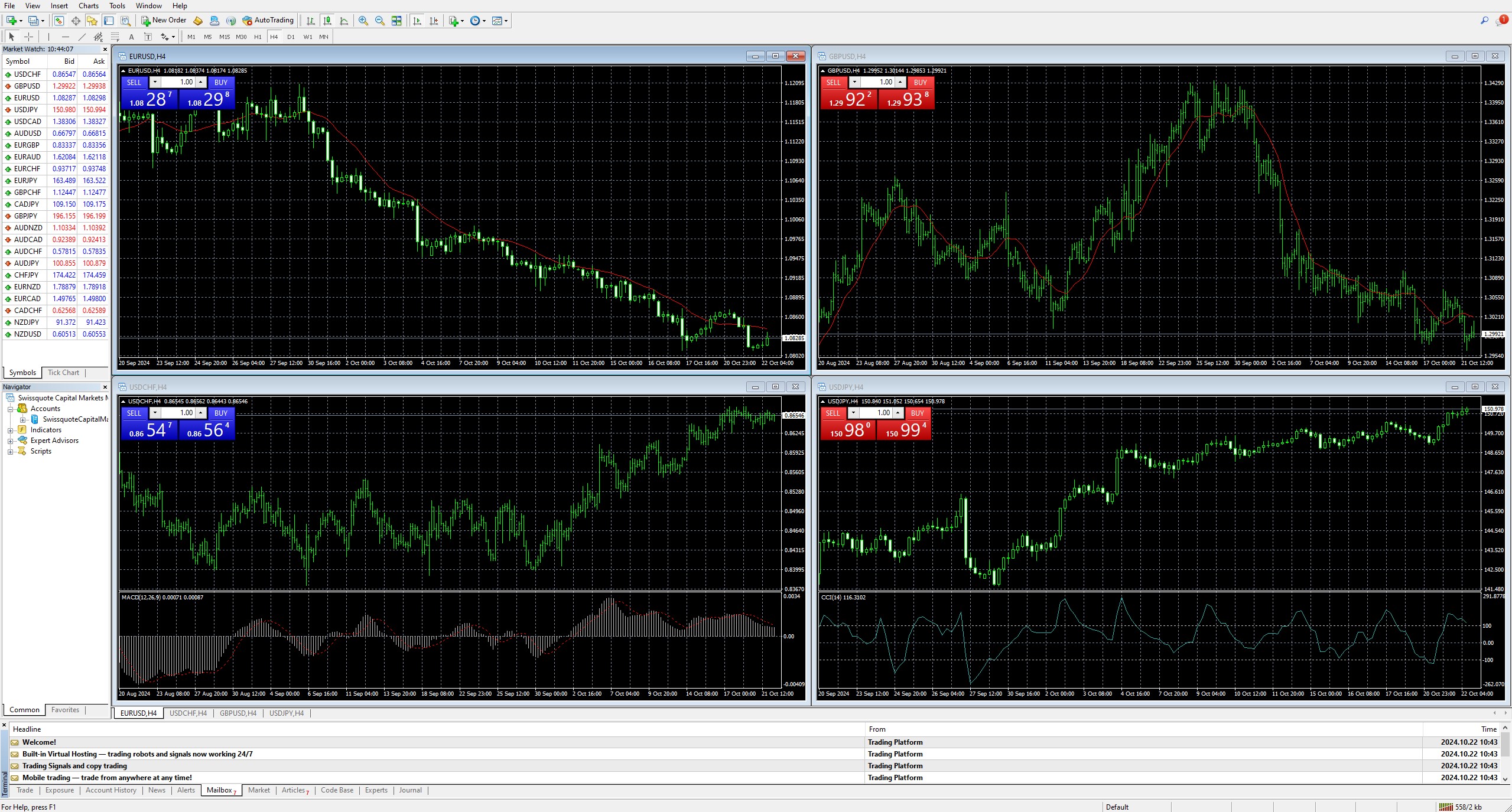
One of the standout features of MT4 is its support for automated trading through Expert Advisors (EAs). EAs automate trading strategies, allowing trades to be managed automatically based on predefined conditions. Users can create custom indicators and scripts using the MQL4 (MetaQuotes Language 4) programming language, specifically designed for developing trading robots and technical indicators. MT4 provides robust security by encrypting data between the trader and the server with a 128-bit key and supporting RSA digital signatures, ensuring that trading and personal data are well-protected. The platform includes advanced communication tools for brokers to post messages and communicate directly with traders, which can be very useful for real-time updates and support. : MetaTrader 4 is available as a web version accessible via an internet browser, and as fully-fledged desktop applications for Windows, Mac, and Linux. It also offers mobile versions for iOS and Android, allowing traders to manage their accounts from smartphones and tablets, providing the flexibility to trade on the go. The platform grants access to market news and includes an internal mailing system to keep traders updated with the latest economic events.
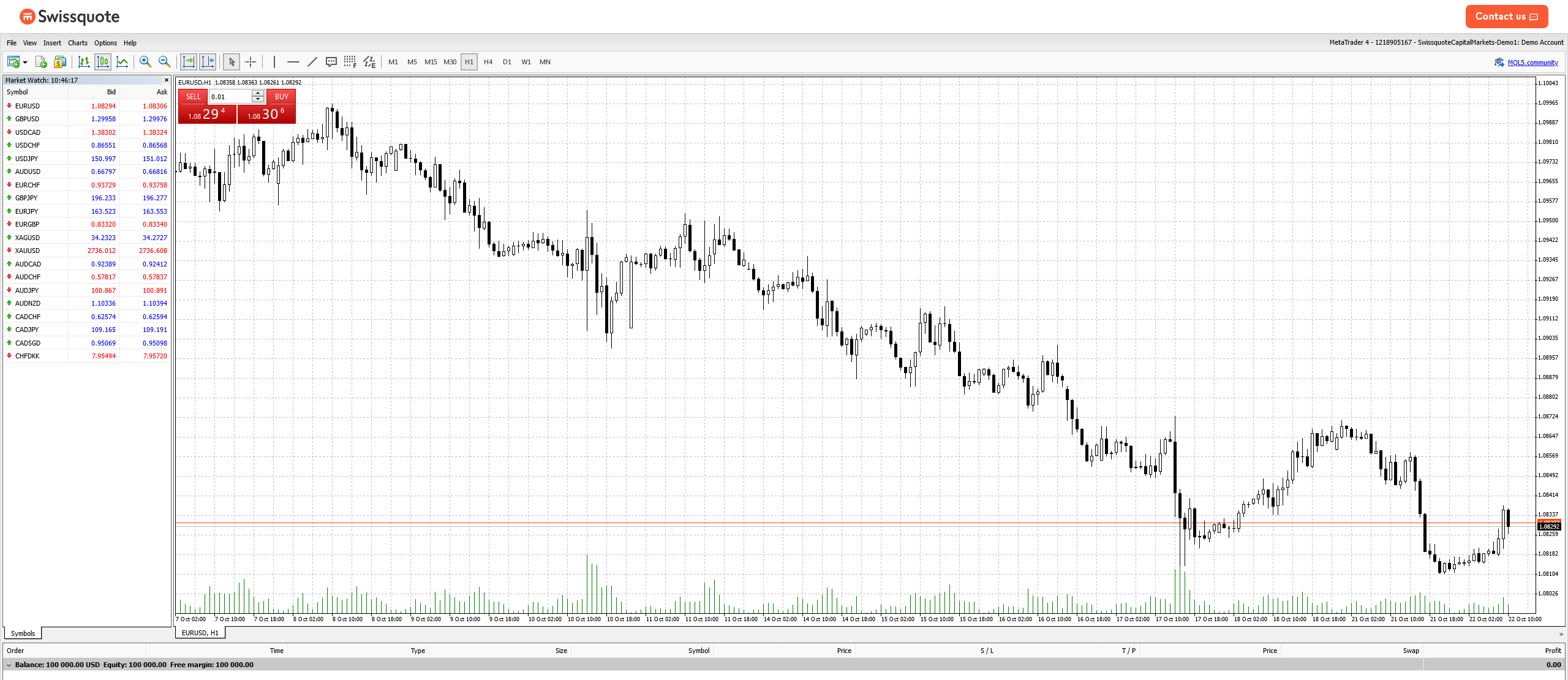
MetaTrader 5 (MT5) is the successor to MetaTrader 4, developed and released by MetaQuotes Software in 2010. It’s designed to cater to a broader market, including not just Forex but also stocks, commodities, and futures. MT5 is equipped with more advanced technological features compared to MT4 and offers additional functionalities aimed at professional traders. Unlike MT4, which is primarily focused on Forex trading, MT5 allows trading in several financial markets from a single account. This includes stocks, futures, and CFDs, providing traders with extensive opportunities to trade different instruments. MT5 includes more technical indicators, graphical objects, and timeframe options than MT4. It features 21 timeframes, over 80 technical indicators and analytical tools, and has an integrated economic calendar directly on the platform.
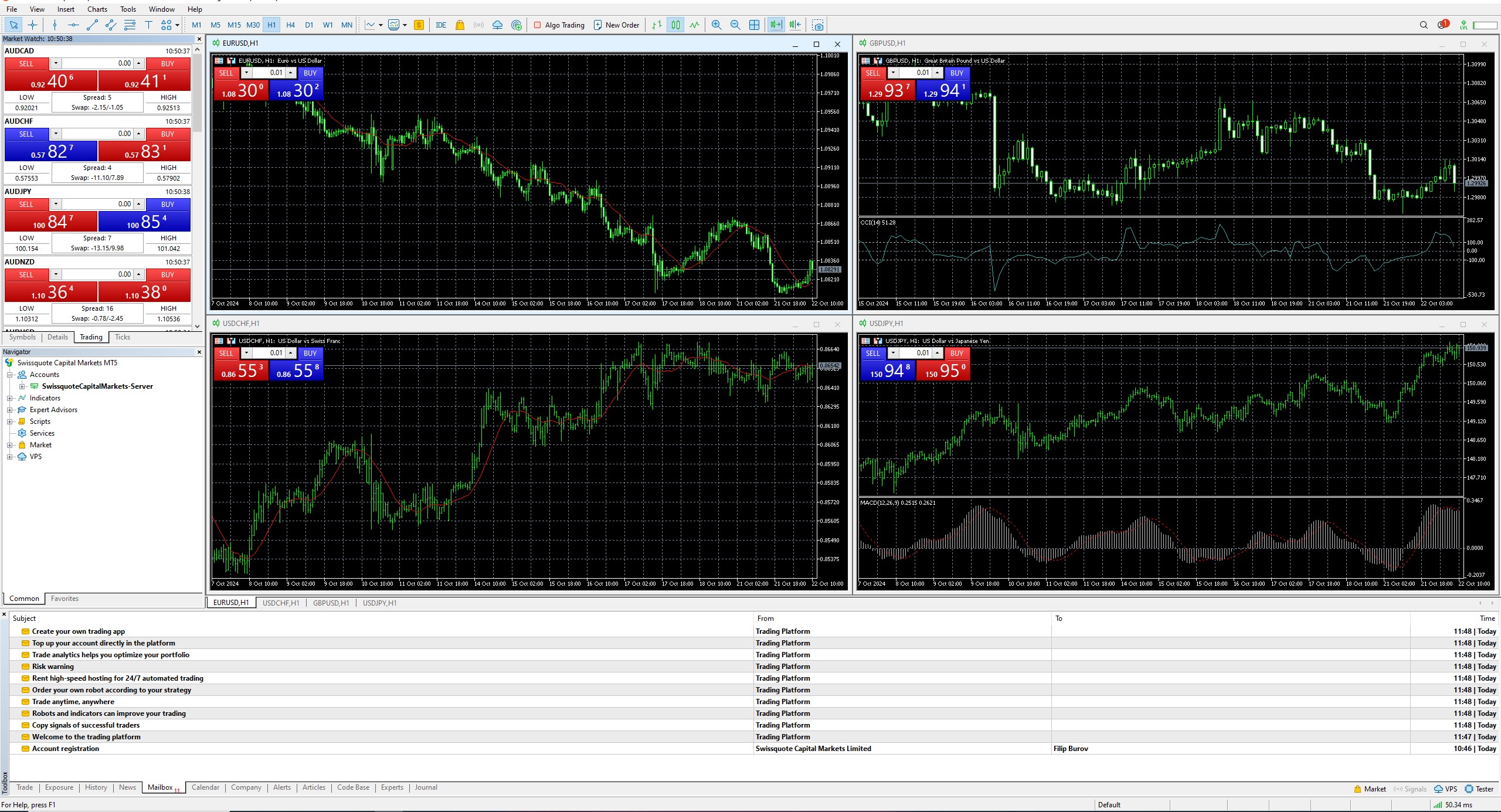
A significant feature of MT5 is the Market Depth functionality, which shows the price quotes from different market participants in real-time. This is particularly useful for day traders and those using scalping techniques. The platform supports MQL5 (MetaQuotes Language 5), which is more powerful and efficient than MQL4. MQL5 allows for faster execution, more advanced EA (Expert Advisor) capabilities, and easier programming of complex trading strategies. However, this means that scripts developed for MT4 cannot be directly implemented in MT5. For those who develop and test algorithmic trading strategies, MT5 offers a powerful strategy tester that supports multi-threaded, multi-currency, and real tick data testing. It also allows the visualization of testing results, providing more insights into the effectiveness of a strategy.
MT5 provides more advanced charting capabilities, allowing for more thorough analysis. Traders can open up to 100 charts simultaneously, and the charts come with 21 timeframes and over 80 built-in technical indicators and analytical tools. Integrated directly into the platform, the economic calendar keeps traders apprised of major economic events that can impact the market, without needing to use an external website. MT5 offers four types of order execution: Market, Instant, Request, and Exchange. This variety allows for greater flexibility and precision in executing different trading strategies.: MT5 supports both netting and hedging systems. While MT4 only offers hedging, MT5 allows traders to choose the system that best suits their trading style and regulatory requirements.
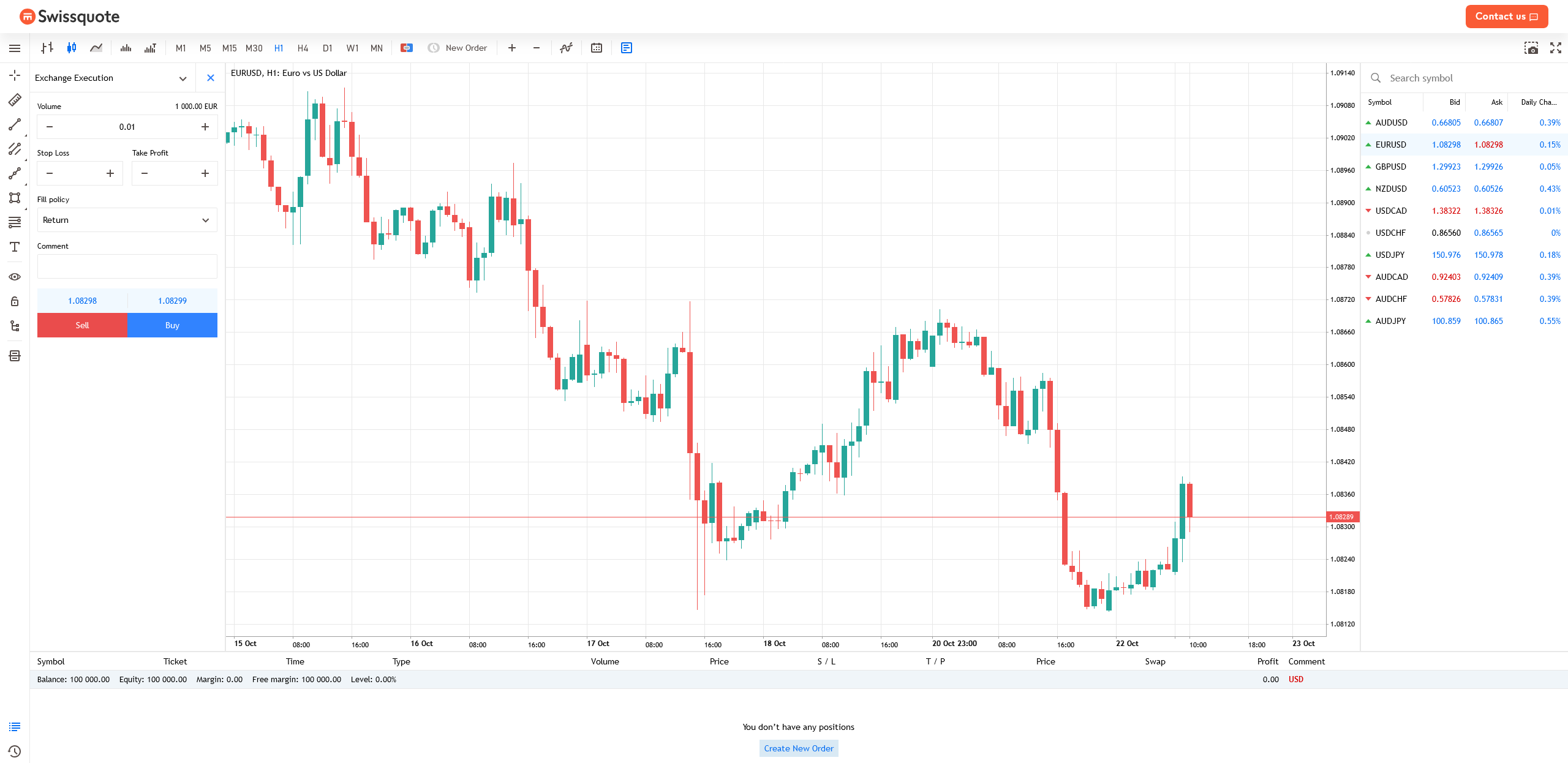
Many traders find MT4 simpler and more straightforward compared to MT5, which offers a broader range of features that can sometimes feel overwhelming. MT4 has been around longer than MT5, leading to wider adoption among brokers and a larger user base. As a result, many brokers continue to support MT4, and it often covers a wide range of markets that traders are interested in. The MQL4 programming language used in MT4 is considered by some traders to be easier to learn and use compared to MQL5. The extensive library of EAs, custom indicators, and scripts available for MT4 is a significant advantage for those who rely heavily on automated trading. Some trading strategies developed for MT4 are not directly compatible with MT5 due to differences in the programming languages and platform architecture. Traders who have invested time and resources in developing or acquiring MT4 strategies may prefer to continue using MT4 to avoid the hassle of converting their tools to MT5.
Full utilization of the capabilities of the MetaTrader platforms for automated trading requires the use of a Virtual Private Server (VPS). This allows scripts to run reliably 24/7 without depending on the trader’s personal hardware and internet connection. Some forex brokers offer their own VPS service or underwrite the subscription fees of clients meeting certain capital and volume traded conditions. While Swissquote appears to target high-volume and sophisticated traders, the broker does not offer VPS services.
In summary, Swissquote’s broad platform offering—now expanded with direct TradingView execution—positions the broker as a top-tier choice for traders who demand both flexibility and functionality. Whether you’re using TradingView’s powerful interface, MT4 and MT5’s multi-asset engine, or CFXD’s innovative tools, Swissquote ensures that every trader can operate in their preferred environment with confidence.
Swissquote Account types and trading conditions
allows registration of Demo accounts , which are active for 30 days. These Demo Accounts only allow access to the trading platforms but not to the Client Area of the website. Three separate Demo Accounts must be registered to test the three available platforms. This does not meet industry standards. It is common for brokers to allow easy initial registration, then allow the creation of multiple Demo and Live trading accounts. This allows clients to test all possible combinations of account type, trading platform, base currency and other parameters, as well as implement different trading strategies simultaneously.
Registration of a live account with the Swissquote requires the completion of a detailed questionnaire on personal details, financial situation, origin of funds, investment intentions and knowledge of the risks of trading financial instruments. The live account registration process can be completed only after verifying identity and residency by providing relevant documents.
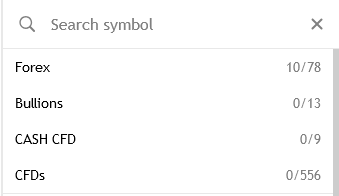
Available tradable instruments include about 80 major, minor and exotic currency pairs, 13 metals, 9 cash CFDs, as well as over 500 CFDs on commodities, stocks, indices, bonds, and two cryptocurrencies – Bitcoin and Ethereum. But note that the full list of tradable instruments is only available when using the CFXD and MT5 platforms. If you are using MT4 you will have access to a smaller number of CFDs instruments due to platform limitations.
Clients of the broker’s Cyprus division have three options for trading account types – Premium, Prime and Elite. The base currencies of the accounts can be CHF, EUR or GBP. The minimum deposit required by the broker is quite high – 1000 EUR or equivalent for Premium, 5000 EUR for Prime and 10,000 for Elite.
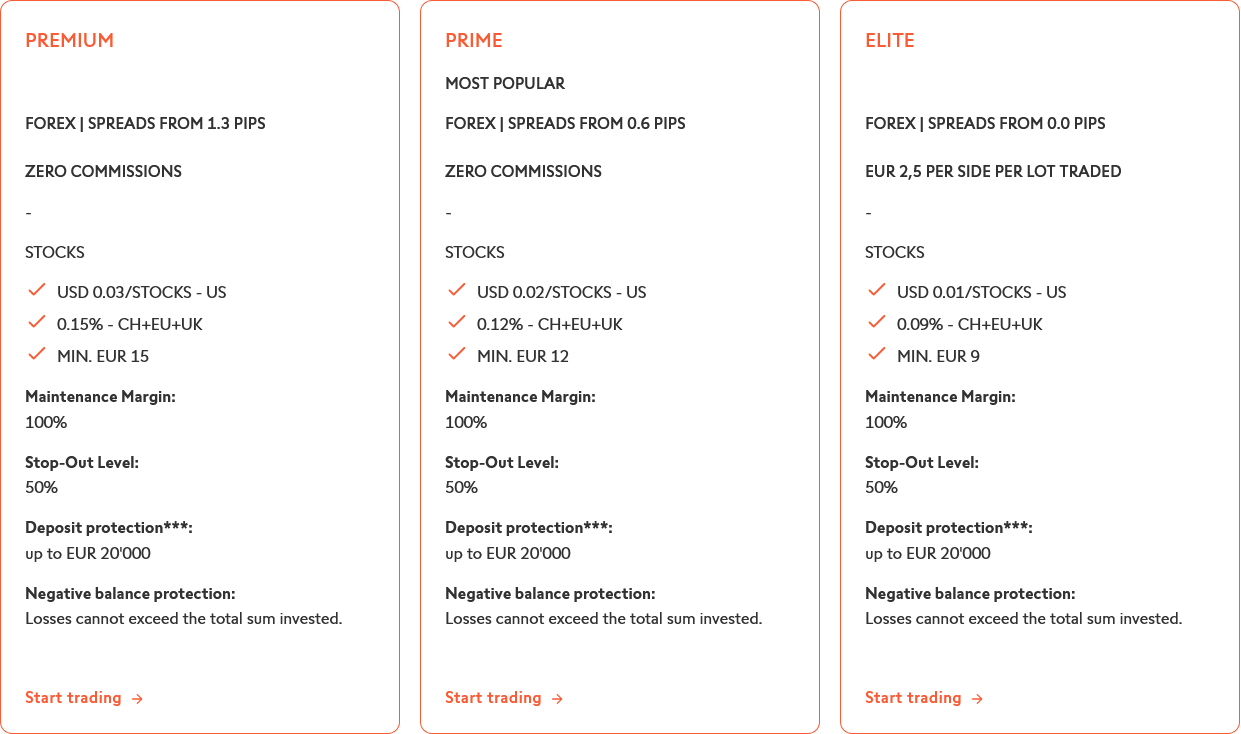
In comparison, the usual minimum deposit required by the leading brands in the industry is 50-100 EUR/USD. These high initial investment requirements can hardly be justified by the trading conditions offered, which are comparable to, but not better than, those of the competition.
Premium and Prime accounts are standard account types where the customer pays a floating spread. According to the account descriptions, the spread for the Premium account starts at 1.3 pips for major currency pairs such as EUR/USD, while the Prime account provides spreads starting at 1 pip. The Elite account is an ECN type account where the spread is very low and starts from 0 pips, but the client pays a fixed commission of 2.5 EUR preside per lot. The Swissquote website provides up-to-date information on the actual spreads, which are 0.2 pips above the base values (respectively 1.5, 1.2 and 0.2 pips for the three account types)
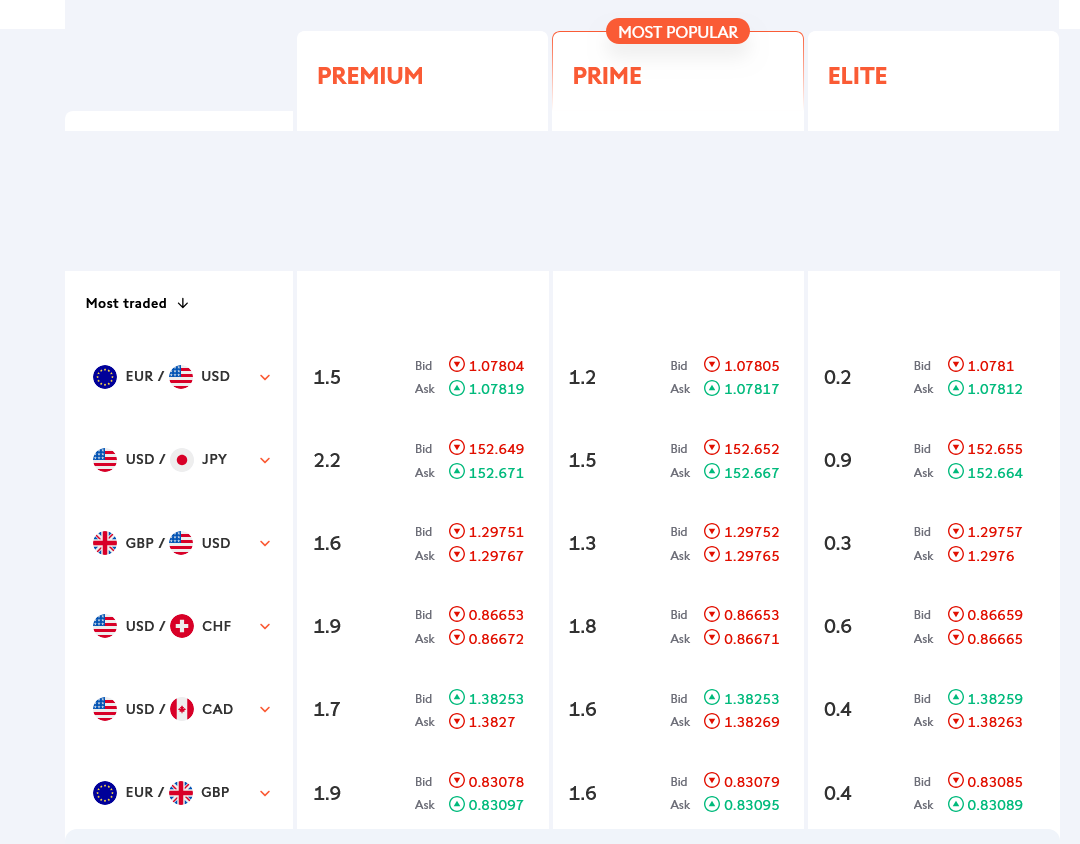
When signing up for a Demo account, you do not get a choice of account type, only a trading platform. Using Demo accounts, we saw a spread of 0.2 pips in the CFXD and MetaTrader 5 platforms, which corresponds to the spreads for an Elite account. When using the MetaTrader 4 platform, we saw a spread of 1.2 pips for EUR/USD, which corresponds to a Prime account. It would be more logical for the demo servers to show spreads for the starting account type, in this case Premium.
The broker’s clients in Switzerland, Dubai and the rest of the world also have a choice of three account types – Standard, Premium and Premium. The required minimum deposits are 1,000, 10,000 and 50,000 USD respectively. These divisions of the broker do not offer different pricing models – all three account types have a floating spread. The account descriptions promise EUR/USD spreads of 1.7, 1.4 and 1.1 pips respectively. Unlike the website designed for the EU, those for Switzerland and Dubai do not provide actual spread information. But even the advertised levels are not at all competitive, especially compared to the required investment.
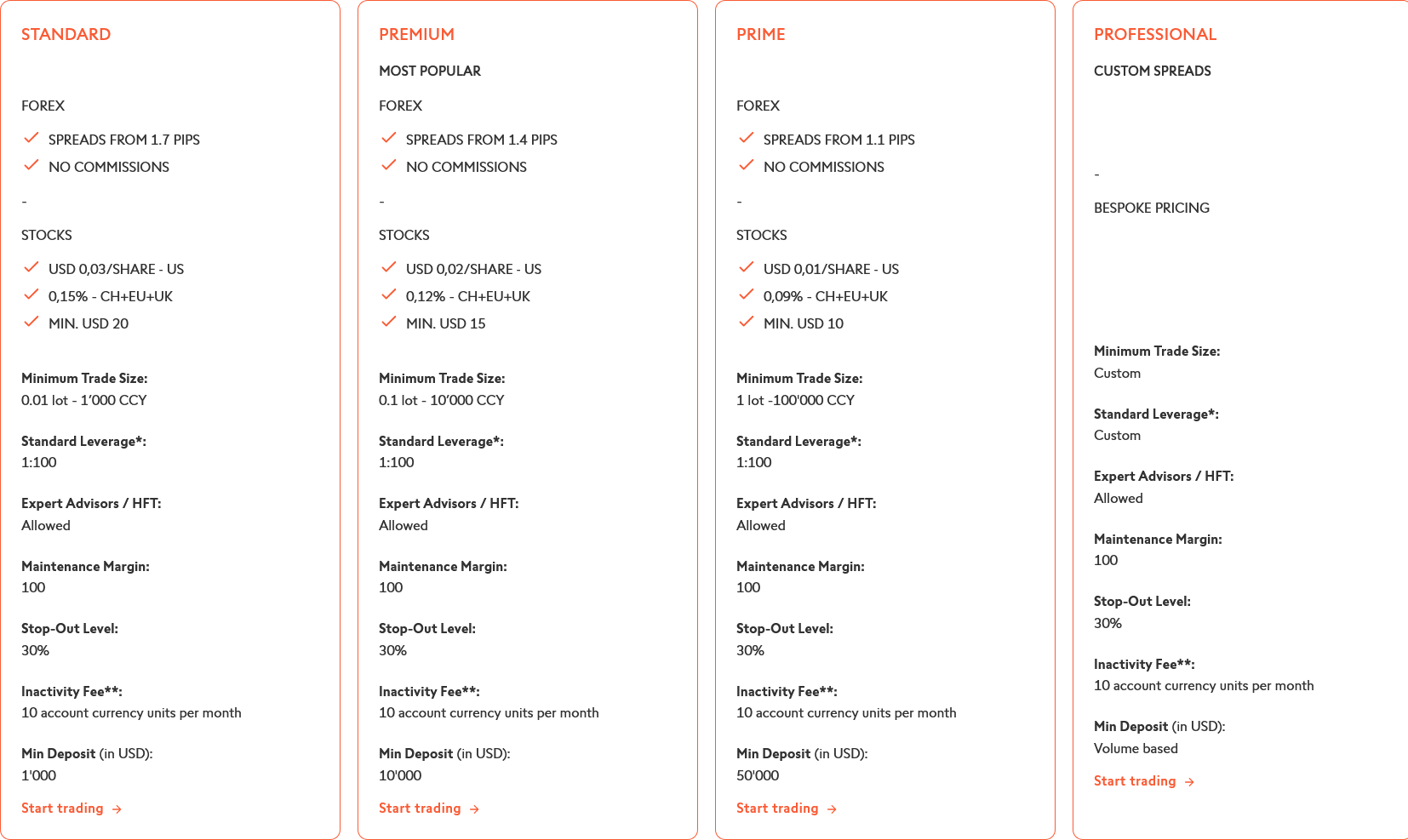
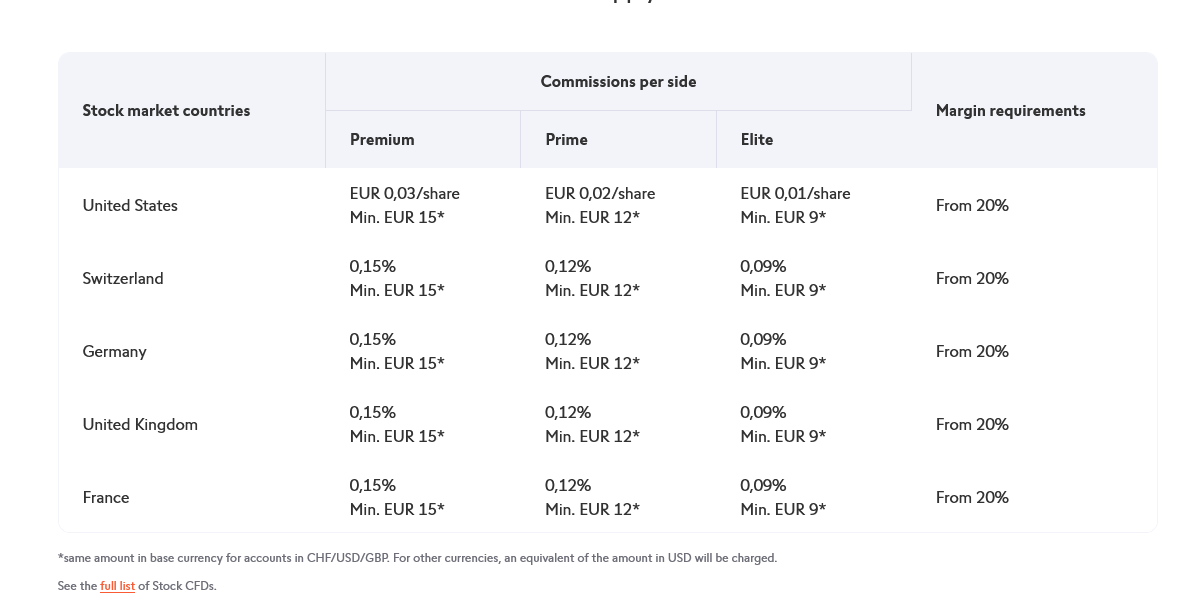
Trading commissions on stock CFDs are also relatively high – 0.03 USD per share for US stocks and 0.15% for European stocks. For Cypriot clients, the minimum order size is 15 EUR, for the rest – 20 USD.
The website intended for non-EU and Dubai clients also advertises a Professional account, which has no publicly stated deposit and trade price requirements. Clients of this broker unit have a wider choice of base currencies – EUR, USD, JPY, GBP, CHF, CAD, AUD, TRY, PLN, SEK, NOK, SGD, XGD, HUF and CZK.
In general, only the clients of the Cypriot company receive relatively competitive trading conditions, and if we exclude the high minimum deposit. They are also the only ones who have a choice of pricing method, albeit locked behind a very high minimum deposit.
With the accounts where traders pay only the spread, those spreads are usually higher than those in raw spread accounts, because this is the primary way the broker earns revenue on these accounts. Traders don’t have to calculate additional commission costs, because the cost of the trade is clear from the spread alone. These accounts are generally more suitable for beginner traders, less frequent traders, or those who prefer simplicity in cost calculations.
Raw spread accounts with fixed commission offer spreads that are very close to the interbank spread (which can be zero or near zero) and charge a fixed commission on each trade. A fixed commission is charged per lot traded, which is separate from the spread. This fee is explicitly stated and is generally based on the transaction size. These accounts provide more transparency in pricing and can be more cost-effective for frequent traders or those trading large volumes. For high-volume traders, raw or zero spread accounts can be more cost-effective despite the commission. The narrower spread means that the cost to enter and exit trades is lower, which can significantly impact profitability in strategies that involve frequent trading (like scalping). Raw or zero spread accounts offer more transparency. Traders can see the actual market spread and are only charged a clearly defined commission, making it easier to analyze and forecast trading costs.
The choice might depend on your trading strategy. If your strategy involves opening many trades quickly (scalping or high-frequency trading), a raw spread plus commission account might be more suitable because the transaction costs could be lower per trade. For less frequent trades or longer-term positions, the simplicity of a spread-only account might be preferable if the slightly higher spread isn’t a significant factor in the strategy’s performance.
A forex broker that only offers standard spread accounts may face challenges in appealing to a wider range of traders, particularly active and professional traders. The lack of raw spread and fixed commission accounts can result in higher trading costs, less transparency, and reduced market competitiveness. Traders generally appreciate the flexibility of choosing between different cost structures, and without that option, brokers may struggle to attract more sophisticated or high-volume traders.
The European Securities and Markets Authority (ESMA) and accordingly all EU regulators limit leverage for retail clients to 1:30 for major currency pairs, 1:20 for non-major pairs, gold and major indices, 1:10 for other commodities and non-major indices, and 1:2 for cryptocurrencies. European regulations also set a stop-out level of 50%. Accordingly, these are also restrictions for the retail customers of the Swissquote’s Cypriot subsidiary.
EU regulations allow brokers to offer higher leverage to traders with professional status who meet very high requirements for available capital and trading experience. Professional traders must have executed transactions of significant size in a relevant product with an average frequency of at least 10 per quarter over the previous four quarters (with this broker and/or other providers). The size of the professional client investment portfolio, defined as including cash deposits and financial instruments, must exceed 500,000 USR. Another requirement is that you work or have worked in the financial sector for at least one year in a professional position that requires knowledge of relevant products. There is no information on the Trade Markets website regarding special conditions for professional customers.
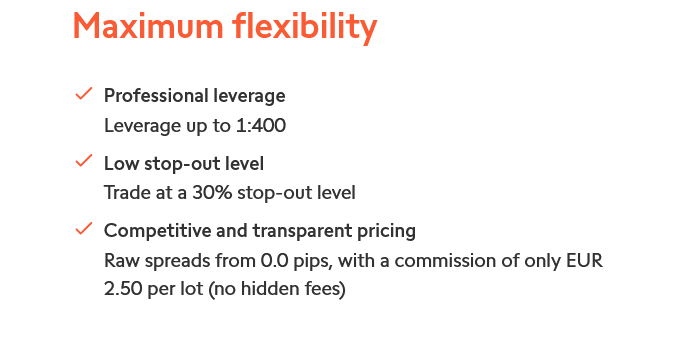
Swissquote Cyprus offers clients with professional status much higher leverage – up to 1:400. Professional clients also have a more flexible stop loss level of 30%. For retail clients in the EU, regulations impose a stop-out level of 50%. The Professional account has the same pricing model as the Elite account – a raw spread and a commission of EUR 2.5 per lot.
Swissquote’s retail clients in Switzerland, Dubai and the rest of the world can leverage up to 1:100. While this level is higher than that available to retail clients in the EU, it is not competitive with offshore brokers and offshore divisions of established brands that offer leverage ratios of 1:500, 1:1000 or even higher.
Swissquote does not offer popular passive income options such as Copy Trading or PAMM accounts. Customers of the Swiss company of course have the option to use standard banking services, but they are not the subject of this review.
If an account has had no trading activity for six calendar months, the broker will consider it inactive and start charging a monthly fee of 10 units of the account’s base currency.
Swissquote Deposit and Withdraw Methods
In order to deposit and withdraw funds from your Swissquote trading account, you must have completed the verification process, which requires providing identification and proof of address.
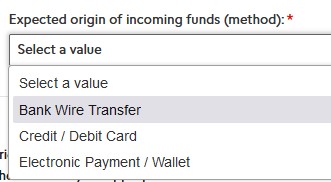
In the questionnaire that is filled in when registering a live account there is a question about the preferred method of funding – wire transfer, credit/debit card or e-wallet. But in reality, the available choice of payment methods is much more limited. In fact, customers of the Cypriot company can only deposit and withdraw funds via bank transfer. The broker states that it does not charge its own trax for deposits, but it is not clear whether there are fees for withdrawals.
Other Swissquot customers have one additional option – Visa and MasterCard. When depositing with cards there is a third-party fee of 1.9% for residents of SEPA countries.
Withdrawals by wire transfer are subject to a fee depending on the currency, in most cases EUR 10 or close equivalent. It is not clear from the available information whether credit and debit cards can be used for withdrawals.
These limitations could be explained by the fact that Swissquote is also a bank. But this does not actually apply to the Cypriot company serving European Union clients. Leading brands in the industry often offer a much wider range of payment methods, including popular e-wallets such as PayPal, Skrill and Neteller, local payment processors such as Klarna, GiroPay, iDeal, Sticpay, Perfect Money, Pix, Astro Pay and others. A growing number of brokers also offer cryptocurrency transactions.
Swissquote promises to process bank transactions within one business day and card transactions within two hours. But the broker warns that bank transfers could potentially take up to 3-5 business days.
A Client wishing to submit a withdrawal request must inform Swissquote through the Client Portal or via email. The Back Office department shall evaluate the withdrawal request ensuring that the equity in the client’s trading account is positive. Consequently, the broker shall process and approve the client’s request to withdraw funds within one business day.
Otherwise, depending on the case, the Back Office shall request to be provided with additional information and/or documentation.
| Deposit method | Minimum | Maximum | Processing time | Fee |
| Bank | €1000 | Unspecified | up to 5 days | Free |
| Credit/Debit Card | €1000 | Unspecified | up to 2 hours | 1,9% |
| Withdrawal method | Minimum | Maximum | Processing time | Fee |
| Bank | Unspecified | Unspecified | up to 5 days | €10 |
| Credit/Debit Card | Unspecified | Unspecified | up to 24 hours | Unspecified |
Swissquote Bonuses and Promotions
Clients of the Cyprus office of the Swissquote can expect no bonus offers or promotions. The regulatory framework of the European Union does not allow forex brokers based in the bloc to offer their clients bonuses and promotions. The broker also does not offer bonuses to clients outside Europe. This, like the low maximum leverage, makes it not very competitive in these markets. If you want to take advantage of deposit bonuses, cashback, loyalty programs, competitions and prize games, the best option is an offshore division of an established global brand.
Swissquote Tools and Education
Swissquote is clearly not a broker aimed at novice traders. Because of this, we didn’t expect it to offer things like basic tutorials or even a forex glossary. However, Swissquote offers some resources for more experienced investors. This includes webinars, available in several languages – English, Polish and Italian. The broker also maintains its own YouTube channel where you can find up-to-date market insights from experts.
The Help Center does not allow keyword searches, so finding relevant information requires digging through the available categories. The broker also does not provide the ability to contact customer support via live chat.
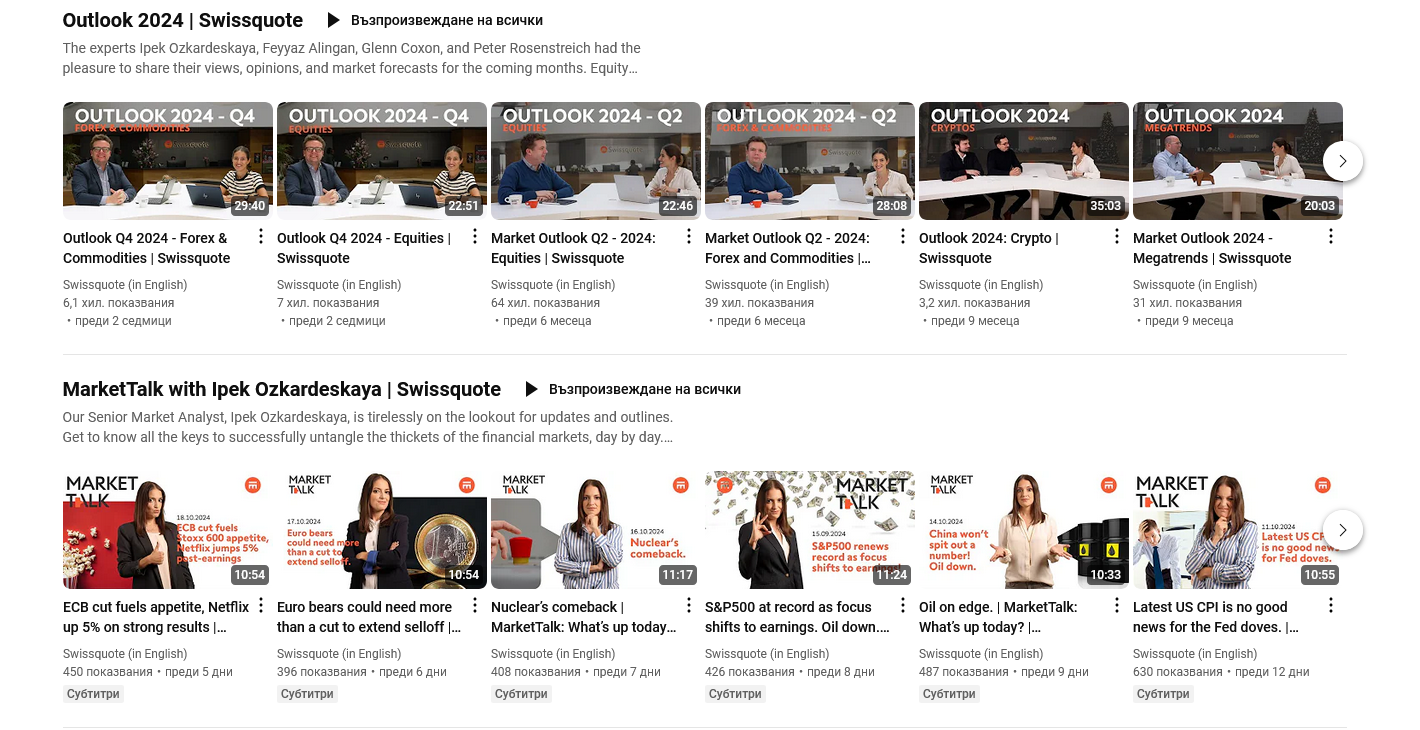
In terms of ancillary instruments, Swissquote offers nothing beyond those included in the trading platforms. There is no separate economics calendar, forex calculators, analytics and other research resources on the website. While Autochartist is integrated with Swissquote’s own trading platform, we find no information regarding Autochartist plugins for the MetaTrader platforms, which is odd.
Notes from the author:
Swissquote is a broker with a banking license that offers investments in securities, crypto and other products in addition to CFD trading. But these services are not integrated for many clients. In fact, European Union clients do not have access to banking services. Moreover, in the EU market, forex and CFD trading is managed by a company in Cyprus, while investment services are offered by a company in Liechtenstein and require separate registration through a separate website. In terms of forex and CFD trading, which is the focus of this review, clients of the Cypriot company get a good package, but with one caveat - the high minimum deposit. If amounts between €1,000 and €10,000 are not a deal breaker for you, then Swissquote offers a pretty good quality web trading platform in addition to the industry staples MT4 and MT5, relatively competitive spreads and pretty low commissions for the raw spread account. The available tradable instruments are fairly numerous and diverse, although there are only two tradable cryptocurrencies. It should be pointed out as annoying that three separate demo accounts have to be registered in order to test the three available trading platforms. It is not clear from the information available whether the same applies to live accounts. For customers outside Europe, the Swissquote just doesn't look competitive. In these markets, the broker offers only floating spread accounts, and these spreads are high, coupled with even higher minimum deposits. Many clients in these markets have a choice of more competitive terms, coupled with higher leverage and bonuses.


