




Titan FX Minimum Deposit
Titan FX offers three account types – Standard, Blade and Micro. No minimum deposit is specified in the account type descriptions. The FAQ section states that the minimum initial deposit is 200 USD. This is not a very high level, but nowadays brokers usually allow you to start trading with a lower amount, usually 50-100 USD, and sometimes only 5 USD. The description of the Micro Account states the minimum deposit is correspondingly lower, but nowhere is a specific amount stated. Different payment methods have different minimums for single transactions.
Whether you are a beginner trader or an experienced investor testing a new broker, it is advisable to start with a more moderate amount. Trading with a small amount limits potential losses. Forex markets can be volatile, and prices can fluctuate rapidly. By investing small amounts, you minimize the risk of substantial financial damage. Starting small allows you to gain practical experience without risking a significant portion of your capital. This real-market exposure is invaluable for understanding trading strategies, market behavior, and your own psychological reactions to wins and losses.
Small investments are ideal for testing and refining trading strategies. You can see how different approaches perform under real market conditions without the fear of losing large amounts of money. Forex trading often involves leverage, which can amplify both gains and losses. Starting with a small investment helps you learn to manage leverage effectively, preventing scenarios where large losses exceed your initial deposit. If you have a broader investment portfolio, starting with a small forex trading investment can serve as a test to see how it fits with your overall investment strategy without significantly impacting your total portfolio. Starting small gives you the flexibility to adapt and adjust as you learn. You can increase your investment size gradually as you become more confident and successful in your trading tactics.
Titan FX offers a fairly diverse set of payment methods through which to deposit and withdraw funds from your trading accounts. Available options include credit/debit cards, international bank transfer, local bank transfer for customers residing in Japan, Sticpay, Skrill, Neteller, Bitwallet, Apple Pay and cryptocurrencies.
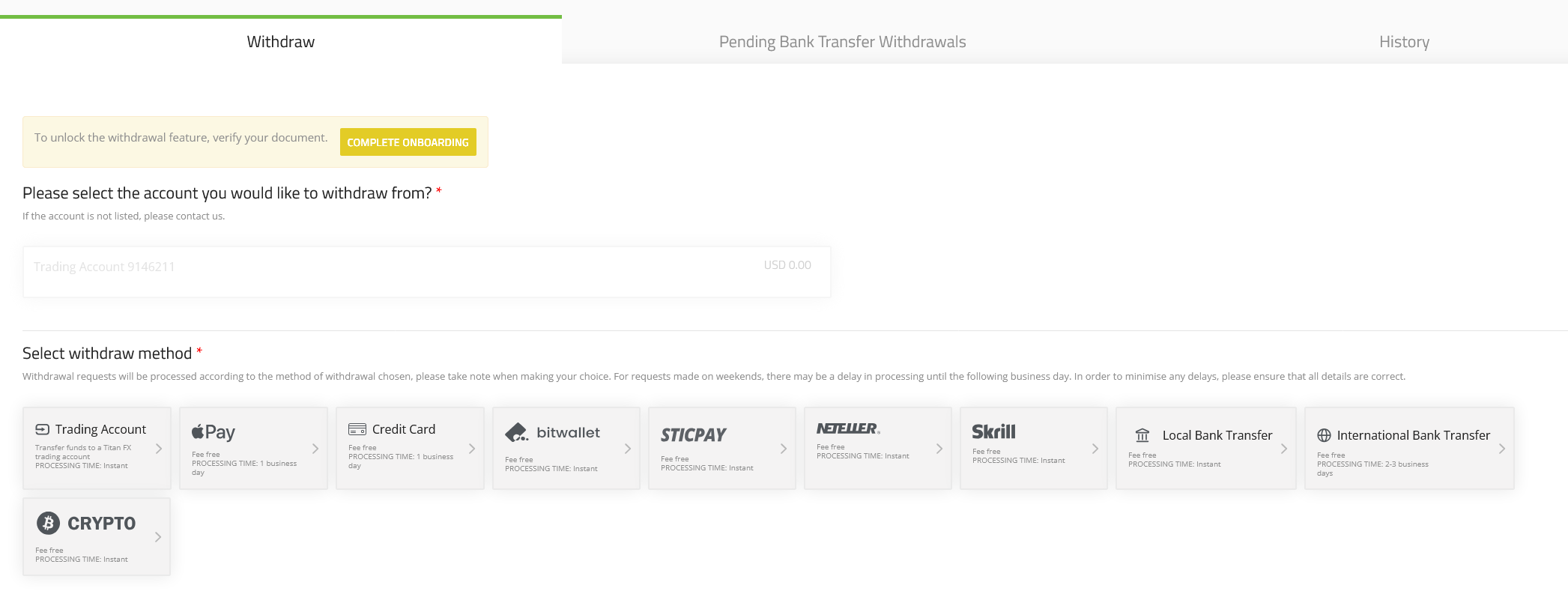
The minimum and maximum deposit and withdrawal amounts depend on the payment method and currency. When using Visa and Mastercard, there is no minimum deposit amount and the maximums are 100,000 USD, AUD, EUR and SGD and 10,000,000 JPY respectively. For JCB cards, the transaction amount must be between 20 and 5,000 USD or equivalent. When depositing with Apple Pay, the deposit amount must be between 1 USD or equivalent in AUD, JPY, EUR or SGD and 80,000 USD or equivalent. For Sticpay the deposit amount must be between 30 USD or equivalent and 100,000 or equivalent, for Skrill between 10 USD/EUR and 1000 JPY and 50,000 USD, 5,000 EUR or 750,000 JPY, and for Neteller between 10 USD/EUR/JPY and 5,000 USD/EUR and 750,000 JPY. The minimum and maximum deposit when using an international bank transfer is 50 USD/EUR/GBP/SGD and 100,000 USD or equivalent. For a local bank transfer in Japan, the deposit can be between JPY 5,000 and JPY 10,000,0000. For cryptocurrencies, the minimum deposit is USD 60 or equivalent and USD 50,000 or equivalent. There are no set minimums and maximums when using Bitwallet.
It is advisable to use more established and familiar payment methods, especially if you are a new trader or trying out a new broker. But all available payment methods have their advantages. Let’s discuss in detail what they are.
One of the most widely used payment methods are credit and debit cards. Nearly everyone has a credit or debit card, and they are easy to use online, making this a very convenient option. Credit and debit card deposits are usually instant, which is crucial for taking advantage of market movements in fast-paced forex markets. Payments made through credit and debit cards can be easily tracked and recorded, helping traders keep a good record of their investment funds.
But bank cards also have some potential drawbacks as a payment method for funding a forex trading account. Because credit cards allow the use of borrowed money, there’s a risk of overleveraging—trading with more money than one can afford to lose. While generally secure, credit and debit card transactions are susceptible to fraud and hacking. If a trading platform’s security is compromised, card information could be at risk. Many brokers allow deposits via credit or debit cards but might require withdrawals to be processed through bank transfers or other methods.
Depositing funds into a forex trading account using international and local bank transfers is a common practice, each method having its own set of advantages and disadvantages. Bank transfers are among the most secure methods for transferring large sums of money. Banks employ high levels of encryption and security protocols, providing peace of mind, especially for substantial transactions. Compared to e-wallets and other payment methods, bank transfers often have much higher or no limits on the amount you can deposit, making them ideal for traders handling large volumes of funds. Funds move directly from a trader’s bank account to the forex broker’s account without the need for intermediaries, simplifying the process and sometimes reducing fees.
But bank transfers, especially international ones, can be slow. They may take several days to process, which can be a significant disadvantage in forex trading where market opportunities can change rapidly. Both local and international bank transfers can incur significant fees. International transfers often have additional costs, including currency conversion fees and intermediary bank charges. Setting up a bank transfer, particularly an international one, can involve a lot of paperwork and compliance checks, which can be time-consuming and cumbersome. In some regions, especially in developing countries, access to banking services can be limited, which might restrict some traders from using bank transfers effectively. Besides being generally slower, bank transfers can be subject to unexpected delays due to banking hours, national holidays, or errors in filling out transfer forms. Local bank transfers usually incur lower fees compared to international transfers and are often processed more quickly.
Depositing funds into a forex trading account using cryptocurrencies is an emerging option that offers unique benefits and certain drawbacks. As this method becomes more widespread, understanding its advantages and disadvantages becomes important for traders considering this option.
Transactions with cryptocurrencies can be processed quickly, often faster than bank wire transfers. This speed facilitates rapid account funding, which is critical in the fast-paced forex market. Cryptocurrency transactions generally have lower fees compared to traditional banking methods, especially for international transfers. Since cryptocurrencies operate on decentralized networks, traders can conduct transactions without the need for a central authority, potentially reducing paperwork and compliance requirements. Cryptocurrencies provide a uniform method of payment regardless of the trader’s or broker’s location, bypassing some of the limitations and fees associated with currency conversion and international banking.
Once confirmed, cryptocurrency transactions are final, which protects the recipient from chargebacks or disputed payments that can occur with credit cards. The value of cryptocurrencies can be highly volatile. The amount deposited in crypto could rapidly change in value, affecting the actual fiat value when credited to a trading account. The regulatory environment for cryptocurrencies is still evolving, which can introduce risks and uncertainties. Some countries may impose restrictions on their use, affecting their acceptability and legality. Managing cryptocurrencies requires a certain level of technical understanding, including the use of wallets and the safeguarding of private keys. Loss of access to a crypto wallet can result in irreversible financial loss. While blockchain technology is secure, other aspects such as exchange hacks or compromised wallets pose significant risks. Cryptocurrency transactions may trigger tax events in certain jurisdictions. Traders need to be aware of and comply with their local tax regulations regarding crypto transactions. For traders considering using cryptocurrencies to fund forex accounts, it’s crucial to weigh these factors and consider personal needs and local regulations.
Using e-wallets such as PayPal, Skrill, Neteller, Google Pay, and Apple Pay to deposit funds into a forex trading account offers several advantages and disadvantages, impacting the ease of use, cost-effectiveness, security, and overall trading experience. E-wallets generally offer instant or very fast transaction times, allowing traders to fund their accounts quickly and take advantage of trading opportunities as they arise.These platforms are typically user-friendly and accessible via smartphones, making it easy to manage and transfer funds on the go. Integration with mobile devices allows traders to deposit funds from nearly any location. E-wallets employ robust security measures, including encryption and two-factor authentication, to protect users’ financial information. This is particularly important in the context of online trading, where security concerns are paramount. Compared to traditional banking methods or credit cards, some e-wallets may offer lower transaction fees, particularly for international transfers. Many e-wallets handle multiple currencies and automatically convert them at competitive rates, which is beneficial for forex traders dealing in various currencies.
While some e-wallets offer lower fees for certain transactions, they might charge higher fees for others, such as currency conversion fees or withdrawal fees to bank accounts. Traders need to be aware of and understand the fee structure of their chosen e-wallet. Some e-wallets may impose limits on the amount of money that can be withdrawn or transferred at a time, which can be inconvenient for traders managing larger balances or those who need to access their funds swiftly. The use of e-wallets is not universally accepted in all countries, and in some jurisdictions, traders may face regulatory challenges or limitations on the use of digital payment methods. E-wallets require internet access to conduct transactions. In areas with unreliable internet service, this can be a significant drawback.
The broker promises execution of transactions within one day for most payment methods. The exception is international wire transfers, which can take up to 7 business days. Titan FX does not generally charge transaction fees, but the customer pays their own banking and crypto fees.
Standard and Blade accounts use lots of 100,000 currency units, with a minimum order size of 0.01 lots, or 1000 currency units. At a leverage of 1:500, this means you only need 2 USD to place a minimum order. If you are using a Micro Account with a leverage of 1:1000, then you only need a few cents to place a minimum order.
Trading in smaller lot sizes significantly reduces the financial risk per trade. Losses on any single trade are more manageable and have a smaller impact on the overall account balance. This is especially beneficial for beginners who are still learning about market fluctuations and risk management. With the ability to make smaller trades, traders can fine-tune their risk management strategies. This includes adjusting the trade size according to the volatility of the currency pair or economic events, thus allowing for more precise control over the exposure of each trade.
Smaller lot sizes allow new traders to gain real-market experience without the pressure and potential severe losses that larger lot sizes could entail. This practical experience is crucial for understanding market behavior, testing strategies, and building confidence without risking significant amounts of money. Traders using mini and micro lots can diversify their trading strategies across different markets and positions. This flexibility enables the execution of multiple trades simultaneously while spreading risk across various instruments, thus not putting all eggs in one basket.
Depositing and withdrawing funds into your Titan FX trading accounts can only be done through the client area of the website. Your account must be fully verified to access the transaction menus.
After logging in, you have two options to access the deposit menu – through the main menu located on the left side of the interface, or through the Deposit Funds button on your trading accounts screen.
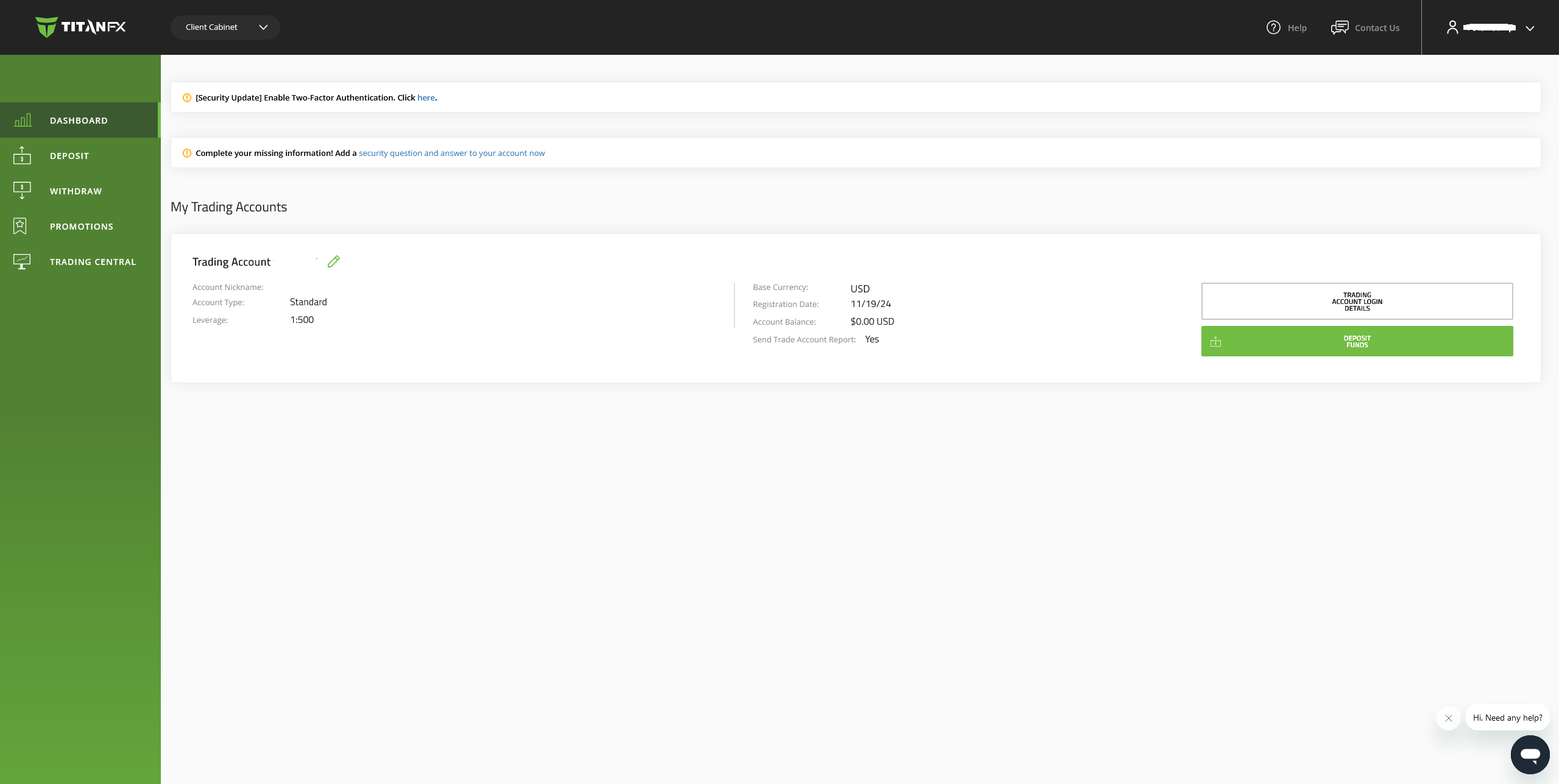
The next step requires you to select a payment method and enter an amount to deposit. Electronic wallets require an account registered with the same email as your Titan FX account. Credit and debit cards must be pre-registered in your broker account. If all required details are entered, click the Deposit button at the bottom of the screen.


