





Ventorus Review
Ventorus is a relatively new entrant to the forex and CFD industry, launching in 2024 with the promise of a proprietary web-based trading platform and a diverse product range designed to attract retail clients. The broker markets itself as a modern, accessible alternative, emphasizing technology and ease of use.
The real concern, however, is not the platform but the regulatory framework. Ventorus is incorporated in the Comoros Islands (Mwali) and licensed by the Mwali International Services Authority (MISA) — a regulator widely viewed as offering only minimal oversight. Unlike top-tier authorities such as the FCA (UK), ASIC (Australia), or CySEC (Cyprus), MISA does not impose strict capital requirements, enforce robust fund segregation, or maintain investor compensation schemes.
For traders, this creates a significant risk profile. In cases of disputes, insolvency, or withdrawal issues, clients have little to no protection compared with what they would receive under stronger regulatory regimes.
This review takes a closer look at Ventorus’ regulation, platform, account types, payment policies, and trading conditions, with a focus on where the broker falls short of the standards set by reputable, well-regulated competitors.
Ventorus Regulation
Ventorus presents itself as a licensed broker, but a closer look at the regulatory structure reveals important weaknesses. The company behind the brand, Apex MKT Ltd, is registered in the Comoros Islands (Mwali) and operates under a license from the Mwali International Services Authority (MISA), number T2023290, with company registration 2023-00162. The broker also lists an address in Saint Lucia and uses Valsia Services Ltd, a Cyprus-incorporated firm, as its payment agent.
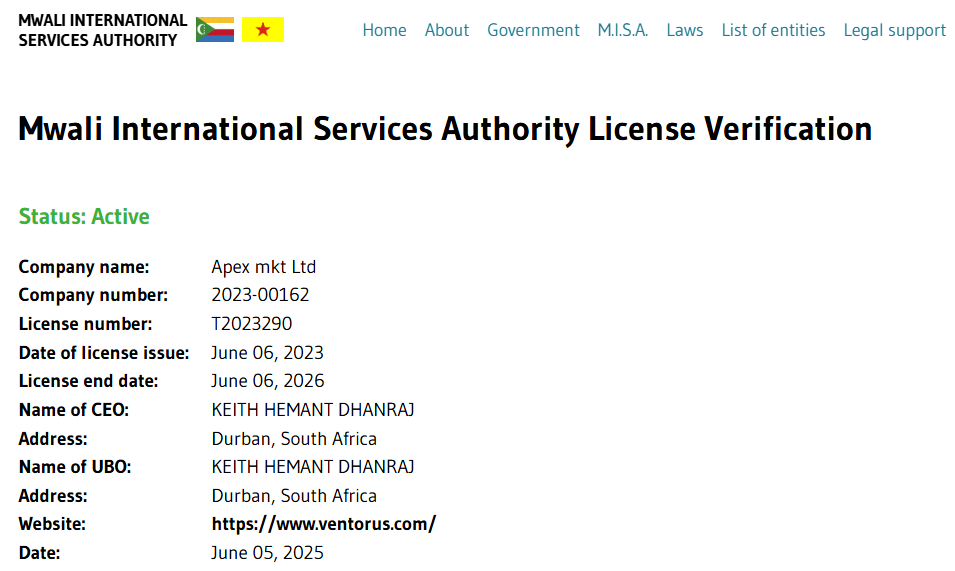
While this arrangement creates the impression of a global presence, the regulatory backbone remains fragile. MISA is not a top-tier authority and is often regarded as offering only nominal oversight. Unlike the FCA in the UK, ASIC in Australia, or CySEC in Europe, MISA does not enforce strict requirements for capital reserves, segregation of client money, or independent audits. Nor does it maintain an investor compensation fund to protect clients in the event of insolvency.
The practical consequences for traders are significant. With Ventorus, there is no assurance that deposits are separated from company operating funds, no mandatory negative balance protection, and no independent verification of the broker’s financial health. Dispute resolution mechanisms are also weak, meaning that clients may have little recourse if problems arise.
In essence, Ventorus holds a license, but it is one that offers legal recognition without real security. Traders considering this broker should weigh the risks of offshore regulation carefully — the difference between a regulatory stamp and genuine investor protection can mean the difference between safety and exposure.
Ventorus Trading Platform
Ventorus delivers its services exclusively through a proprietary web-based platform, bypassing industry staples like MetaTrader 4 (MT4), MetaTrader 5 (MT5), and cTrader. This decision immediately sets the broker apart — but not necessarily in a good way. For many traders, the absence of widely trusted platforms means giving up a global ecosystem of tools, integrations, and proven reliability.
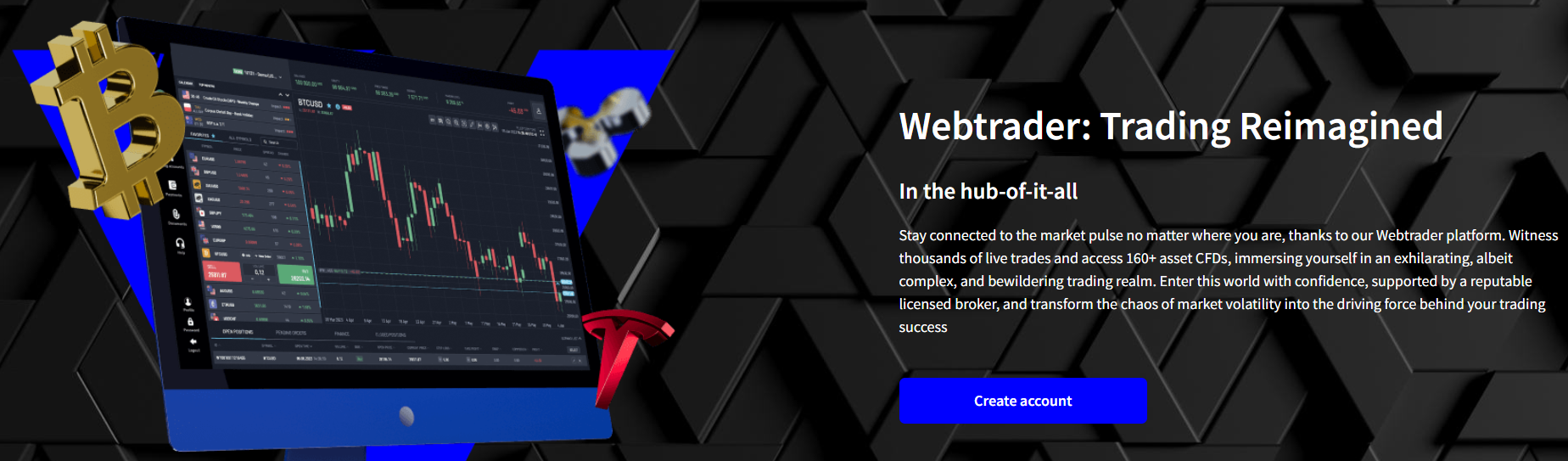
According to the broker, the in-house WebTrader is designed to be user-friendly. It offers a customizable interface, built-in charting with common indicators, and standard order management tools such as stop loss and take profit. The platform is accessible via any browser, providing 24/7 availability across supported markets. These features may be sufficient for newcomers seeking simplicity, but they fall short of what professional traders expect.
The main drawback is depth. Unlike MT4 or MT5, Ventorus’ proprietary system does not support algorithmic trading through Expert Advisors, advanced backtesting, or the extensive libraries of third-party indicators that many traders rely on. Serious users accustomed to VPS hosting, automation, or custom strategies will find this environment restrictive.
Another concern is transparency. Because the platform is entirely controlled by Ventorus, all pricing, execution, and order routing occur without the external oversight that comes with established third-party platforms. This makes it difficult for clients to verify execution quality or ensure fair dealing.
In short, Ventorus’ WebTrader may serve beginners who want quick access and a straightforward interface. But for traders who value flexibility, advanced tools, or independent transparency, the lack of MT4/MT5 integration is a major limitation — and a red flag for those seeking a robust trading environment.
Ventorus Trading Accounts
Ventorus states that the minimum deposit to open an account is $250, but beyond this figure, no further details are provided. Despite advertising five account tiers — Classic, Silver, Gold, Platinum, and VIP — the broker does not disclose the specific deposit requirements for each level.
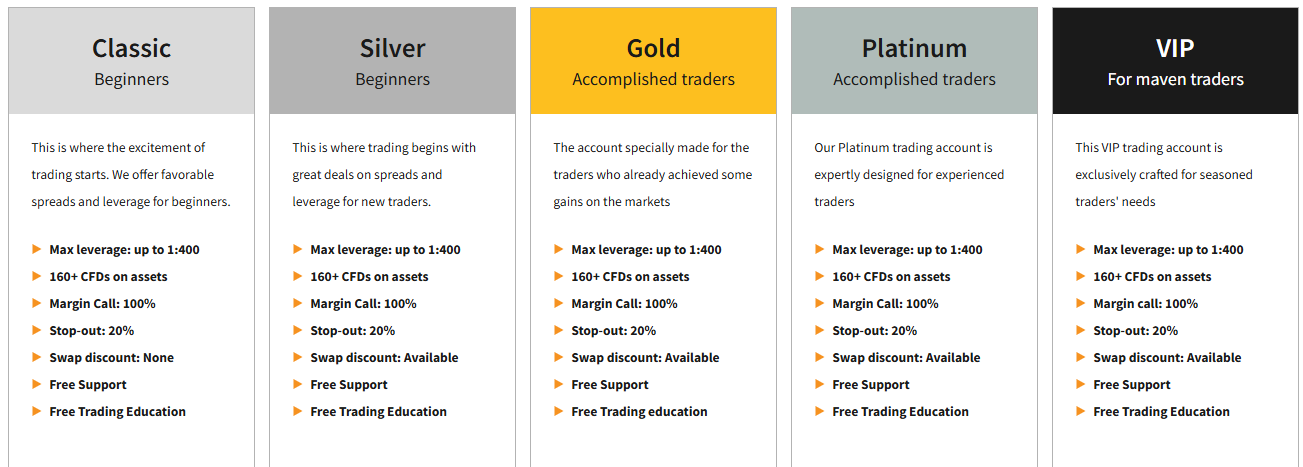
On the surface, these accounts are marketed to cover the full spectrum of traders, from beginners to so-called “maven traders.” All tiers promise access to over 160 CFDs, leverage up to 1:400, educational materials, and customer support. Higher-level accounts (Silver and above) also claim to include swap discounts. Yet without published deposit thresholds, traders have no way of knowing what it actually takes to qualify for Gold, Platinum, or VIP status.
This lack of transparency is problematic. With reputable brokers, deposit requirements, spreads, and commission structures are displayed clearly, allowing traders to compare accounts and assess value before signing up. With Ventorus, clients must first register — and potentially share personal information — just to discover how much capital is needed to access different tiers.
In practice, the account structure looks more like a marketing layer than a transparent offering. The single published figure of $250 gives a baseline entry point, but the absence of detailed requirements for each account type makes it impossible to judge whether the supposed progression from Classic to VIP delivers genuine benefits. For traders, this vagueness adds unnecessary risk and raises questions about the broker’s credibility.
Ventorus Trading Instruments
Ventorus promotes itself as a multi-asset broker, highlighting access to six core markets: forex, shares, indices, metals, commodities, and cryptocurrencies. This mix covers both traditional instruments and newer, more speculative assets, suggesting traders can build diverse strategies under one roof.
The appeal is obvious. Currency pairs offer constant liquidity, while global stock CFDs provide exposure to corporate performance without requiring ownership of the shares themselves. Indices such as the S&P 500 or DAX allow traders to take a view on entire markets, and precious metals like gold and silver remain classic hedging tools during times of volatility. Commodities and energy products, meanwhile, add a cyclical dimension tied to global demand. Finally, CFDs on digital assets such as Bitcoin and Ethereum cater to traders seeking high-risk, high-reward opportunities in the crypto space.
But what looks comprehensive at first glance quickly loses weight under scrutiny. Ventorus does not publish contract specifications, typical spreads, trading hours, or margin requirements for any of these instruments. Without these details, traders cannot compare costs or understand the true exposure they are taking on. By contrast, brokers regulated in major jurisdictions routinely publish transparent product sheets, leaving little guesswork for clients.
This lack of disclosure means that while Ventorus’ catalog sounds competitive, the actual trading experience is impossible to measure in advance. For traders, the difference between what is advertised and what is delivered could be significant — and potentially costly.
Ventorus Trading Conditions
One of the biggest challenges with Ventorus is the lack of clarity around its spreads. The broker promotes “competitive pricing” but does not publish average spreads on any asset class — not for forex pairs, not for indices, not for metals, and not for cryptocurrencies. For traders, this is a critical gap. Spreads are the primary trading cost: every trade starts at a loss equal to the spread, and the wider that spread, the harder it is to achieve profitability.
To put this into perspective, regulated brokers often provide benchmark spreads on EUR/USD in the range of 0.0–1.5 pips, depending on account type. With Ventorus, the true cost remains hidden. Clients may only discover the real spreads once funds are deposited and live trading begins — a scenario that leaves traders vulnerable to potentially inflated costs. In 2025, withholding this information is a major red flag.
Leverage is another area where Ventorus adopts an aggressive stance. The broker advertises ratios of up to 1:400 across its accounts. On paper, this can make small deposits stretch much further: a trader with $250 can theoretically control positions worth $100,000. For risk-takers, that kind of exposure is tempting.
The flip side, however, is steep. High leverage magnifies losses just as quickly as it amplifies profits. Even small market moves can wipe out an account in seconds if risk management is not applied. Compounding the risk, Ventorus does not offer negative balance protection — a safeguard that prevents clients from owing more than their deposits. In volatile conditions, this means traders could end up in debt to the broker, a serious concern for anyone new to leveraged trading.
Ventorus markets attractive conditions — “competitive spreads” and high leverage — but fails to back them up with transparency or safeguards. Without published spread data and with leverage left unchecked by negative balance protection, traders face significant risk. For beginners in particular, these policies may do more harm than good.
Ventorus Payment Methods
Ventorus claims to support a variety of standard funding channels, including credit and debit cards, wire transfers, and alternative payment systems. On the surface, this seems sufficient, but the conditions attached to deposits and withdrawals tell a different story.
To start, clients must commit at least $250 to open an account. While this might not sound extreme, it is noticeably higher than the entry points of many established brokers, which often allow new traders to start with as little as $50–$100. The choice of base currencies is also limited to USD and JPY, restricting flexibility for those who would prefer to fund in euros, pounds, or other widely used currencies.
When it comes to accessing funds, the situation becomes more concerning. Withdrawals via cards are allowed from as little as $10, which appears practical, but wire transfers require a minimum of $100, making small withdrawals effectively off the table. E-wallet withdrawals carry no set threshold, though clients are expected to cover transaction fees, which may vary.
The most striking detail is the processing time. Ventorus states that withdrawals may take 8–10 business days to be completed. In today’s market, where leading brokers typically process requests in 24–72 hours, such delays are excessive. For a trader, waiting up to two weeks to regain access to capital can be more than inconvenient — it raises doubts about operational efficiency and financial reliability.
Ventorus provides the necessary payment channels, but the higher-than-average deposit requirement, restrictive currency options, and unusually long withdrawal times make funding and cashing out cumbersome. For traders, these conditions mean capital may remain tied up longer than expected, a risk that should not be overlooked.
Ventorus Education and Trading Tools
Ventorus offers no educational resources and provides no additional trading tools beyond its proprietary platform. This is a notable shortcoming in an industry where many brokers, even offshore ones, attempt to add value with webinars, tutorials, research, or third-party integrations.
For beginners, the absence of structured learning materials means there is no guidance on trading basics, risk management, or platform use. For more experienced traders, the lack of analytical tools, market research, or advanced add-ons limits the ability to refine strategies or stay informed.
In effect, clients are left to trade with only the bare minimum — a platform and market access — without the educational or analytical support that reputable brokers usually provide.
Ventorus’ failure to invest in trader education or tools reinforces the impression of a broker focused on account funding rather than long-term client success.
Ventorus Bonus
Ventorus does not offer any bonuses or promotional programs. While this keeps the broker aligned with the restrictions many regulators place on incentives, it also means traders will not find deposit matches, cashback offers, or loyalty schemes here.
For some traders, the absence of bonuses may not be an issue, as such offers often come with restrictive terms and withdrawal conditions. However, given Ventorus’ offshore status, the lack of any promotional benefits removes one of the few features that might have offset its otherwise limited value proposition.
Final Thoughts
Ventorus presents itself as a broker for the modern trader — multiple account tiers, a wide asset mix, and a sleek in-house platform. At first glance, it ticks several of the boxes that retail clients look for when choosing where to trade.
Look closer, though, and the picture becomes less convincing. The broker operates under a MISA license from the Comoros Islands, a jurisdiction that grants legal status but imposes few of the protections found in tier-one regulatory hubs. Key trading information — spreads, contract details, account thresholds — is either vague or missing altogether. Funding is restricted by higher entry costs and slow withdrawal times, with payouts that may stretch to 8–10 business days. Add to that the absence of negative balance protection, education, or advanced tools, and the offering feels thin for both beginners and experienced traders.
Ventorus is not entirely without merit. The $250 minimum deposit is manageable, the product range is broad in theory, and its web-based platform may appeal to those seeking simplicity over sophistication. But for most traders, the risks outweigh the conveniences. Offshore regulation, lack of transparency, and sluggish payments are red flags that cannot be ignored.
Ventorus gives the impression of choice and accessibility, but under the surface, it leaves too many unanswered questions. Traders looking for security, speed, and transparency will likely be better served by a broker regulated in a stronger jurisdiction.
Notes from the author:
Ventorus reflects the common profile of offshore brokers: a polished presentation with broad promises, but significant gaps in regulatory strength and transparency.
The broker’s appeal lies in its accessibility. A $250 minimum deposit, a multi-asset lineup spanning forex, commodities, indices, shares, and crypto, and a proprietary web platform all create the appearance of a modern, client-focused offering. For traders who value simplicity and a straightforward setup, this can be attractive.
However, the underlying issues cannot be overlooked. Ventorus is regulated by MISA in the Comoros Islands, a jurisdiction that provides legal recognition but lacks the safeguards associated with tier-one authorities such as the FCA, ASIC, or CySEC. Critical protections — segregated accounts, compensation schemes, and negative balance safeguards — are not enforced under this framework, leaving clients exposed if disputes or financial instability arise.
Equally concerning is the absence of key trading information. Spreads, commissions, and detailed account thresholds are not disclosed, making it impossible for prospective clients to assess competitiveness before committing funds. Withdrawal times of 8–10 business days are also far behind industry standards, where most regulated brokers complete requests in under three.
In my assessment, Ventorus may meet the needs of traders seeking ease of entry and basic market access. Yet for those who prioritize security, speed, and full transparency, the risks attached to offshore regulation and the lack of disclosure outweigh the benefits. In today’s competitive brokerage landscape, there are stronger, more reliable options available under reputable regulatory oversight.


