





XSMarkets Review
XSMarkets is a new broker licensed in Cyprus. This broker is part of a fintech group operating through regulated companies in Australia, South Africa, Labuan and the Seychelles. But the group’s global brokerage business uses a different brand, XS.com, which is the subject of a separate review. The XSMarkets licence was recently acquired by buying an already licensed company in Cyprus. Although XSMarkets does not allow the creation of trading accounts, its website is not fully functional. At the time of writing this review, for example, it was not possible to create Demo accounts. More importantly, the information regarding account types and trading conditions is highly contradictory. It could be expected that in the future this broker will clear up these inconsistencies and start offering a quality service, but in this review we will describe the situation as it is now.
XSMarkets Licenses and Regulation
XSMarkets is a brand managed by the company XS Markets Ltd (previously Rockfrost Ltd), which is authorized and regulated by the Cyprus Securities and Exchange Commission (CySEC) under licence number 412/22.
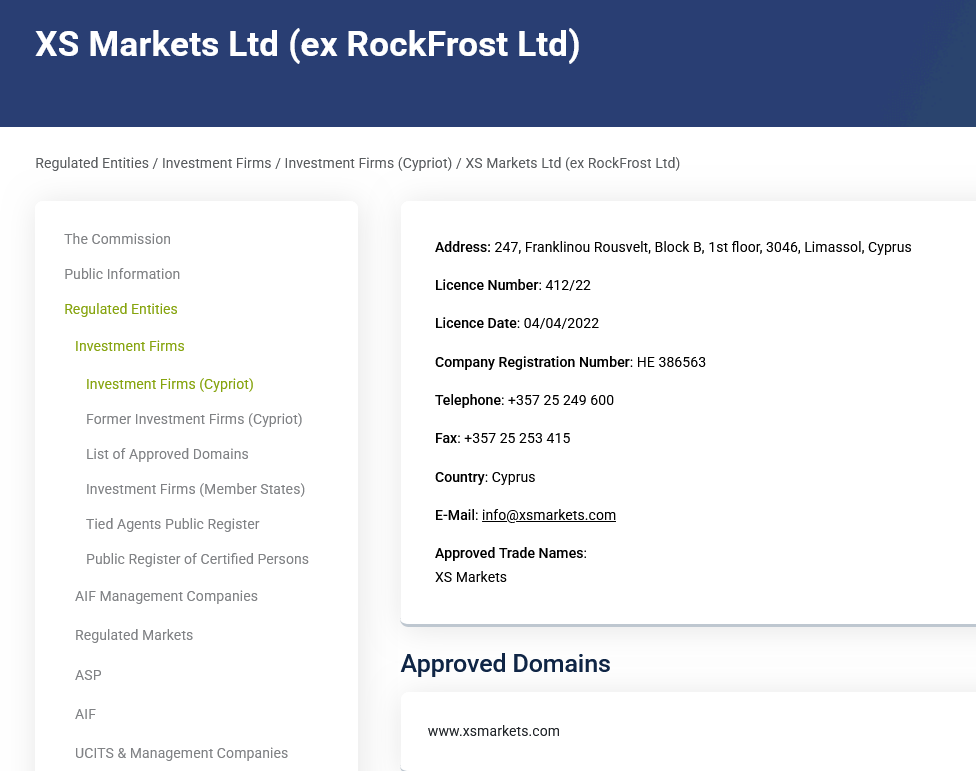
Thanks to Cyprus’s well-developed financial and accounting ecosystem, many EU-based forex and CFDs brokers choose the island nation as their primary headquarters. This concentration of financial firms has elevated the Cyprus Securities and Exchange Commission (CySEC) into a globally respected regulator. Holding a CySEC license enables brokerage companies to offer their services across the entire European Economic Area.
When deciding whether to become a client of a broker licensed by the Cyprus Securities and Exchange Commission (CySEC), especially when the license is newly acquired and the broker’s website is still incomplete or underdeveloped, a forex trader should approach with a combination of optimism and caution. The fact that the broker is licensed by CySEC is a strong starting point—it indicates that the firm is operating under the regulatory framework of the European Union, specifically under the MiFID II directive. This means the broker must adhere to important standards such as client fund segregation, negative balance protection, transparent pricing, fair marketing practices, and participation in the Investor Compensation Fund, which provides coverage of up to €20,000 per retail client in case of insolvency.
However, a new license also implies that the broker’s operational track record under CySEC regulation is limited. Regulatory compliance on paper does not guarantee a proven history of client satisfaction, platform reliability, or consistent service quality. When the broker’s website appears unfinished or lacks key functionality—such as complete legal documents, transparent fee disclosures, platform access, or a clear description of account types and trading conditions—it may suggest that the firm is still in the early stages of building out its infrastructure and public-facing services. This creates a layer of uncertainty for potential clients, as it becomes more difficult to assess how the broker handles real-time trade execution, customer support, withdrawals, or platform stability under live conditions.
The fact that the broker is part of a larger financial group with global operations is a potentially reassuring factor. If the group has a history of successful brokerage services in other jurisdictions, this may suggest that the CySEC-regulated entity is an extension of a more experienced operation and could soon meet high international standards. Still, the trader must confirm that the broker’s operational standards in Cyprus align with EU requirements and that the entity is not merely using the license to gain regulatory credibility while operating primarily from offshore or less regulated subsidiaries.
Due diligence becomes critical in this context. A trader should confirm that the broker’s legal entity is clearly listed in CySEC’s public registry and examine any early reports, press releases, or public communications about its Cyprus operations. It’s important to test account registration, review the availability of customer support, and request clarification on trading conditions, especially regarding spreads, leverage, withdrawal methods, and fees. Traders may also consider starting with a small deposit to test the platform and evaluate the quality of service before committing larger funds.
In summary, while a CySEC license provides a solid regulatory foundation, the combination of a recently acquired license and an underdeveloped website signals that the broker may still be in the process of establishing itself in the European market. A cautious, step-by-step approach—supported by independent research and real-time testing—is advisable before fully committing to the broker’s services.
XSMarkets Trading Software
The homepage of the website claims that XSMarkets offers a combination of the MetaTrader 4 (MT4) and MetaTrader 5 (MT5) platforms. In practice, however, at the time of writing this review, the broker was only offering MT5. While this is the newer and more advanced platform, the lack of MT4 could be a drawback for traders with certain preferences. To the extent that sister brand XS.com offers both MetaTrader platforms, perhaps in the future XSMarkets will also offer both platforms. XSMarkets also does not offer its own mobile app – something that is a disadvantage compared to more established forex brokers.
MetaTrader 5 (MT5), developed by MetaQuotes Software, is a cutting-edge multi-asset trading platform that grants traders access to forex, stocks, commodities, indices, and futures. Building on MetaTrader 4 (MT4), its predecessor, MT5 delivers enhanced features, superior performance, and broader market coverage, catering to both retail and institutional traders. Thanks to their reliability, broad broker adoption, and robust support for technical analysis and automated trading, the MetaTrader platforms have become the industry standard in forex trading.
The balance between an intuitive interface and professional-level functionality is a key reason behind the success of MT4 and MT5. Both platforms enable traders to monitor real-time market movements, execute trades accurately, and develop customized indicators and trading strategies via their integrated programming languages—MQL4 for MT4 and MQL5 for MT5. This customization capacity has spurred the creation of a vast ecosystem of external tools, expert advisors (EAs), scripts, and indicators, offering diverse resources for traders across all skill levels.
Compared to MT4, MT5 provides a number of notable benefits, including faster execution, support for a wider range of tradable assets, and extra order types. It offers 21 timeframes (versus MT4’s nine) and can simultaneously display up to 100 charts. Added features include an economic calendar, built-in depth of market (DOM) data, and compatibility with both netting and hedging systems, making MT5 well-suited for complex portfolio strategies. MQL5, its programming language, is more powerful than MQL4, enabling quicker, more effective backtesting, multi-threaded strategy runs, and more extensive custom applications.
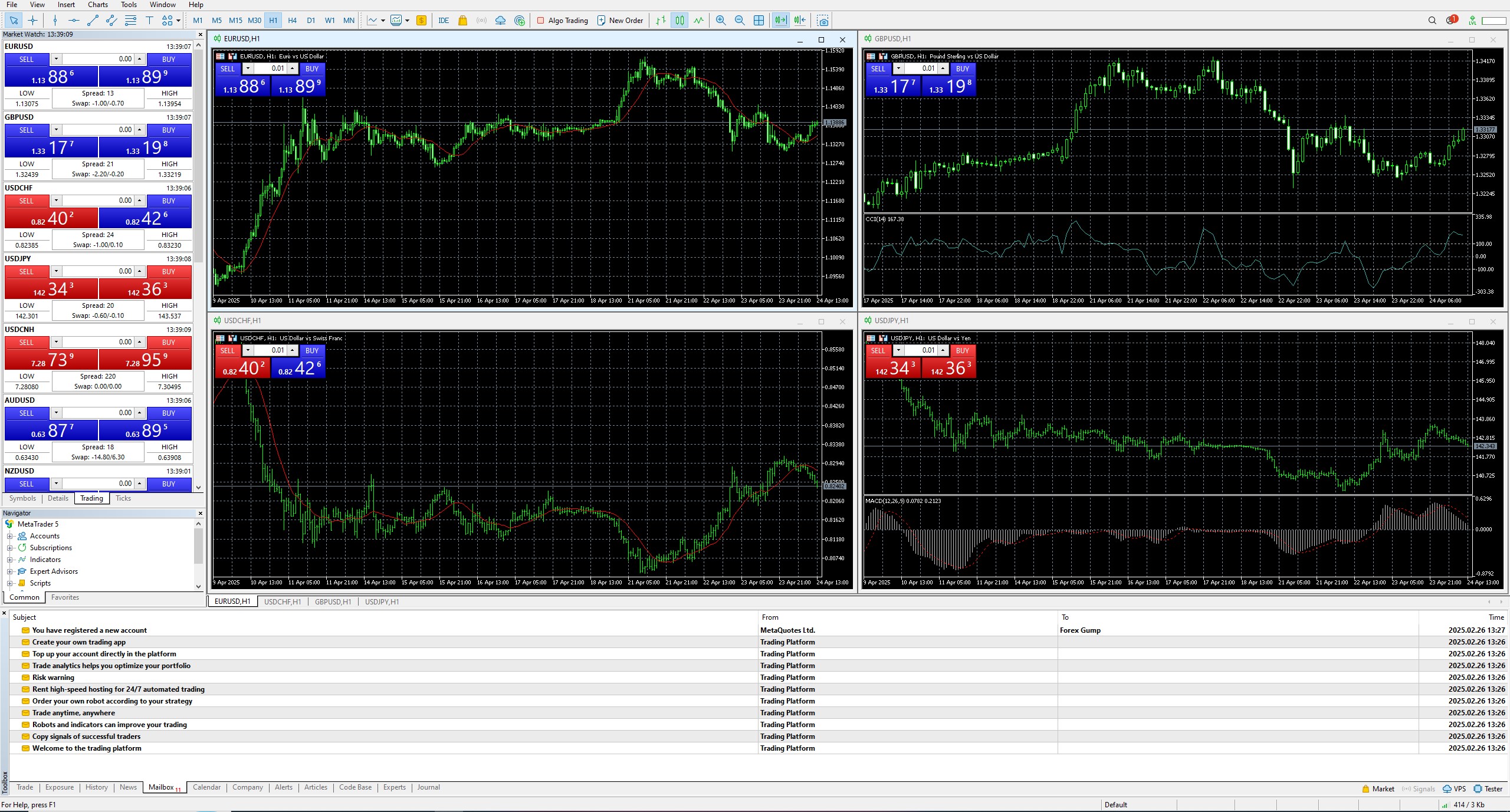
From a technical standpoint, MT5 includes six pending order types, advanced charting with more than 80 built-in indicators and graphical tools, and an internal email system for communication with brokers. Users also benefit from integrated reporting functions, a strategy tester for EA optimization, and VPS integration to facilitate uninterrupted trading. Its architecture emphasizes high performance, boosting order execution speed and lowering latency relative to MT4.
MetaTrader 5 is available in desktop, web, and mobile formats. The desktop version encompasses the full range of functionalities—including algorithmic trading, custom indicators, comprehensive backtesting, and detailed market analysis—and is thus favored by serious traders who require advanced capabilities. The web platform offers fundamental trading and charting features in a browser-based format, though it does not support EAs or advanced scripting. The mobile app for Android and iOS allows traders to oversee real-time quotes, view basic charts, place orders, and manage their accounts on the go, albeit without automated trading or the more robust features found on the desktop version.
Despite MT5’s improvements, MT4 remains popular for its simplicity, lighter resource demands, and expansive library of specialized indicators and EAs developed exclusively for the platform. Tools and strategies designed for MT4 must be reworked to be compatible with MT5, and this lack of backward compatibility has led some traders to continue using MT4. Additionally, many brokers—particularly those specializing in forex—still prioritize MT4, while MT5’s support for multiple asset classes is especially appealing to traders aiming for portfolio diversification.
Overall, MT5 stands out as a versatile, high-performing, and feature-rich platform that addresses modern trading demands across numerous asset categories. Its technical advantages make it an excellent option for professional and multi-asset traders, while the streamlined user interface helps new traders get started. However, MT4’s enduring prominence, driven by its community, simplicity, and long-established toolset, means the choice ultimately depends on a trader’s strategy, asset preferences, and desired level of technical depth.
To fully leverage the automated trading functions of both MT4 and MT5, a Virtual Private Server (VPS) is typically necessary. By operating EAs around the clock without relying on a user’s personal hardware or internet connection, a VPS ensures continuous trade execution. Some brokers offer their own VPS solutions or cover fees for clients meeting certain capital or trading volume thresholds. XSMarkets, however, does not provide any VPS information on its website.
XSMarkets Account types and trading conditions
One of the most worrying things about XSMarkets at the time of writing this review is the lack of clarity about the types of trading accounts offered by the broker and the conditions associated with them. XSMarkets also did not offer an option to create a Demo account, although one is advertised on the homepage. Due to EU regulatory requirements, creating a live account requires verification of identity and residency. Generally, it is clear that this broker will offer a standard choice between floating spread and fixed commission accounts, but it has not been possible to ascertain exactly what the cost of trading is. There is also no clarity on another important parameter – the minimum deposit.
The home page of the website describes two types of trading accounts, Standard and Premium. The Standard account promises floating spreads starting at 0.8 pips. The Premium account offers spreads starting from 0 pips, but the client pays a fixed commission of 3 USD per side per lot, or 6 USD per round turn. No minimum deposits are specified in these descriptions.
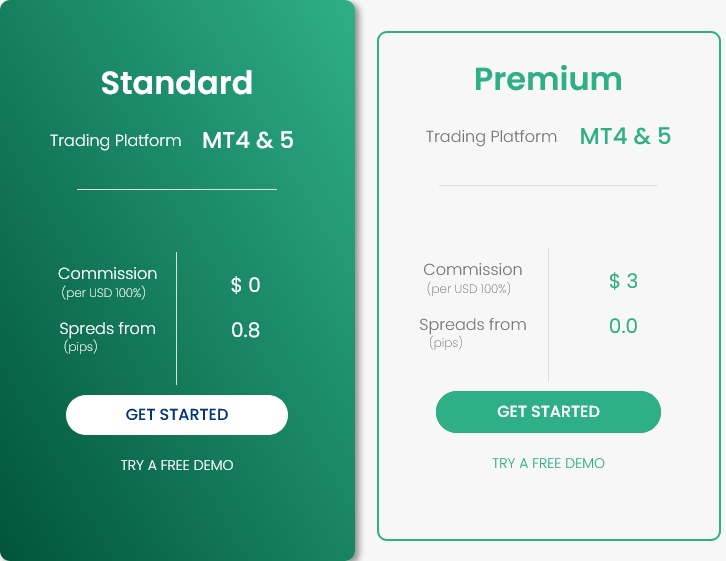
This site claims that both accounts can be used with the MT4 and MT5 platforms, and that there are options for demo accounts as well. As previously stated, at the time of writing this review both of these things were not true.
The “Trading Accounts” subsection of the website also describes two accounts, but instead of Standard and Premium, they are called Standard and Raw.
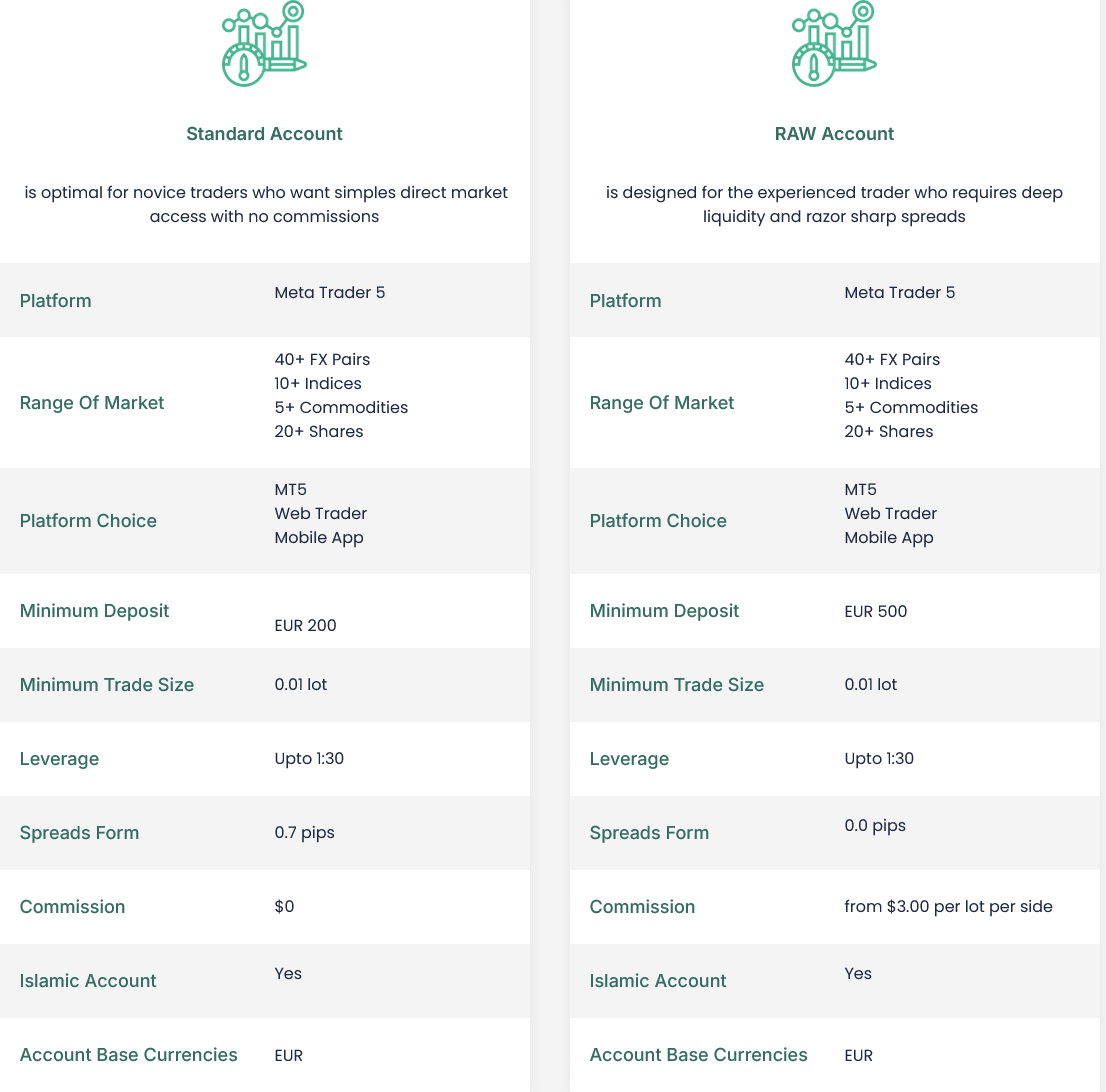
It is stated here that the only trading platform available is MT5. Minimum deposits of 200 EUR for a Standard account and 500 EUR for a Raw account are specified. To the extent that we found upon account registration that only the MT5 platform is available and the only base currency option is EUR, these descriptions are closer to the truth than those on the website home page.
This states that XSMarkets offers a relatively small number of tradable CFD instruments – 40 forex pairs, 10 indices, 5 commodities and 20 shares. Some asset classes such as cryptocurrencies are missing.
A lower spread of 0.7 pips is indicated for the Standard account, while the commission for the Raw account is the same as indicated for the Premium account.
When deciding between a floating spread account and an account with a fixed commission, forex traders must carefully consider their trading style, cost preferences, execution needs, and the broader market environment. Each account type comes with its own set of benefits and limitations, catering to different trader profiles.
A floating spread account features variable spreads that change in response to market liquidity and volatility. Typically, spreads are narrower during periods of high liquidity, such as major trading sessions, and can widen significantly during volatile conditions or news-driven events. This pricing model is commonly offered by market maker or Straight Through Processing (STP) brokers, where the broker either takes the opposite side of a trade or passes orders to liquidity providers. Floating spread accounts usually don’t charge separate commissions, as trading costs are embedded within the spread itself. This simplicity appeals to traders who prefer not to track or calculate additional fees.
These accounts are particularly favorable for casual or beginner traders, as well as swing traders who hold positions over longer periods and are less affected by small fluctuations in spread. They are also a practical choice for those who trade infrequently and value a straightforward, all-inclusive cost structure. However, the main drawback of floating spreads is their tendency to widen sharply during market volatility, which can increase trading costs unexpectedly. For short-term or high-frequency traders, such sudden changes can disrupt strategies and impact overall profitability.
In contrast, an ECN (Electronic Communication Network) account follows a raw spread plus fixed commission model. Traders pay a set fee per traded lot but gain access to much tighter spreads—sometimes as low as 0.0 pips on major pairs. ECN brokers connect clients directly to a network of liquidity providers, offering greater market transparency, deep liquidity, and typically faster execution speeds. Because the spreads are raw and not influenced by broker markups, trading costs become more consistent and predictable, which is crucial for those executing high volumes of trades.
This account type is best suited to scalpers, day traders, and algorithmic traders who depend on precise entries, rapid execution, and low-latency order processing. For these traders, the tight spreads and reliable trade conditions often outweigh the cost of commissions. Additionally, ECN trading tends to minimize slippage and provides more accurate pricing, which is essential for strategies that require precision and responsiveness.
Despite these advantages, ECN accounts may not be ideal for traders who operate infrequently or focus on long-term positions. In such cases, the cumulative cost of commissions could outweigh the benefits of tighter spreads. Furthermore, ECN accounts often come with higher minimum deposit requirements, which might deter beginners or those with smaller trading capital.
In the end, the choice between a floating spread and an ECN account hinges on the trader’s specific goals and approach. Those seeking simplicity and trading less frequently may find the floating spread model more convenient, while active traders who prioritize tight spreads and direct market access will likely gain more from an ECN setup. Assessing how trading costs fluctuate under various market conditions and understanding one’s trading frequency will help identify the most efficient and appropriate account type.
After the initial registration, we find a description of four account types on the dashboard of the website – Cent, Standard, Premium and Raw. The specified minimum deposits for the four account types are $10, $100, $300 and $500, respectively.
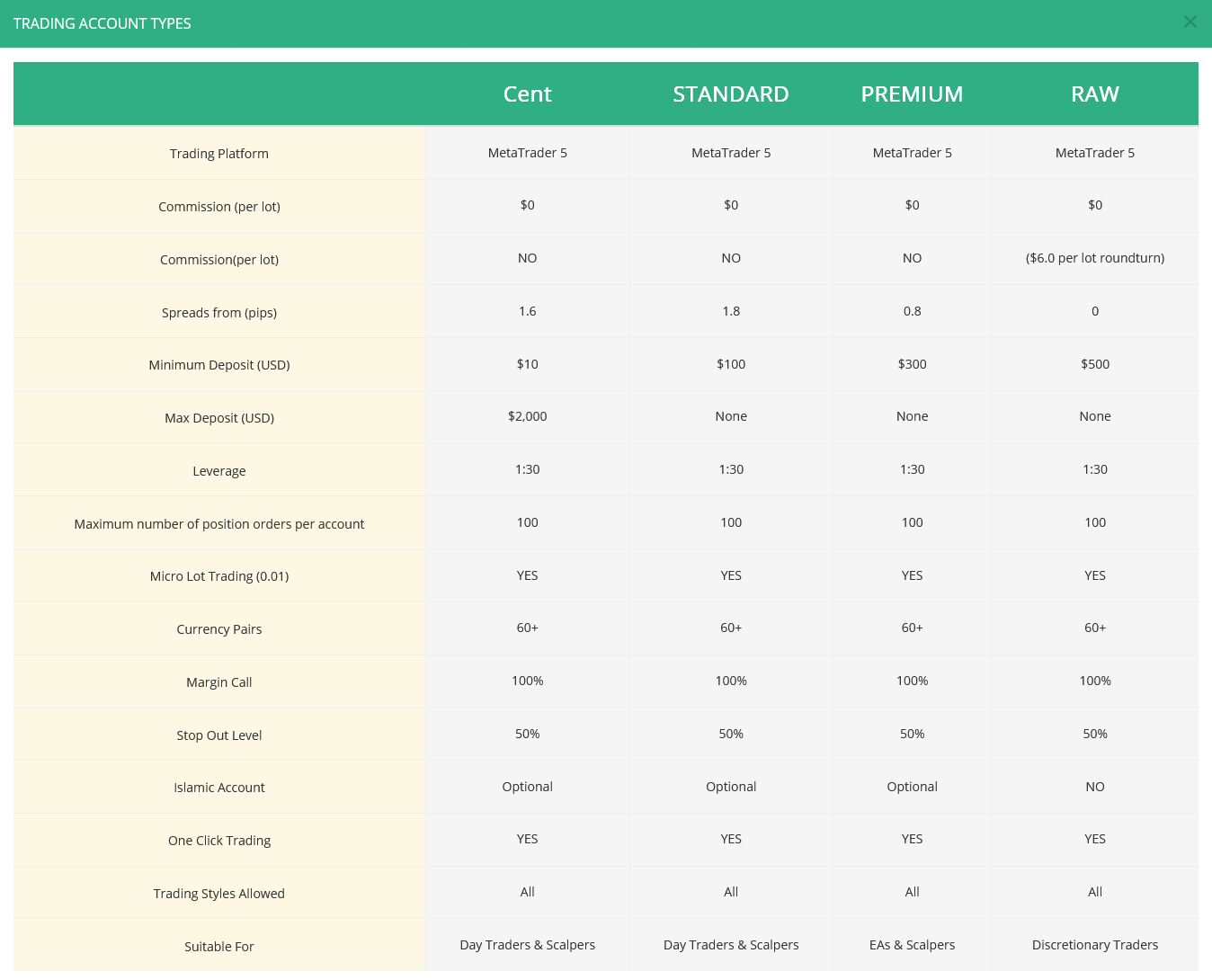
Here the starting spread for the Standard account is much higher – 1.8 pips. Unlike the description in the home page, the Premium account here also has a floating spread and no commission. The promised starting spread is 0.8 pips. For the Raw account the same commission of 6 USD per traded lot is listed.
It is also stated here that the only trading platform available is MetaTrader 5. In terms of tradable instruments, only “60+” currency pairs are listed.
A Cent account is a type of forex trading account designed primarily for beginners and traders with smaller capital, where balances and trade sizes are denominated in cents rather than standard currency units. This means that if a trader deposits 10 USD into a Cent account, it will be displayed as 1,000 cents, allowing them to trade with smaller position sizes compared to standard trading accounts.
Cent accounts are particularly useful for new traders who want to gain real-market experience without exposing themselves to significant financial risk. Unlike demo accounts, which simulate market conditions but do not involve real money, Cent accounts allow traders to experience real spreads, slippage, execution speeds, and market dynamics, helping them develop emotional discipline and confidence in a live trading environment. Additionally, traders who want to test new trading strategies, Expert Advisors (EAs), or automated systems often use Cent accounts as a low-risk way to evaluate performance under real market conditions before scaling up to larger accounts.
Another key advantage of Cent accounts is that they allow traders to trade micro-lots with minimal capital. Many brokers set the minimum trade size at 0.01 lots (1,000 units) in a standard account, but in a Cent account, this becomes 0.01 of a cent lot, equivalent to just 10 currency units. This makes it ideal for those who want to practice risk management and trade sizing without needing a large deposit.
However, Cent accounts also come with limitations. Many brokers restrict the maximum deposit amount, making them unsuitable for professional traders or those looking to trade with significant capital. Additionally, while Cent accounts typically offer floating spreads, the trading conditions may not always match those of standard accounts, particularly in terms of execution speed and liquidity, since brokers often route Cent account trades through internal dealing desks rather than through real market liquidity providers.
Cent accounts serve as a valuable bridge between demo trading and full-scale live trading, providing traders with a safe and affordable way to experience real trading conditions. They are best suited for beginners, strategy testers, and those who want to trade with minimal financial exposure, but they may not be ideal for those looking to trade high volumes or access deep market liquidity.
The only clear trading parameter is leverage, because its maximum levels are set by the EU regulatory framework. The European Securities and Markets Authority (ESMA) and accordingly all EU regulators limit leverage to 1:30 for major currency pairs, 1:20 for non-major pairs, gold and major indices, 1:10 for other commodities and non-major indices, and 1:2 for cryptocurrencies. Regulated brokers offer higher leverage only to professional clients who must meet very high standards for capital and experience and forgo the guarantees enjoyed by retail traders. There is no information on the XSMarkets website regarding special conditions for clients with professional status.
If your account has no trading activity or transactions for 12 consecutive months, it will be classified as inactive. The broker charges an inactivity fee of 10 EUR per month.
XSMarkets claims to offer Islamic accounts, but does not provide information regarding the terms and conditions associated with these accounts. So-called Islamic accounts do not charge a swap in order to comply with the requirements of Sharia law against interest.
XSMarkets does not offer passive income options such as Copy/Social Trading or PAMM/MAM accounts.
XSMarkets Deposit and Withdraw Methods
XS Markets offers a relatively limited range of payment methods, but all the basic options are available. Deposits and withdrawals can be made via bank transfer, credit/debit cards and e-wallets – Skrill, Neteller and MiFinity.
The minimum and maximum amounts for single transactions vary depending on the method used. The minimum deposit when using a bank transfer is EUR 200, but may vary depending on the bank chosen. There is no maximum deposit amount when using this payment method.
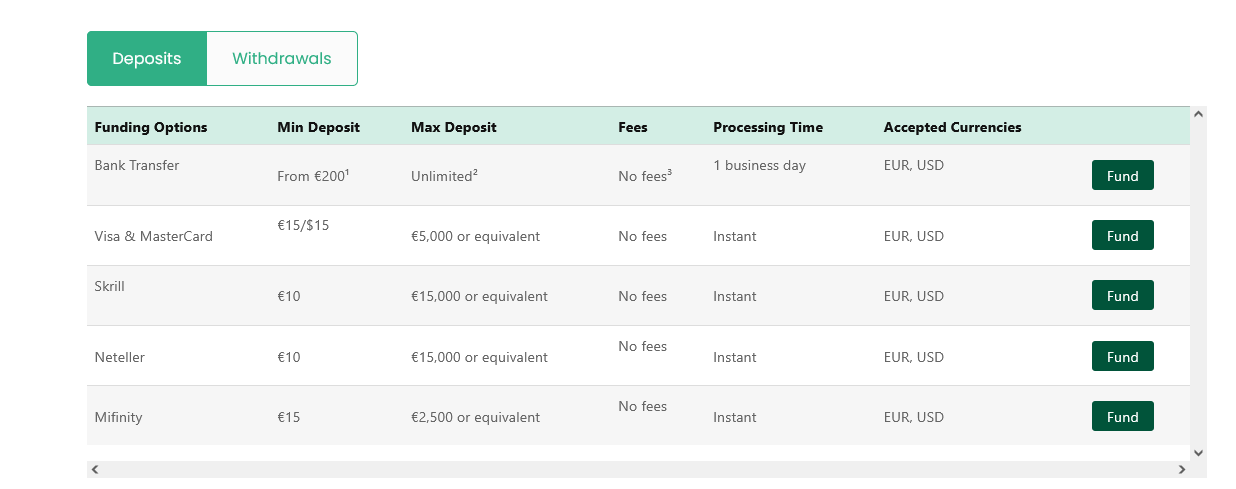
If you deposit by credit/debit card, the minimum amount is EUR 15/USD and the maximum is EUR 5,000 or equivalent. Skrill and Neteller accept deposits between EUR 10 and EUR 15,000 and MiFinity between EUR 15 and EUR 2,500.
The minimum withdrawal amount via bank transfer is also EUR 200. There is no maximum withdrawal amount with this method. The minimum withdrawal amount by card is EUR 25 and the maximum is EUR 5,000 or equivalent. MiFinity allows single withdrawals of between EUR 15 and EUR 2,500, Skrill between EUR 25 and EUR 15,000 and Neteller between EUR 50 and EUR 15,000.
The broker states that it does not charge its own withdrawal fees. But if you request a withdrawal without any trading activity in your account, you will be charged a fee of 3% of the amount.
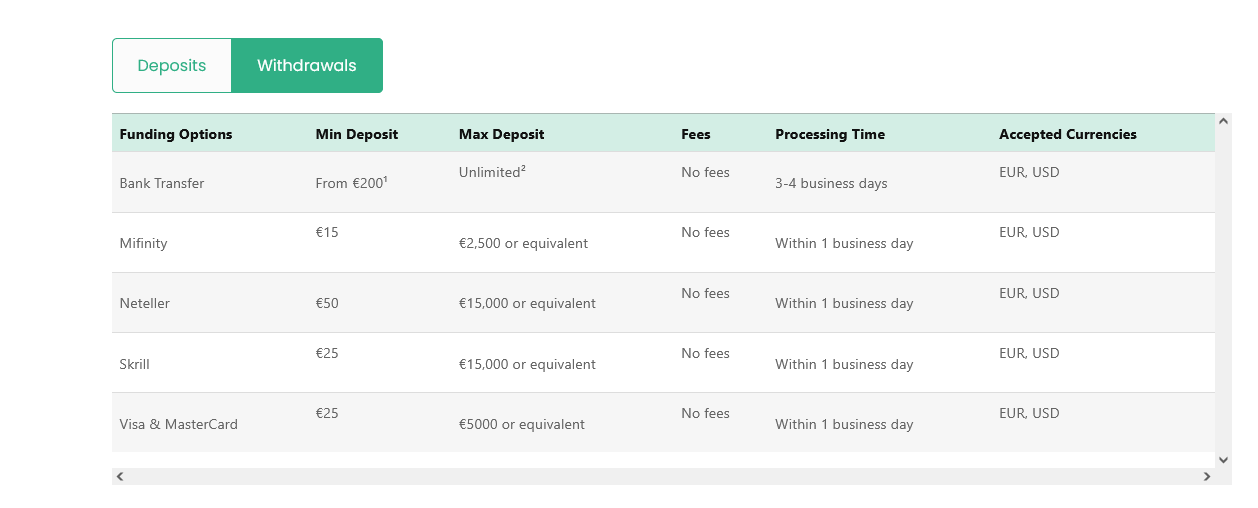
Deposit via bank transfer takes 1 business day, while other payment methods are preferred to be instant. Withdrawal by bank transfer may take 3-4 business days, while other payment methods should not take more than 1 business day.
Deposits can only be withdrawn using the same method with which they were made. Credit and debit cards cannot be used to withdraw winnings. If you wish to withdraw an amount in excess of your deposit, you must use a bank transfer or e-wallet.
| Deposit method | Minimum | Maximum | Processing time | Fee |
| Bank | €200 | Unspecified | up to 24 hours | Free |
| Credit/Debit Card | €15 | €5000 | Instant | Free |
| Skrill | €10 | €15000 | Instant | Free |
| Neteller | €10 | €15000 | Instant | Free |
| MiFinity | €15 | €2500 | Instant | Free |
| Withdrawal method | Minimum | Maximum | Processing time | Fee |
| Bank | €200 | Unspecified | up to 3 days | Free |
| Credit/Debit Card | €25 | €5000 | up to 24 hours | Free |
| Skrill | €25 | €15000 | up to 24 hours | Free |
| Neteller | €50 | €15000 | up to 24 hours | Free |
| MiFinity | €15 | €2500 | up to 24 hours | Free |
XSMarkets Tools and Education
At the time of writing this review, XSMarkets does not offer any educational or research resources, nor auxiliary tools such as forex calculators or economic calendar. A forex broker that does not offer educational and research resources places its traders at a disadvantage, particularly beginners and those looking to refine their trading strategies. Without access to structured learning materials such as trading guides, webinars, video tutorials, and market analysis, novice traders must seek information elsewhere, which can lead to misinformation or reliance on unreliable sources. Education is a critical component of success in forex trading, as understanding technical analysis, risk management, trading psychology, and fundamental market drivers helps traders make informed decisions rather than relying on guesswork.
Beyond education, the absence of research tools such as economic calendars, market news updates, trading signals, and sentiment analysis means traders may struggle to stay ahead of market movements. Many brokers provide these tools in partnership with leading research firms like Trading Central or AutoChartist, offering insights that help traders identify opportunities and manage risk more effectively. Without such tools, traders must rely on external sources, which may not be conveniently integrated into their trading platform, leading to delays in decision-making and potential missed opportunities.
For advanced traders, the lack of in-depth research reports, technical indicators, and real-time market commentary reduces their ability to conduct comprehensive market analysis. Many professional traders depend on institutional-grade research to validate their strategies, and without access to these resources, they may face increased uncertainty in their trades. Additionally, the absence of sentiment analysis or algorithmic insights can put traders at a disadvantage when trying to anticipate market reactions to key economic events.
Brokers that offer educational content and research tools not only help traders develop their skills but also foster a sense of trust and credibility. A broker that neglects these aspects may indicate a lack of commitment to client success and long-term trader retention, suggesting that their focus is solely on executing trades rather than supporting traders in making informed decisions. This can make such brokers less attractive, particularly when many competitors provide extensive educational resources, market analysis, and real-time data as part of their service offering.
Overall, a forex broker that does not provide educational materials and research tools makes trading more challenging, particularly for those still developing their expertise. Traders using such brokers must seek information externally, which can lead to a fragmented and less efficient trading experience. In contrast, brokers that invest in trader education and market research tend to foster more informed, disciplined, and successful trading communities, ultimately benefiting both the trader and the brokerage itself.
Notes from the author:
In theory, a Cyprus-licensed division of a brokerage firm with a global presence should be easy to recommend. After all, these factors mean that there are significant financial resources and experience behind the particular brand. In the case of XSMarkets, however, the recommendation is not so easy, or at least not yet. This broker's European business is just getting off the ground and is still a work in progress. While you can register a live account, it will be very difficult to find out exactly what the trading conditions are. At the time of writing this review, XSMarkets offers three different descriptions of trading account types. In addition to this, Demo accounts are not available. There is every reason to believe that this broker has a good foundation for growth and will offer competitive terms in the future. But until XSMarkets gets its house in order, we cannot recommend traders to choose this broker.


