




FxPro Minimum Deposit
The minimum deposit required by the FxPro varies depending on which jurisdiction you are in and what type of account you are using. For UK and Cyprus clients, the broker does not set a minimum deposit requirement. So in theory you can start trading after you have deposited just one unit of your account base currency. But the FxPro recommends that you invest an initial capital of at least 1000 USD, EUR, CHF or AUD, 4000 PLN, 100 000 JPY or 17 000 ZAR. This recommended minimum deposit is quite high compared to the requirements of most leading forex brokers.
Clients of the Bahamas FxPro company have a choice between a different set of trading account types than the broker’s clients in Europe. These accounts have a set minimum deposit. For the Standard account this minimum is 50 USD, 100 USD for Raw+ account and 1000 USD for the Pro account. The only exception is South Africa, where the minimum deposit requirements are different – 100 USD for a Standard account, 500 USD for a Raw+ account and 500 USD for a Pro account.
Even if you are an already experienced trader, it would be a good idea to start with a small amount when trying out a broker you have not worked with before. And for casual traders and novice investors, it makes even more sense to start with the smallest investment possible. Starting with a small investment in forex trading is a prudent strategy for those new to the market or looking to experiment with trading strategies. It offers a practical way to gain experience, manage risks, and potentially grow your investment over time without the pressure and risk associated with larger investments.
Since forex trading involves significant risk, especially due to leverage, starting small helps you learn risk management techniques without the pressure of losing a large amount of capital. Forex trading is complex and involves understanding market movements, leverage, and the impact of global economic events. Trading with a small amount allows you to experience all these factors firsthand without risking substantial money.
Trading with real money, even if it’s a small amount, introduces you to the emotional aspect of trading, such as dealing with loss, making decisions under pressure, and experiencing the thrill of a successful trade. This emotional conditioning is vital for developing a disciplined trading approach. A small investment is ideal for testing and refining trading strategies. It allows you to see how your strategies perform under real market conditions and make adjustments without the worry of significant financial consequences. Starting small and gradually seeing success can build your confidence in trading decisions and strategies. This confidence is crucial when you decide to increase your investment. A small initial investment in forex can be part of a broader investment strategy, allowing you to diversify your portfolio without committing a significant portion of your capital to one area.
FxPro allows the deposit and withdrawal of funds through a relatively limited set of payment methods. In the UK, the broker’s clients can only transact via bank transfer, credit/debit cards and Broker-to-Broker. Those registered through the company in the Bahamas have two additional options – Scrill and Neteller. FxPro clients in the European Union have the largest selection, which includes PayPal in addition to the above options. While the most established and popular payment methods are available, the lack of locally specific payment providers and cryptocurrencies should be noted as a negative. However, the established payment methods offered by FxPro have a number of advantages.
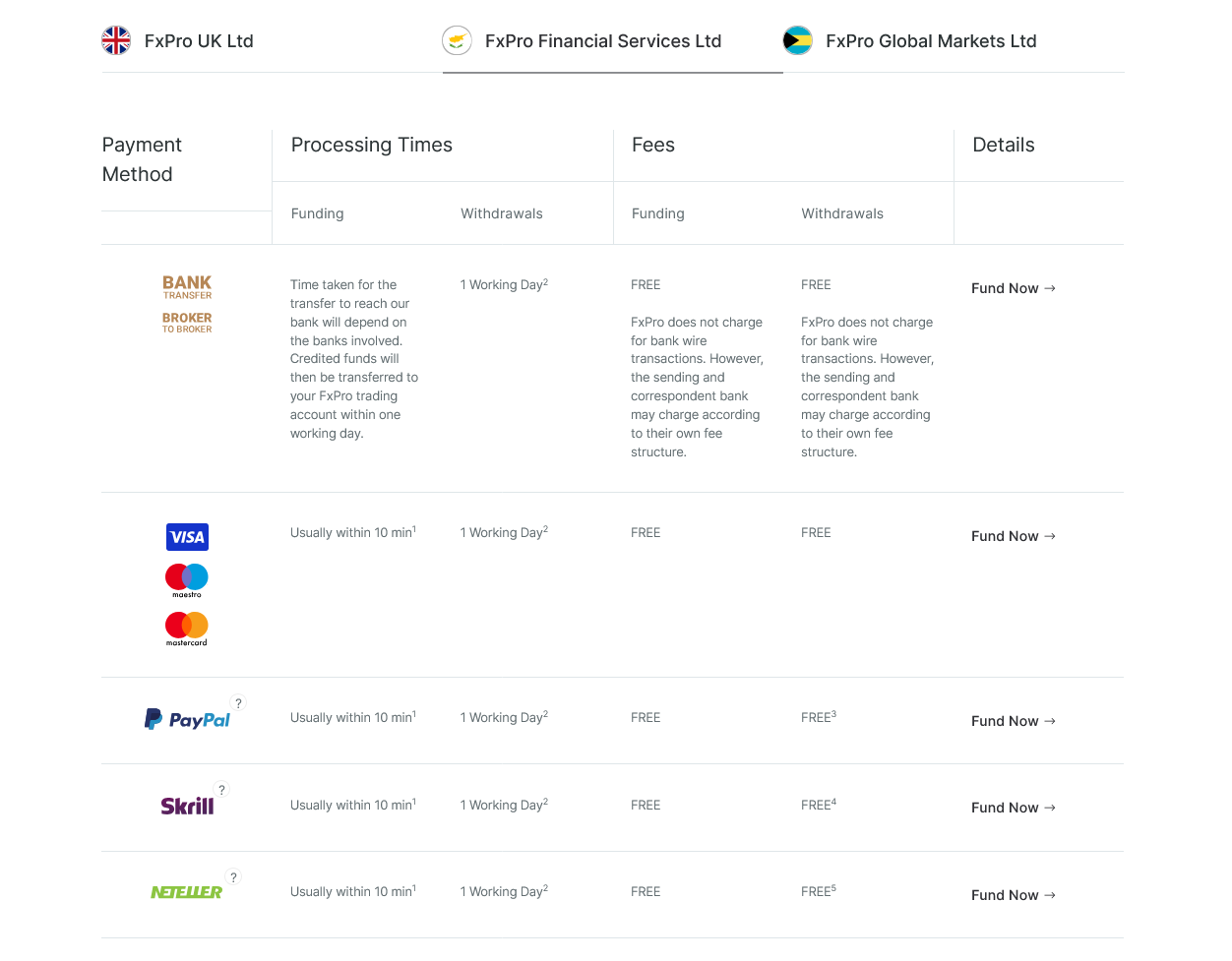
Utilizing credit or debit cards to fund a forex trading account presents numerous benefits, which is why it’s favored by many traders. The processing of deposits via credit or debit cards is typically swift, with transactions often completing instantly. This immediacy enables traders to capitalize on trading opportunities without the delay associated with fund clearance, a common issue with bank transfers that may extend over several days. The widespread possession and familiarity with credit or debit cards for online transactions add to their convenience as a funding method for trading accounts, eliminating the necessity for establishing new accounts or services.
When funding with credit or debit cards, tracking deposits and withdrawals becomes straightforward. These transactions are clearly itemized on card statements, facilitating more efficient management of personal finances and trading budgets. Additionally, credit and debit cards are equipped with robust security measures, such as fraud protection. This allows cardholders to contest unauthorized transactions, offering an extra safeguard for their investment. Specifically, funding with a credit card grants traders the potential to access leverage exceeding the limits of their trading accounts. Nonetheless, caution is advised to mitigate the risk of incurring debt and interest charges. Funding through credit cards bears the risk of overspending and accumulating debt if not judiciously managed. Moreover, traders should be cognizant of possible fees charged by brokers and card issuers for these transactions. Being aware of these aspects and adopting a thoughtful approach to credit card funding can aid in effectively managing risks and expenses.
Funding a forex trading account via bank wire transfer offers several advantages, especially for traders looking to move large sums of money. Bank wire transfers are among the most secure methods of funding a trading account. Banks use sophisticated encryption technologies and security protocols to protect the transfer of funds, reducing the risk of fraud. Compared to other funding methods, bank wire transfers often come with higher deposit limits or no limit at all. This makes them ideal for serious traders or institutional investors who need to transfer large amounts of capital to their trading accounts.
Funds are transferred directly from the trader’s bank account to the trading account, simplifying the process and reducing the need for intermediaries.:Bank wire transfers provide clear, official records of transactions, which can be useful for tax reporting and financial record-keeping. Unlike e-wallets or credit card payments, bank wire transfers do not require setting up additional accounts or services, reducing complexity and potential fees. However, it’s important to note some downsides to using bank wire transfers, such as potentially higher fees and longer processing times compared to electronic payment methods.
E-wallets have become a favored choice for many traders due to their rapid processing speeds. Deposits via platforms like PayPal, Skrill and Neteller typically instantaneous or completed within a few hours. The ease of access through both web and mobile applications adds to the convenience of e-wallets, eliminating the need to input card details for every transaction. Although certain fees might be incurred, e-wallet transactions generally incur lower charges than other payment methods, including bank wire transfers, offering cost savings especially valuable for traders who regularly transfer funds to and from their accounts.
Supporting a variety of currencies, e-wallets enable traders to manage and transfer funds across different currencies without mandatory conversion, avoiding conversion fees and streamlining multi-currency transactions. Beyond depositing funds, e-wallets also streamline the withdrawal process, with most withdrawals processed swiftly, thus minimizing wait times for accessing funds. Despite these benefits, it’s important for traders to consider some drawbacks, such as restrictions on withdrawal limits and potential fees for currency conversion or transferring funds to a bank account.
Funding a forex trading account using the broker-to-broker transfer method involves moving funds directly from one brokerage account to another. This method has several advantages, especially for traders looking to switch brokers without liquidating positions or those wanting to diversify their trading activities across different platforms. Broker-to-broker funding allows for the seamless transfer of funds between accounts. This is particularly beneficial when moving accounts or changing brokers, as it simplifies the process and avoids the need to first withdraw to a bank account or payment system.
For traders who wish to change brokers without closing open positions, some broker-to-broker transfers can facilitate the transfer of open trades, depending on the agreement between the two brokers. This can be a crucial advantage for maintaining trading strategies uninterrupted. Transferring funds directly between brokers can be more cost-effective than withdrawing to a bank or payment system and then depositing again. This process can save on transaction fees, withdrawal charges, and potential currency conversion fees. This method bypasses the banking system, which can be advantageous for traders in countries with restrictive banking regulations or for those who prefer not to involve their bank in their trading activities. For traders with funds dispersed across multiple brokers, broker-to-broker transfers offer a way to consolidate these funds under a single broker, simplifying account management and strategy implementation. It’s important to note, however, that not all brokers offer the broker-to-broker transfer option, and the terms, conditions, and fees associated with such transfers can vary significantly. Additionally, traders should ensure that both the sending and receiving brokers are reputable and regulated to avoid potential risks associated with transferring funds between platforms.
Withdrawals must be made using the same method as the deposit. FxPro does not charge its own transaction fees and promises deposits within 10 minutes and withdrawals within one business day. Withdrawals without a trade will result in a charge if the Skrill and Neteller methods are used. The fee is 2.6% and 2% respectively.
The deposited funds feed your FxPro Wallet through which you can in turn fund your trading accounts. This allows for more flexible management of individual accounts as well as risk management because you determine exactly how much of your available money is invested. Transfer between the Wallet and trading accounts of different currencies will be subject to the prevailing conversion rate of the currency.
All account types of FxPro allow trading with different lot sizes, including a micro lot (0.01 standard lot), or just 1000 currency units. Trading forex with smaller trade sizes offers several compelling advantages, particularly for retail traders and those new to the forex market. Smaller lot sizes significantly reduce financial risk. Losses on trades will be smaller, making it easier for traders to manage their risk, especially important for beginners who are still learning how to navigate market volatility. Trading with Micro lots helps in preserving capital by limiting the amount of money exposed to the market on each trade. This is crucial for traders with limited trading capital who cannot afford to take large losses.
For those new to forex trading, using Micro lots provides a practical way to gain real-market experience without the stress of potentially losing large amounts of money. Micro lots allow traders to test and refine their trading strategies in a live market environment with minimal risk. This is beneficial for developing a trading strategy that is robust and consistent over time. Trading with smaller lot sizes offers greater flexibility in position sizing and portfolio diversification. Traders can more precisely adjust their exposure to various currency pairs, helping to optimize returns and spread risk across different trades. Micro lot trading is suitable for traders with varying account sizes, allowing those with smaller accounts to participate in the forex market alongside more significant investors.
EU and UK retail clients of FxPro can take out leverage up to 1:30 when trading major forex pairs. This means that they can place a micro lot order with only about 33.33 USD. Professional clients in these jurisdictions, as well as most retail clients serviced by the broker’s offshore firm, can use leverage of 1:200. This means that for the same order they only need 5 USD. Clients of the offshore company with professional status, as well as all clients of the broker in South Africa, can use an extremely high leverage of 1:10 000 under certain conditions. With such leverage, an order for an entire standard lot requires only 10 USD and order for a micro lot only 0.1 USD.
The initial registration of an FxPro account provides limited access to the Client Portal and the ability to create Demo Accounts. In order to deposit funds and begin actual trading, you are required to verify your account by providing personal details and proving your identity and residency.
Depositing can be done either through the Client Portal on the website or through the FxPro mobile app. In the dashboard of the website, you can access your Wallet by clicking on the “Wallet” tab in the menu located on the left side of the screen. In the mobile app, the “Fund” button is located on the bottom bar.
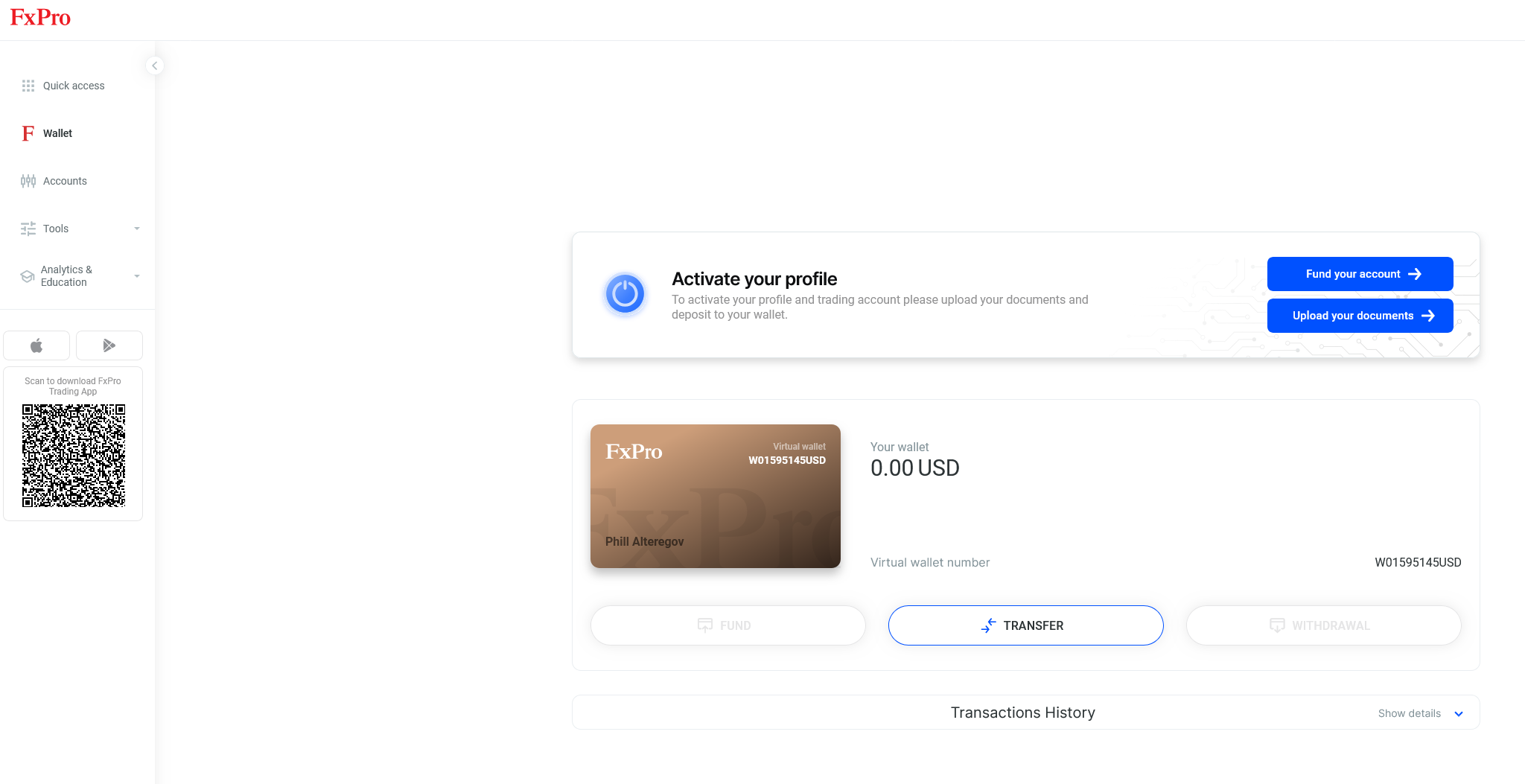
The next steps are to select a payment method and enter the deposit amount and billing details required by the specific payment method. You can then transfer funds from the Wallet to your individual trading accounts. The Client Portal menu also allows you to transfer amounts between individual trading accounts.


